Independent Contractor Classification Laws by State
State laws, not federal rules, determine contractor classification and carry the steepest penalties.
The 2024 DOL Final Rule on independent contractor status under the FLSA remains operative CFR text as of 2026, but it is effectively dormant. In May 2025, the DOL announced it would not apply the 2024 rule in enforcement, reinstating Fact Sheet #13 and Opinion Letter FLSA 2019-6 as its operative guidance. In February 2026, the agency proposed formal rescission at 91 Fed. Reg. 9932; the public comment period closed April 28, 2026, and the outcome is still pending.
Fact Sheet #13 is broadly considered more business-friendly. It applies no singular test, requires no equal weighting of factors, and returns significant discretion to the totality-of-circumstances analysis that characterizes common law classification frameworks. For companies running multi-state contractor programs, this shift matters at the federal margin. Only there.
It does nothing at the state level. States enforce their own classification standards independently of DOL posture, and they always have. A more permissive federal enforcement environment provides no safe harbor against a California Labor Commissioner audit, a New Jersey Wage and Hour investigation, or a Massachusetts Attorney General action. State-level liability is typically the more consequential exposure: unemployment insurance back contributions, wage-and-hour liability, representative-action penalties, and plaintiff-bar collective actions can attach simultaneously under multiple statutory regimes, each carrying its own penalty multiplier.
The federal flux of 2025 and 2026 makes the state classification landscape not just the more stable surface area, but the one where compliance decisions actually carry weight. Every practitioner I know who has lived through a California audit or a New Jersey wage investigation knows exactly why tracking DOL posture while leaving state-level documentation to chance is the wrong priority.
How the ABC Test Works and Why Condition B Is the Hardest to Clear
The ABC test conditions are conjunctive. All three must be satisfied for a worker to qualify as an independent contractor. Fail any one, and the worker is a statutory employee under that state's law, regardless of what the contract says or what the parties intended.
Condition A requires that the worker be free from the company's control and direction in performing the work. Not trivial, but it is the condition most companies understand how to document. Companies get this one wrong sometimes; when they do, they usually understand why.
Condition B is where arrangements collapse. It requires that the work be performed outside the usual course of the company's business, and it functions more like a bright-line rule than a multifactor inquiry. Consider the obvious cases: a software company engaging a freelance developer, a media company engaging a freelance writer, a staffing firm engaging a recruiter on contract. In each case, the work falls squarely within the company's usual course of business. No level of operational autonomy, no contractual language, and no worker preference resolves this. Either the work is outside the usual course of business or it is not, and for every scaling company whose contractors perform work integral to the core product or service, Condition B is the condition that fails.
Condition C requires that the worker be customarily engaged in an independently established trade, occupation, or business, meaning the worker actively maintains their own business, serves other clients, uses their own tools, operates their own entity, and sustains their own market presence. A worker who exclusively serves one company is not demonstrating independent business operation, regardless of the label attached to the arrangement.
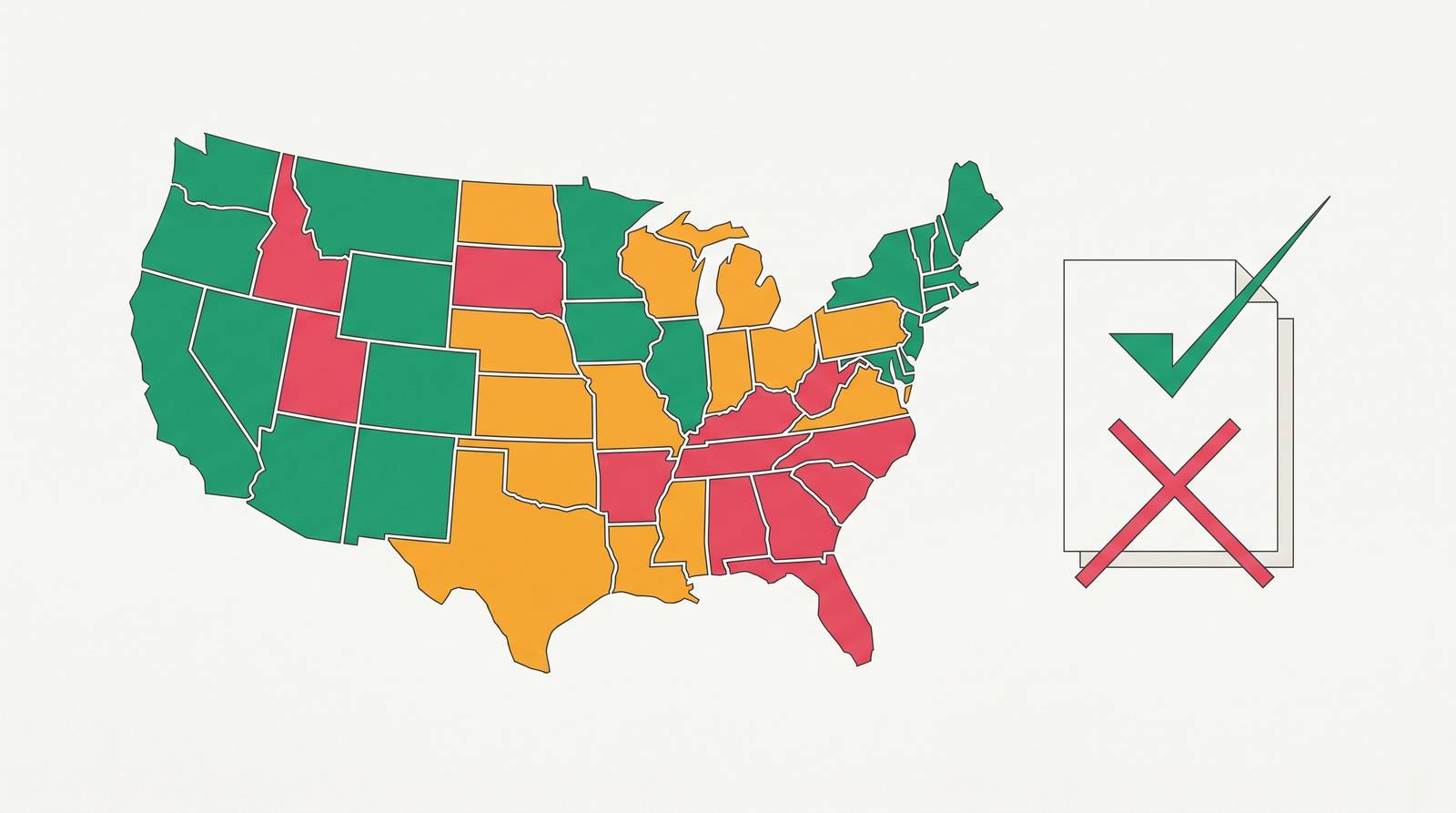
Roughly a third of U.S. states use the ABC test or a variation of it. Condition B will surface the most difficult classification decisions every time companies expand into these jurisdictions.
California's AB 5 and the Prop 22 Carve-Out — the Strictest State in Practice
California's AB 5 codified the ABC test as the state's default classification standard. AB 1514, signed in June 2025, provides clarification for specific industries. Read that correctly: it is targeted adjustment, not a retreat. The underlying framework is intact, and the history of AB 5 litigation should leave no one with the impression that California is softening its posture.
Condition B has driven the most consequential reclassification decisions under AB 5. Companies whose contractors perform work integral to the core product or service carry the highest structural exposure. No contract design mitigates a Condition B failure. Creative drafting doesn't cure a fundamental mismatch between the work being performed and the company's core business. The analysis turns on facts, and facts are not negotiable.
Proposition 22 created a separate statutory regime for app-based ride-share and delivery drivers under Cal. Bus. & Prof. Code §7448 et seq. Covered workers are classified as independent contractors under the Prop 22 framework rather than under AB 5. The requirements are substantive: an earnings floor at 120 percent of the applicable minimum wage for engaged time, healthcare subsidies for drivers working a qualifying number of hours, and occupational accident insurance. The California Supreme Court upheld Prop 22 as constitutional in Castellanos v. State of California, 16 Cal. 5th 588 (2024). The carve-out is real, narrow, and industry-specific. Companies outside the app-based ride-share and delivery sector should not treat it as a template.
Two additional California-specific layers deserve attention. First, the Borello common law multifactor test continues to apply in certain California contexts outside AB 5's explicit scope, so AB 5 is not the only classification framework in play. Second, the Private Attorneys General Act creates a representative action mechanism under which a single misclassified worker can trigger penalty proceedings on behalf of all similarly situated workers statewide. PAGA amplifies the financial consequences of any misclassification decision that affects more than one person, which in practice means nearly all of them.
California is the hardest state to clear. Treat it as the stress test.
New Jersey's Final ABC Regulations and What They Add for Employers
On May 5, 2026, New Jersey published Final ABC Regulations at N.J.A.C. 12:11-1 et seq., effective October 1, 2026. These regulations codify decades of New Jersey Supreme Court precedent. The legal standard itself is not new; courts have applied it for years. What codification does is move the standard into enforceable regulatory text with defined enforcement mechanisms and a concrete compliance deadline. That shift in form has real operational consequences. Companies that have been relying on informal familiarity with case law should not assume that familiarity translates cleanly to the regulatory text.
The scope spans three distinct liability tracks simultaneously: the New Jersey Wage and Hour Law, the Wage Payment Law, and the Unemployment Compensation Law. A single misclassified worker in New Jersey can generate exposure across all three regimes at once. Companies that have been applying the New Jersey ABC test informally should conduct a structured review against the formal regulatory language before October 1.
New Jersey now sits alongside California as a state where the ABC test is fully codified, actively enforced, and capable of generating multi-statute penalty exposure from a single determination. These are the two states where the cost of getting this wrong is highest.
Massachusetts — the Three-Prong Test and Its Unusual Reach into Noncompetes
Massachusetts applies the ABC test under MGL c. 149, §148B, one of the longest-standing and most consistently enforced versions in the country. All three conditions are required. Condition B is as difficult to satisfy here as in California, and the enforcement history reflects that.
The distinctive complexity in Massachusetts lies downstream from classification itself. Under Massachusetts law, independent contractors are treated as employees for the purpose of noncompetition agreements. The classification designation does not exempt a worker from the state's noncompete framework. This creates a practical trap for companies that use contractor relationships to protect intellectual property or customer relationships through noncompetes: the noncompete will be analyzed under employee standards regardless of how the worker is classified.
This interaction between classification status and contract enforceability matters more in Massachusetts than in most states because it is structurally embedded in the law rather than a product of isolated case decisions. Companies designing contractor engagements here need to evaluate both the classification test and the downstream contractual implications simultaneously. Treating them as separate legal questions is a natural mistake, and it produces exposure on both fronts.
The Modified ABC Test — How Oklahoma and Virginia Offer More Flexibility
The modified ABC test offers an alternative path to contractor status. Rather than requiring satisfaction of all three conditions, it allows a worker to qualify by satisfying either Conditions A and B together, or Conditions A and C together. As of 2026, Oklahoma and Virginia apply this approach.
The practical effect is significant. Under a strict ABC test, a contractor whose work falls within the company's usual course of business fails Condition B and cannot be classified as an independent contractor regardless of how the rest of the relationship is structured. Under a modified ABC test, that same contractor can still qualify if Conditions A and C are satisfied: the worker is free from the company's control, and the worker genuinely operates an independent business. Inability to satisfy Condition B is no longer fatal.
For companies engaging contractors in Oklahoma and Virginia, the analytical and documentation focus shifts accordingly. Instead of proving the work is outside the company's core business, which is often an honest impossibility, the company focuses on demonstrating the worker's operational autonomy and independently established business existence. That is a meaningfully more achievable bar for the types of contractor relationships most scaling companies actually use.
One caution: the label "modified ABC" is not universal. States that apply a modification do not necessarily apply the same modification. Examine each state's specific statutory or regulatory language directly, and do not assume consistency across states that share only the general category.
Common Law States — What the Control Test Requires and Which States Use It
Roughly a third of U.S. states rely on a common law or right-to-control framework rather than the ABC test. Texas is a prominent example. New York applies common law classification principles alongside its separate statutory framework for freelance engagements.
The common law test evaluates three dimensions. Behavioral control asks whether the company controls how the work is performed, not merely what output is delivered. Financial control asks whether the worker has made a meaningful investment in their own tools and facilities, whether genuine opportunity for both profit and loss exists, and whether the worker serves multiple clients rather than functioning as a dedicated workforce extension. The type-of-relationship inquiry examines the written terms, the permanency of the arrangement, and whether the work is integral to the company's business operations.
No single factor is determinative. This is a totality-of-circumstances analysis, which gives companies more latitude to structure and document a lawful contractor relationship. It also introduces a different kind of uncertainty: a poorly documented engagement can fail even where the underlying facts are favorable. The latitude cuts both ways, and every experienced practitioner I know has learned not to find much comfort in it.
The critical difference from the ABC test is what common law states do not require. A contractor performing work similar to the company's core business is not automatically disqualified. The question is how the relationship is structured and evidenced, not what type of work is performed. This distinction materially affects which contractor arrangements are viable in which states. Common law states are generally more contractor-friendly than strict ABC states, but more flexible does not mean risk-free. A long-term, deeply integrated contractor relationship will fail the common law test regardless of jurisdiction.
New York's Freelance Isn't Free Act — Classification Plus Contract Requirements
New York's Freelance Isn't Free Act is now in force statewide, and it is distinct from and additive to the common law classification framework. Its requirements are procedural rather than definitional: the Act does not change who qualifies as a contractor; it regulates how contractor engagements must be documented and administered.
The Act requires a written contract for any freelance engagement exceeding $800, whether that threshold is reached through a single engagement or through aggregate engagements within a 120-day period. The contract must contain defined terms. The Act creates a formal enforcement process through which freelancers can file complaints, and companies face statutory penalties for non-compliance with the contract requirements, independent of whether the worker was correctly classified.
This matters because it creates a separate liability pathway. A company can correctly classify a worker as an independent contractor under New York's common law test and still face Act-based liability if no compliant written contract exists for a qualifying engagement. Correct classification is necessary. It is not sufficient.
Illinois adds a parallel layer. Recordkeeping and invoicing obligations under recent labor transparency reforms require companies to retain independent contractor records for at least five years. The specific requirements differ from New York's, but the structural pattern is consistent: classification tests determine who is a contractor, and a growing number of states also regulate how contractors must be engaged. Violations of those process requirements carry their own penalty exposure, independent of the underlying classification analysis. Companies that treat classification as the finish line are missing an entire category of risk.
How Misclassification Risk Compounds as Companies Add Contractors and Jurisdictions
Worker misclassification rates have been estimated at between 10 and 20 percent across U.S. businesses as a baseline, before any growth-related complexity is introduced. Contractor hiring has risen sharply year-over-year as companies pursue flexible workforce models. Exposure scales with each new engagement, and it does not scale linearly.
The compounding mechanism operates on several axes at once. Each new state adds a classification test that must be satisfied independently. Each new contractor in a non-compliant role extends the back-exposure period under that state's statute. A single misclassified worker in California can trigger a PAGA representative action covering all similarly situated workers in the state. New Jersey's three-statute exposure structure means a single determination generates simultaneous liability under the Wage and Hour Law, the Wage Payment Law, and the Unemployment Compensation Law.
The same contractor arrangement that is legally sound in Texas can constitute a violation in California, New Jersey, and Massachusetts simultaneously, under three different penalty regimes, through three different enforcement mechanisms, with three different penalty multipliers. For a company that has added those three states to its contractor footprint in a single growth year, the exposure is not the sum of three independent risks. It is a product of interdependent ones that surface together, typically in the context of a single audit that pulls the thread.
This is how multi-state contractor risk actually accumulates: it grows as companies grow, surfaces in clusters rather than in isolation, and the penalty exposure in the most aggressive states can dwarf anything the federal framework imposes.
What Classification Tests Actually Require Companies to Document
Documentation is the mechanism by which a company demonstrates that its classification decisions reflect the actual working relationship rather than a desired outcome. A contract that labels a worker an independent contractor establishes nothing. Classification is determined by the substance of the relationship, and documentation must reflect that substance accurately.
In ABC test states, documentation priorities map directly to each condition. Condition A documentation should capture operational independence: no scheduling requirements from the company, no supervision of method, output-based rather than time-based engagement terms. Condition B documentation should establish that the work falls outside the company's core business, though this is often the most difficult challenge, because the underlying facts either support it or they do not. Documentation cannot manufacture a Condition B defense where the relationship doesn't support one. Condition C documentation should demonstrate the worker's independent business existence: other client relationships, the worker's own tools and infrastructure, a separately maintained business entity, and active market presence.
In common law states, documentation priorities shift toward the three-dimensional inquiry that governs those states. Behavioral control documentation should show project-based scope with defined outputs rather than ongoing direction of how work is performed. Financial control documentation should capture the worker's investment in their own tools and facilities, service to multiple clients, and genuine possibility of profit or loss on the engagement. Relationship-type documentation should include written contracts with defined project terms, no employee-style benefits, and no expectation of indefinite ongoing work.
Illinois's five-year recordkeeping requirement establishes a concrete floor for retention periods. New York's written contract requirement for engagements over $800 means that documentation is not solely a defense mechanism: it is a statutory obligation with its own penalty exposure. Both requirements point to the same discipline. Documentation must be created at the time of engagement. Retroactive documentation assembled after an audit begins is legally weaker, practically harder to make credible, and almost always too late to matter.
Why Manual Tracking Across State Tests Breaks
Managing contractor classification across multiple states manually exceeds what a spreadsheet or a static policy document can reliably contain. Each state has its own test, its own statutory language, its own penalty structure, its own documentation requirements, and its own enforcement timeline. Every new engagement in a new state creates a new classification obligation under a new legal framework, and compliance must be tracked not just at the point of hire but continuously, as engagements extend, as state laws change, and as the scope of work evolves.
The problem expands in two directions at once. Breadth increases as more states are added to the contractor footprint. Depth increases as existing contractor relationships extend over time, because longer relationships generate larger back-exposure periods and attract greater scrutiny under permanency factors in both common law and ABC test states. Manual tracking degrades in both dimensions simultaneously, and the degradation tends to stay invisible until an audit makes it visible. By then, it is expensive.
The states with the highest penalty exposure, California, New Jersey, Massachusetts, and New York, are also the states with the most detailed and prescriptive classification frameworks. Getting California right requires knowing AB 5, PAGA, Borello, and Castellanos. Getting New Jersey right requires understanding the Final ABC Regulations effective October 1, 2026, and how they interact across three separate statutory wage regimes. Getting New York right requires satisfying both the common law classification test and the Freelance Isn't Free Act's contract requirements. A general-purpose contractor policy survives none of these audits.
Every startup I know that is serious about scaling contractor workforces across jurisdictions needs compliance infrastructure that tracks each state's operative test, surfaces the documentation requirements specific to each engagement, and updates as the law changes. The 2025 to 2026 period alone includes the DOL's proposed rescission of the 2024 rule, AB 1514 in California, New Jersey's codification of its ABC regulations, and the nationwide expansion of the Freelance Isn't Free Act. That volume of change in a single two-year window is not unusual. It is the normal rate of development in this area of law, and nothing in the current legislative or regulatory environment suggests it will slow.