State Income Tax Withholding Rules for Remote Employees
Hiring remote workers in new states creates unexpected tax obligations beyond income withholding.
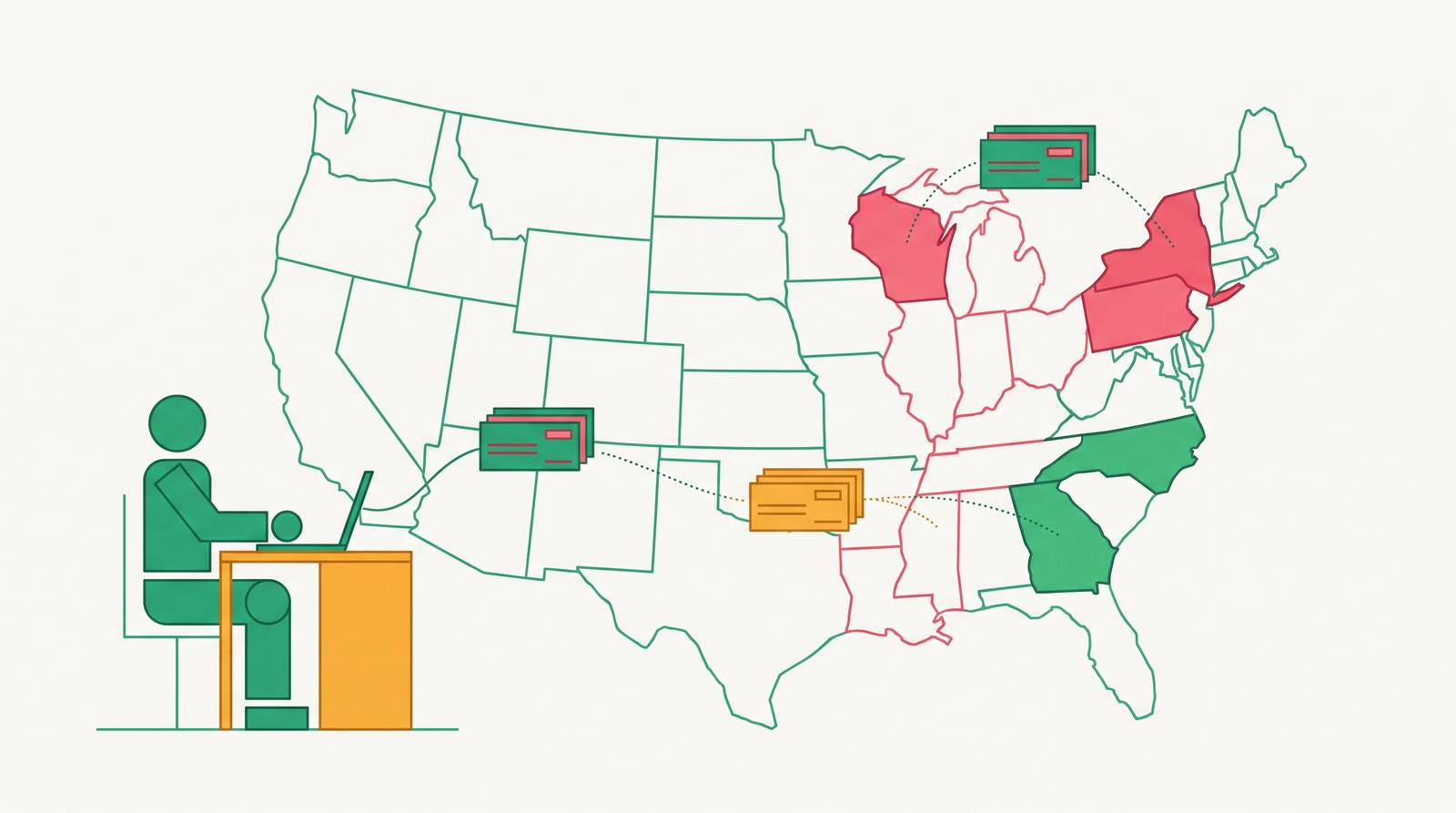
Nexus is the legal threshold at which a business acquires sufficient presence in a state to fall under its tax authority. One remote employee working from a home office in a state where the employer has never operated can establish nexus there, triggering obligations the company never anticipated when it extended the offer letter.
Withholding registration is only the first door that hire opens. State unemployment insurance, SUTA, must be registered separately; every state runs its own program with its own rates, wage bases, and procedural requirements. Some states layer disability insurance and paid family leave contributions on top of that. Depending on the employee's role, the hire can also pull corporate income tax nexus and sales tax obligations into scope.
One of the more costly mistakes scaling companies make is conflating these tracks. Nexus for corporate income tax is a legally distinct question from the withholding obligation. A company that concludes it lacks corporate nexus in a given state still must withhold wages for employees physically working there. Running the corporate nexus analysis and stopping there leaves the withholding obligation unaddressed. States will eventually find it.
The compliance checklist before a remote hire in a new state extends considerably further than a payroll registration form.
The States With No Income Tax and What They Actually Simplify, and Don't
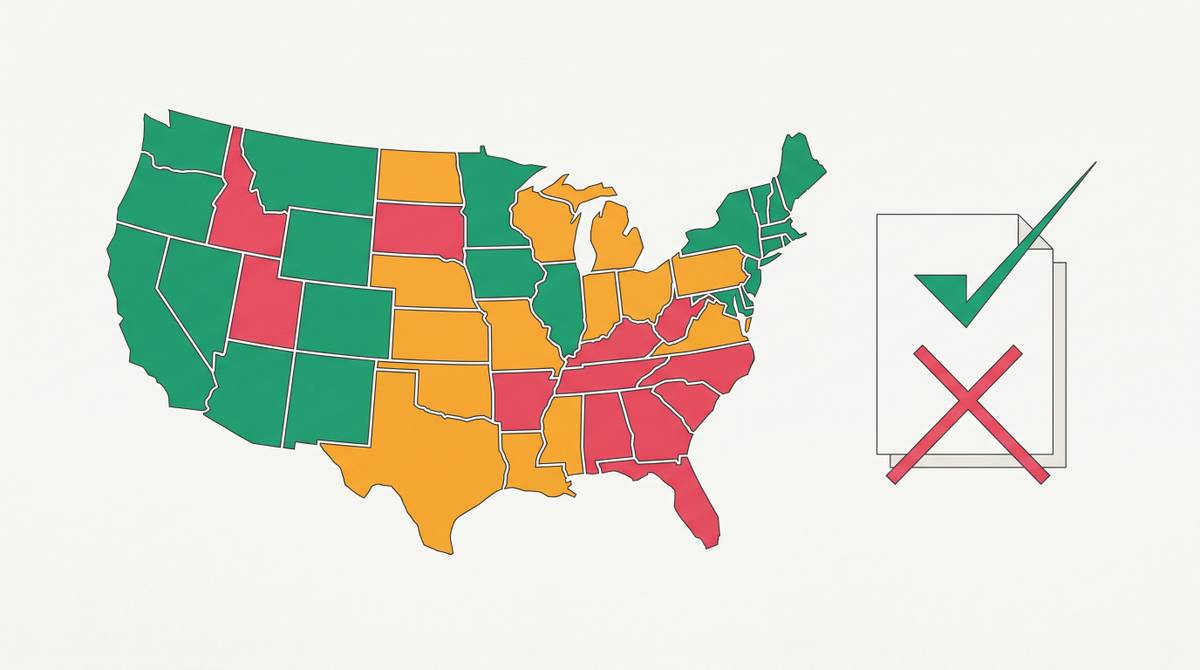
Nine states levy no state income tax as of 2025: Alaska, Florida, Nevada, New Hampshire, South Dakota, Tennessee, Texas, Washington, and Wyoming. For employees working exclusively within these states, income tax withholding isn't required. One layer removed.
But no-income-tax status doesn't touch the rest of the payroll compliance stack. SUTA applies in every state without exception. Some no-income-tax states carry their own payroll-adjacent levies; Washington maintains a mandatory paid family and medical leave program requiring both employer and employee contributions. The absence of income tax removes one obligation. The others remain.
For a company hiring at scale, the operationally significant universe is the forty-one states that do impose income tax. That's where complexity concentrates and where the real work accumulates.
How Withholding Thresholds Vary — Day-Based, Dollar-Based, and States That Start the Clock on Day One
Not all states require withholding from the moment a nonresident employee performs work within their borders. As of January 1, 2025, nine states have broadly applicable day-based thresholds for nonresident employees. Connecticut, New Mexico, and New York allow roughly half a month of work before withholding kicks in; Arizona and Hawaii allow closer to two months. Some states require withholding from the first day an employee earns wages there, no threshold, no grace period. Others set dollar-based thresholds tied to in-state compensation rather than days worked.
There has been legislative momentum in some states toward a standardized thirty-day threshold before withholding is required for traveling or short-term employees. Adoption remains uneven. High-tax states including New York and California haven't adopted it, which reflects something deliberate rather than administrative delay. Those are precisely the states most motivated to tax nonresident income aggressively.
The more insidious problem for growing companies isn't the obvious new hire in a new state. It's the project-based employee spending scattered weeks in a threshold state over the course of a year, accumulating enough days to trigger an obligation before anyone on the payroll team notices. No onboarding checklist fires. No offer letter flags the issue. The obligation accrues quietly. Precise day-counting and location tracking reduce both audit risk and double-tax exposure. A policy document sitting in a shared drive is not a tracking system.
Reciprocity Agreements and Where They Simplify Cross-Border Withholding
Reciprocal agreements between states allow an employee to pay income tax only to their state of residence, rather than to the state where they physically work. Illinois has reciprocal agreements with Iowa, Kentucky, Michigan, and Wisconsin. Montana and North Dakota maintain a bilateral agreement. New Jersey and Pennsylvania have one of the more consequential arrangements, given the volume of cross-border commuters that corridor produces daily.
The mechanics are relatively clean. The employee submits an exemption certificate to the employer, and the employer withholds only for the employee's state of residence. But the employer must track residency and verify the certificate remains current. A certificate on file from two years ago is not a compliance defense when the underlying facts have changed. If an employee moves or shifts where they primarily work, withholding must be updated promptly.
Reciprocity doesn't resolve the full payroll picture. Coverage is bilateral and limited to specific state pairs; most combinations have no agreement at all. It applies to income tax withholding only. SUTA, disability insurance, and other payroll obligations in the work state remain in effect regardless. For employers with remote employees in non-reciprocal pairs, the withholding obligation defaults to the work-location rule, and sometimes to something considerably more complicated — the convenience-of-employer doctrine.
The Convenience-of-Employer Doctrine and Why New York's 2025 Ruling Matters
The convenience-of-employer rule is one of the more assertive positions a state can take in the withholding landscape. Under this doctrine, several states tax nonresidents on income earned while working remotely outside the state if that remote arrangement exists for the employee's convenience rather than out of genuine business necessity for the employer. The states currently applying some version of this rule include Alabama, Delaware, Nebraska, and New York.
The consequences are concrete. An employee who lives and works in Connecticut but whose employer is headquartered in New York owes New York income tax, and the employer is required to withhold for New York, if the remote arrangement is deemed to exist for the employee's convenience. Connecticut taxes the income as the resident state; New York taxes it too. A credit mechanism offsets some liability, but the administrative and cash-flow burden falls on both employee and employer in the interim.
In May 2025, the New York Tax Appeals Tribunal issued a ruling in the Zelinsky matter that clarified this doctrine materially. The Tribunal upheld application of the convenience rule to a New York City law school professor working from his Connecticut home, including work performed during and before the COVID period. Hiring remotely because that's where the best candidates want to live doesn't meet New York's business-necessity threshold. An appeal to a New York appellate court is expected, so the ruling isn't final. But it reflects the current administrative posture, and companies can't responsibly plan against a more favorable assumption.
For any employer hiring remotely in or near New York, the default must be that New York withholding applies unless the employer can document a specific business-necessity basis for the arrangement. That documentation is the substantive defense. These states have also persistently resisted federal mobile workforce legislation that would limit their jurisdictional reach. Employers waiting for a congressional fix are waiting for something that has shown no meaningful signs of arriving.
The Additional Withholding Layers — Disability, Paid Family Leave, and State Unemployment
Income tax withholding is the most visible obligation a remote hire triggers. In most states, it's not the only one.
SUTA sits at the foundation. Every state runs its own unemployment insurance program with its own rates, wage bases, and employer registration requirements, each updated on its own schedule.
Temporary disability insurance adds another layer in five states: California, Hawaii, New Jersey, New York, and Rhode Island. In each, employers must withhold TDI contributions from employee wages in addition to income tax and SUTA.
Paid family and medical leave programs now apply in a growing list of jurisdictions. As of 2025, mandatory PFML contribution withholding applies in Colorado, Connecticut, Maryland, Massachusetts, New York, Oregon, Rhode Island, and Washington. Contribution rates vary, wage base caps differ, and whether the contribution is employee-only or shared with the employer isn't consistent across any of them.
A company hiring its first employee in California faces four distinct obligations from that single hire: income tax withholding registration, SUTA registration, state disability insurance enrollment, and PFML compliance. All of it must be stood up before the first paycheck is issued. Retroactive correction is possible, but it's costly, administratively intensive, and invites the kind of scrutiny employers would prefer to avoid.
Where Manual Tracking Breaks Down as Headcount Grows Across States
At a handful of employees in one or two states, the pain of manual compliance tracking is real but manageable. That calculus deteriorates as headcount grows and state count expands. Each new state adds its own registration cadence, rate update schedule, filing deadline, and reporting requirement. The complexity doesn't grow linearly. It compounds.
Day-based thresholds require knowing where employees physically work, day by day. Hybrid and traveling employees create the hardest version of this problem. No offer letter is generated when a project-based employee spends scattered weeks in a threshold state. No onboarding checklist is triggered. The obligation accrues quietly, and the first indication of it is often an audit notice.
In 2025, U.S. regulators recovered more than $259 million for workers through wage-enforcement actions, reflecting intensified scrutiny of pay practices broadly. Withholding errors sit within the category of violations that attract that attention.
The failures that accumulate at growing companies follow a recognizable pattern. The payroll team learns about a cross-state work arrangement after the fact, once the threshold is already crossed. Reciprocity certificates aren't collected at hire or aren't updated when employees move. SUTA and PFML registrations lag behind income tax registration. No written policy requires employees to self-report temporary work in another state.
These obligations are rules-based and entirely trackable. The problem is that tracking them reliably across thousands of tax jurisdictions, as each jurisdiction updates its rules on its own schedule, is not something any manual process sustains as state count grows past a certain point.
What Getting Multi-State Withholding Right Actually Requires in Practice
Before a remote hire in a new state, the checklist is specific. Determine whether the state has income tax and what withholding thresholds apply. Identify whether a reciprocity agreement with the employee's resident state exists, and collect the required exemption certificate if it does. Register for SUTA. Check for TDI and PFML obligations. Assess whether the hire creates corporate nexus or sales tax obligations beyond payroll. For hires in or near convenience-rule states, document the business rationale for the remote arrangement before day one.
Location tracking requires more than a written policy. A policy requiring employees to report when they work in another state is a necessary starting point; it's not a sufficient compliance mechanism. Work location needs to be recorded and fed into payroll before thresholds are crossed, with alerts triggered when an employee approaches a day-based limit in a state where they work temporarily.
Monitoring cannot be periodic. State rules change. Withholding thresholds are adjusted, PFML rates shift, SUTA wage bases reset annually. A compliance configuration that was accurate at hire will drift into incorrectness without any deliberate corrective action.
At the scale most growing companies reach, the operational load of managing this manually is itself the accumulating risk. Platforms built for this environment handle it differently — monitoring jurisdiction-level rule changes continuously, opening state tax accounts when a new hire triggers a registration obligation, tracking withholding thresholds in real time. Warp operates on this model, covering payroll across all fifty U.S. states and contractor payments in more than 150 countries, with AI agents that own the compliance workflow end-to-end, from state registrations and tax account setup through notice resolution.
Compliance shouldn't depend on a finance team member remembering that a traveling employee crossed a fourteen-day threshold in Connecticut last month. The obligation should be identified, surfaced, and resolved before the exposure exists.