Temporary Remote Work Tax Implications Across State Lines
States tax income based on where work actually happens, not where employers claim it's temporary.

The word "temporary" doesn't mean what most employers assume it means when state tax authorities come calling. That gap is where audit exposure lives, and it's a gap I've watched compound quietly across organizations that believed their HR policies were doing work that only compliance systems can do.
Whether a remote arrangement is temporary or permanent hinges not on an employee's stated intention or the wording of an internal policy, but on whether a state accepts the premise that the employee will, in fact, return to their designated worksite. States make that determination based on duration, observable conduct, and the realistic likelihood of return. Neither category is self-declared by the employer.
A temporary remote worker, in the technical tax sense, is an employee whose official primary worksite remains at the employer's location even while that employee is physically working elsewhere. A permanent remote worker is one whose designated worksite is outside the employer's location entirely. The compliance obligations differ substantially between the two, and most payroll systems are structurally blind to the distinction.
An employee who requested a one-month remote arrangement and quietly stayed for six is, from the employer's vantage, still logged under the original office address. From the state's vantage, that arrangement has crossed into something else, triggering obligations applicable to long-term nonresident workers or, in some states, statutory residents. The HR system says one thing; the state's clock has been running the whole time.
These scenarios are not hypothetical. A hire on a distributed team gets listed under a legacy office address that no one has worked from in years. An employee relocates mid-year, updates their home address in the HR portal, and nobody touches payroll. A worker "stays with family for a few weeks" and keeps answering emails from another state for two months. Finance teams track these situations by stated intent. States track them by duration and observable behavior. Audits begin in the space between those two methods.
How One Employee in a New State Can Trigger Withholding Obligations, Nexus, and Registration Requirements Simultaneously
Physical presence is the foundational trigger. In most states, an employer is required to withhold state income tax for the state in which an employee is physically performing work. That single principle, applied consistently, already creates significant compliance complexity for any employer with a mobile or distributed workforce.
Withholding is only the beginning. A single employee working in a new state can simultaneously create income tax nexus for the employer, meaning the state gains the authority to require corporate income or franchise tax filings entirely independent of any sales activity, registered agent, or economic nexus threshold. The full cascade includes state income tax withholding registration, unemployment insurance, workers' compensation coverage, local tax obligations, paid family or medical leave compliance, corporate income or franchise tax filing, and in some cases formal business registration. None of these obligations wait for the employer to register. They attach the moment the employee begins working in that state.
This is the compounding consequence of "work from anywhere" policies that lack geographic guardrails. When employers tell employees they can work from any location without restriction, they are effectively delegating the company's compliance footprint to individual employees' personal decisions. A family vacation becomes a two-week work trip. A move gets processed in the HR system three months late. A summer arrangement goes unflagged to finance. The perimeter expands without anyone in the organization knowing it has moved.
Many finance and legal teams now maintain a list of pre-approved states where remote work is permitted. That list isn't an HR preference or a cultural statement about flexibility. It's a compliance map, bounded by where the company has already registered and can reliably meet its obligations. The distinction matters when someone asks why an employee in Colorado can't work remotely for a month from Texas, and "because we said so" is not an answer that holds up.
The Convenience-of-the-Employer Rule and Why New York in Particular Creates Withholding Exposure for Remote Workers Everywhere
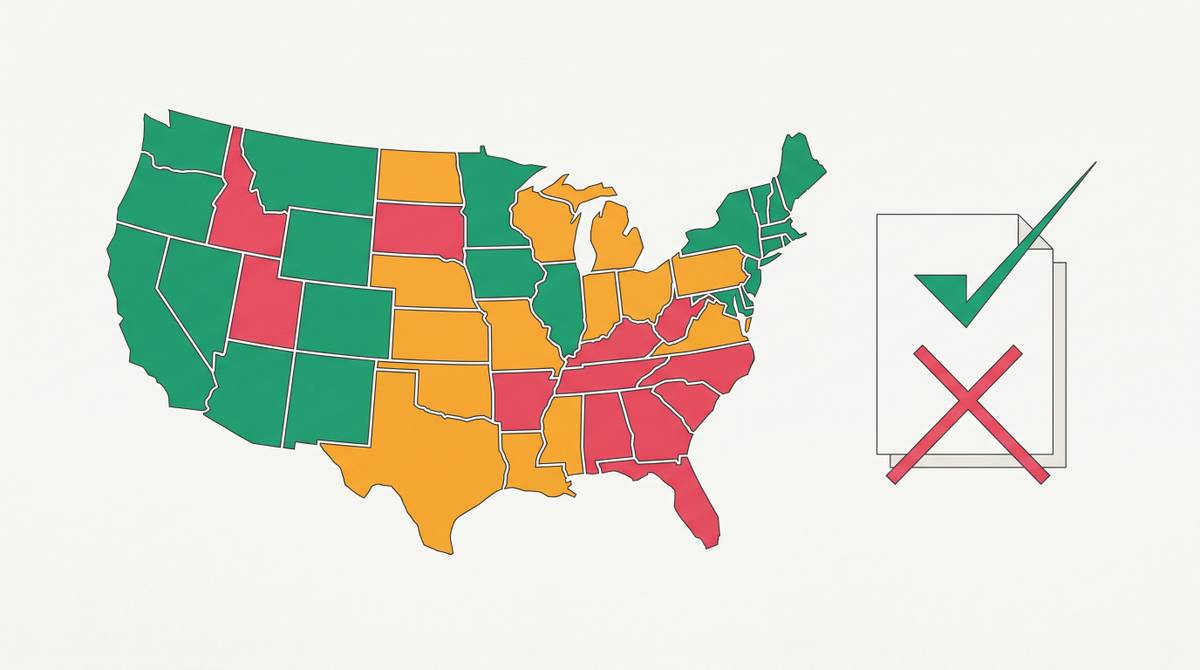
Five states apply the "convenience of the employer" doctrine: Arkansas, Delaware, Nebraska, New York, and Pennsylvania. Under this rule, if an employee works remotely for their own convenience rather than out of a genuine business necessity imposed by the employer, the income is sourced to the employer's state regardless of where the employee is physically sitting. New York's application is the most consequential of the five, and its reach extends well beyond New York employers.
A company headquartered in New York with an employee living and working in New Jersey or Connecticut still owes New York withholding on the days that employee works from home, even if the employee never crosses into New York on those days. The income is treated as New York-sourced because the remote arrangement is deemed to be for the employee's benefit, not a requirement of the job. This catches employers with real regularity; I have yet to encounter a first conversation with a multistate employer that didn't surface at least one misclassified New York remote worker.
The phrase "business necessity" is doing significant legal work here, and its definition isn't uniform across the five states. What is consistent is that the bar is high. An employee's preference to avoid a commute doesn't satisfy it. An employer's decision to allow remote work as a retention benefit doesn't satisfy it. Courts and tax authorities have looked for an objective, operational reason that the employer's business requires the employee to work from that specific remote location. Most contemporary remote arrangements cannot meet that standard, and employers who believe their policy language alone will carry the argument are mistaken.
The SALT deduction cap compounds the harm for affected employees. Under IRC Section 164(b)(6), the federal deduction for state and local taxes is capped at $10,000 per year. When an employee's income is effectively taxed by two states simultaneously under the convenience rule, the combined liability can exceed that cap, leaving the employee with no federal tax relief on the excess. In high-salary roles the dollar impact is material enough to surface during offer negotiation, sometimes before the employee's first day of work.
Day Thresholds, Income Allocation, and Why Recordkeeping Is the Operational Foundation of Multi-State Compliance
States vary considerably in what triggers a filing or withholding obligation for nonresident workers. New York requires a return after a single day of work performed in the state. Arizona's threshold is 60 days. There is no single safe number, and a company whose employees travel frequently or temporarily relocate faces a distinct set of rules in every state they touch. A traveling salesperson or an executive who spends a quarter at a regional office and isn't being tracked is exactly the kind of situation that produces material liability, often in multiple states simultaneously.
When an employee works across multiple states in a given year, income must be allocated proportionally. The standard formula divides days worked in a given state by total working days for the year, then multiplies by total wages to yield income sourced to that state. That calculation is only as accurate as the day-count records supporting it. Most companies are not tracking where employees physically work each day, which means the underlying allocation is, in practice, an educated guess dressed up as a calculation.
Residential address is a poor proxy for work location. It conflates where an employee sleeps with where they perform work. The data that actually matters for multi-state income allocation includes physical work location by day, travel days that include any work activity, residency status changes mid-year, and total days worked in each state tracked continuously across the full calendar year. Not reconstructed at year-end from calendar entries and expense reports during an audit: that process is damage control, not compliance, and it rarely produces figures that survive scrutiny.
Reciprocal agreements between states can simplify some of this. Under a reciprocal agreement, residents of participating states are taxed only in their home state on wage income regardless of where the work is performed. Fewer than half of states participate in any reciprocal arrangement, coverage is patchwork, and the benefit isn't automatic. Employees must file the required exemption certificate with their employer, and employers must verify that the certificate is current and properly filed. A missing or outdated exemption certificate is a routine audit trigger. An employee who verbally claimed reciprocity but never executed the paperwork creates exposure for the employer regardless of intent.
What Finance Teams Are Actually Failing to Track, and How That Gap Compounds at Scale
The structural problem is architectural. Most payroll systems are configured around where employees were hired or where their official worksite is designated, not where they're physically working on any given day. Address changes driven by temporary relocations, extended travel, or permanent moves rarely flow automatically into payroll withholding configurations. The system does what it was built to do; it wasn't built for the workforce that now exists.
Finance teams typically learn about a new-state situation from the employee, often at year-end during W-2 preparation, after months of incorrect withholding have already accumulated. By that point, the company is looking at amended payroll tax filings, potential penalties and interest, and the operational cost of unwinding incorrect account configurations across multiple systems. Discovery is almost always late, and lateness is expensive in ways that compound with each additional state involved.
Per EY's 2025 research, recording a single Form W-4 or state tax form change in an HR system carries an average estimated labor cost of $12.85. That figure covers only the data entry, before any downstream correction, penalty assessment, or amended return. A company with even modest remote flexibility will process dozens of withholding-relevant location changes in a single year. Each untracked event is not just a compliance gap; it's a future rework cost that has been deferred, not avoided.
The fragmentation of payroll, HR, and benefits across separate platforms sharpens the problem further. Payroll knows the registered worksite. HR knows the home address. Neither system reliably captures daily work location in a format that can drive withholding decisions. The IRS assessed more than $28 billion in civil tax penalties in 2024. Companies operating without real-time jurisdictional visibility are contributing to that figure in ways they typically don't discover until a notice arrives.
What Proactive Compliance Looks Like in Practice for a Scaling Company
The companies that manage this well share one operational characteristic: they stopped treating multi-state exposure as a periodic tax question and started treating it as a continuous data problem. What distinguishes them isn't sophistication for its own sake; it's the unglamorous decision to own specific data fields, assign accountability for them, and build review triggers before an audit forces the conversation.
Approved-state policies are the clearest guardrail. Restricting remote work to states where the company is already registered and has active withholding accounts eliminates a category of unpredictability entirely. The approved-state list isn't static; it is updated whenever the company enters a new state for any reason, including hiring, sales activity, or voluntary expansion. That list has to live somewhere both HR and legal can see, and someone specific has to own it.
Work location must flow into payroll configuration in real time, not be reconciled quarterly or annually. The day-count data that determines allocation and threshold compliance needs to exist as a live operational input, not a spreadsheet someone updates when they remember to. A spreadsheet that depends on memory is an intention, not a system.
Proactive state registration means establishing withholding accounts before an employee's first day in a new state; the same logic applies to unemployment insurance and workers' compensation. Registration limits penalty exposure in the event of a future examination because it demonstrates good-faith compliance before the fact, not in response to a notice.
Reciprocity certificate management requires maintaining current, signed exemption certificates for every employee claiming reciprocal treatment, reviewed at minimum annually and updated whenever an employee's state of residence changes. Day-count monitoring requires flagging when an employee's work activity in a threshold state is approaching the level that triggers a filing or withholding obligation. Catching that threshold before it's crossed costs less, across every dimension, than addressing it retroactively.
The compliance footprint expands with every hire, every approved remote arrangement, and every employee who crosses a state line for work. The infrastructure to track that expansion has to exist before the exposure arrives. Building it in response to an audit is the most expensive version of this problem, and also the most common one.