Global Contractor Payroll Infrastructure for Scaling Teams
Hidden tax and labor obligations beyond payment processing create serious compliance risk.

The surface layer of contractor payroll is familiar — convert currency, deliver payment, confirm receipt. Most payment tools handle this adequately. The expensive mistake is assuming that's where contractor payroll ends.
Beneath the payment rail sits a dense set of obligations that vary by jurisdiction, worker type, and payment structure. Some countries require the paying company to withhold tax at source before funds reach the contractor. Others place that obligation entirely on the contractor, with the payer simply reporting gross amounts. Still others require the payer to register with a local tax authority before any payment is made at all. These aren't minor procedural distinctions; they are threshold legal obligations, and miscalculating them in either direction creates liability.
Classification sits at the center of all of it. A contractor in the United Kingdom, a contractor in Brazil, and a contractor in Germany carry materially different legal definitions, each governed by its own compliance regime. The underlying commercial arrangement looks identical — scoped work, defined deliverables, no equity. But the legal meaning of "contractor" in those three jurisdictions isn't the same, and the tax and labor obligations attached to each engagement differ accordingly. Commercial simplicity doesn't transfer to legal treatment.
Reporting compounds the problem. Contractor payments trigger requirements that go well beyond year-end forms. Depending on the jurisdiction, filings are required per transaction, monthly, or quarterly, with format, threshold, and recipient all varying. The U.S. 1099 regime is the most familiar to American finance teams, but functional equivalents exist across dozens of countries, each with its own timing and filing logic.
Permanent establishment risk deserves particular attention because most teams encounter it late, after the exposure has already accumulated. Paying contractors in a country where the company holds no legal entity can, under specific conditions, create an inadvertent tax presence there. The test varies by jurisdiction and applicable tax treaty, but the exposure compounds with volume. A single contractor engagement rarely triggers scrutiny; ten contractors in the same country, maintained over an extended period, is a different calculation entirely.
What purpose-built infrastructure adds on top of payment delivery is the layer that handles all of this systematically — automated gross-to-net calculations, jurisdiction-specific withholding logic, real-time regulatory updates, classification auditing built into the engagement workflow. None of these functions exist on a payment rail. They require systems built specifically for the compliance surface that contractor payroll actually occupies, which is considerably wider than it first appears.
How worker classification becomes the highest-stakes variable across jurisdictions
Classification isn't one test applied globally. It's dozens of tests applied locally, and the same worker can simultaneously carry different legal statuses depending on where the work is performed or where the payer is domiciled. Most finance teams absorb this fact intellectually before they've felt its consequences operationally, and those are two very different kinds of understanding.
Within the United States alone, the divergence is significant. California applies its ABC test, which presumes employment unless three specific conditions are met, and enforcement agencies have applied it broadly. Other states apply common-law tests or their own variants of the ABC standard, with meaningfully different criteria. A worker who clears the contractor bar in one state fails it in another, and a company with contractors distributed across multiple states is managing simultaneous, sometimes conflicting classification obligations, whether or not it has organized itself to do so.
At the federal level, the U.S. Department of Labor suspended enforcement of the 2024 Independent Contractor Rule in mid-2025, reverting to prior guidance. Companies that had already restructured their classification practices in response to that rule are now operating in genuine ambiguity. The regulatory floor shifted twice within a short period, and teams relying on manual interpretation of federal guidance had to absorb both reversals operationally, usually without advance warning.
Internationally, the direction of regulatory movement has been consistent for years. Governments are increasing scrutiny of disguised employment relationships, permanent establishment exposure, and tax leakage through contractor arrangements. According to The Global Payroll Payments Report 2025, 57% of global compliance professionals cite local compliance as their single biggest operational challenge. That figure reflects a structural condition, not cyclical friction.
The compounding risk of misclassification is something finance teams underestimate until they've lived through an audit. When a classification issue surfaces in one jurisdiction, it rarely stays there. Tax authorities and labor agencies frequently use a single case as the basis for a broader examination of the entire contractor workforce. What began as an isolated exposure becomes a lever for scrutinizing every engagement the company has ever made. That transformation, from isolated compliance issue to comprehensive audit trigger, is what makes classification management a material risk management requirement rather than a compliance formality.
Manual classification review can't scale across 40 or more countries without dedicated legal resources in each. Classification must be systematized, embedded into the engagement workflow, and updated as local laws change, rather than addressed case by case after a flag is raised.
The compliance surface area that expands with every new country added
Within the United States, the compliance surface is already non-trivial before a single international contractor is added. A single remote worker, whether correctly classified as an employee or misclassified as a contractor, can establish payroll tax nexus, unemployment insurance obligations, and potential business registration requirements in their state of residence. These obligations activate at the point of engagement. Scale isn't a prerequisite.
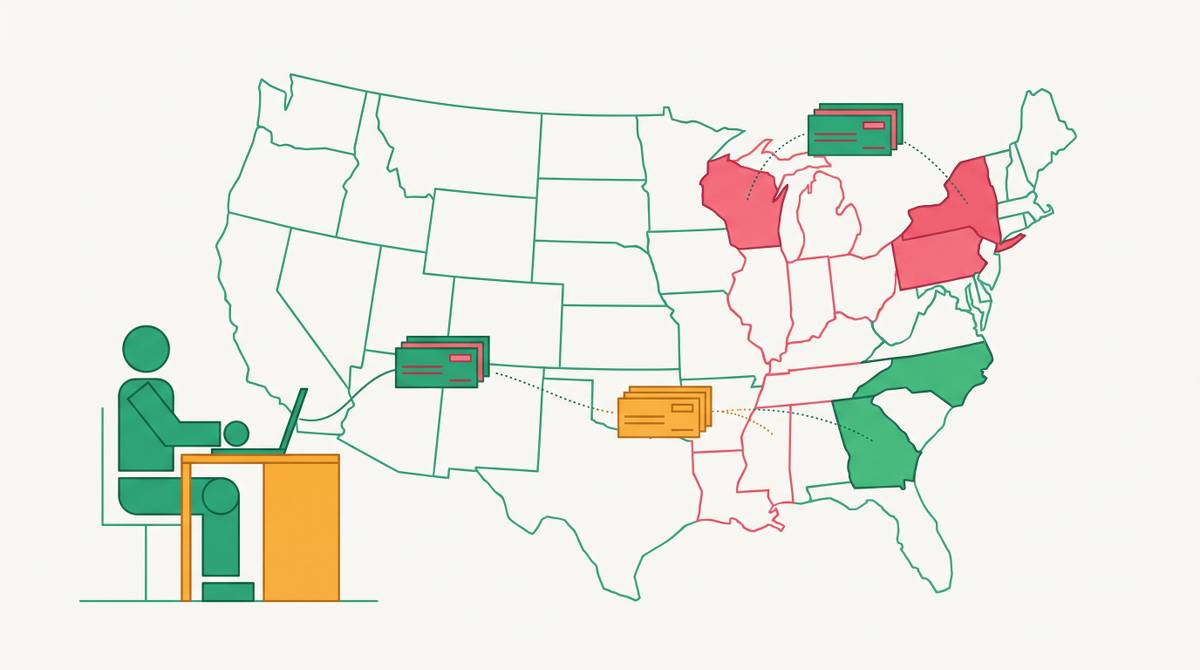
New York and Pennsylvania both apply a "convenience of the employer" rule, which as of 2025 means that non-resident workers can trigger state income tax obligations for the employer even when working entirely remotely. That rule upends the intuition that remote work simplifies state tax exposure. It doesn't. It redistributes exposure in ways that require active, ongoing tracking rather than a one-time configuration.
At the federal level, the Social Security wage base increased to $176,100 in 2025, requiring updated withholding logic. Some states also lost Federal Unemployment Tax Act credits in 2025 due to outstanding federal UI loans, increasing employer FUTA exposure in those specific states. Both changes are mechanical in nature but require real-time adjustment to the calculations that drive payroll. A system relying on manually updated rate tables is, by definition, one legislative cycle away from producing incorrect outputs. Some purpose-built platforms monitor tax rule changes across 10,000-plus jurisdictions automatically so that rate updates don't depend on a human catching them first.
Globally, the compliance surface shows no signs of stabilizing. Pay transparency mandates are expanding across Europe and in a growing number of U.S. jurisdictions. Real-time tax enforcement, in which payment data is reported to tax authorities concurrently with or immediately after a transaction, is spreading across Latin America, Southeast Asia, and parts of Africa. Labor law changes occur continuously across the more than 190 countries where contractors can theoretically be engaged.
Year-end reporting illustrates the maintenance burden plainly. Independent contractor 1099 reporting requirements vary by state; some require separate state-level filings, others don't, and the rules governing which states require what change with enough regularity to invalidate last year's process. Every filing cycle introduces the possibility of operating on stale logic, and stale logic produces filings that don't survive scrutiny.
The infrastructure requirement this imposes is unambiguous — systems that update tax and compliance rules automatically, without a human being responsible for tracking each jurisdiction's regulatory calendar. A human-driven alternative has a structural latency problem. There is always a gap between when a rule changes and when the team learns about it, and liability accumulates in that gap.
What manual contractor payroll operations actually cost at scale
The cost of manual contractor payroll doesn't announce itself cleanly in any single line item. It distributes across error rates, staff hours, organizational friction, and penalty exposure. The aggregate is reliably higher than teams estimate before they begin measuring it properly, and most teams don't measure it properly until something forces the question.
According to the American Payroll Association, businesses operate at a payroll accuracy rate of approximately 80% on average, meaning roughly one in five payroll transactions contains an error, at a correction cost of $291 per instance. That error rate makes manual processes structurally expensive at any meaningful volume. It's not a people problem; it's an architecture problem.
EY's 2025 benchmark found that recording tax form information manually in an HR system costs an estimated $12.85 per instance. At 100 contractors paid monthly, that figure exceeds $15,000 annually in data entry costs alone, before accounting for the downstream corrections that manual entry reliably generates. A payroll administrator spending 3 to 8 hours per cycle on manual data entry accumulates, at the high end, nearly 192 hours annually on a task that well-designed infrastructure handles automatically. That is more than four full work weeks consumed before any exception handling, compliance preparation, or audit response.
The hidden costs are the ones that never appear in payroll line items — finance teams reconciling payment discrepancies across currencies and payment methods; sales teams declining to quote new markets because the compliance uncertainty makes the engagement too risky to commit to; engineering teams building internal gross-to-net tools because no vendor has been deployed to do it. These costs grow proportionally with contractor volume and are almost never attributed to payroll infrastructure failure when they should be.
U.S. businesses pay an estimated $4.5 billion annually in IRS payroll penalties, with contractor misreporting and withholding failures as significant contributors. That number is the accumulated cost of systems that couldn't keep up.
What automated, jurisdiction-aware infrastructure actually does differently
The mechanical core of jurisdiction-aware payroll infrastructure is automated gross-to-net calculation at the country level. The system applies the correct withholding logic for each jurisdiction rather than requiring a human to look it up, interpret it, and enter it manually. Everything else builds from that.
Regulatory updates in a well-built system aren't a manual process. Tax rule changes, new withholding rates, updated reporting thresholds, and revised classification criteria flow in through automated feeds. The human-driven alternative has a structural latency problem — there is always a gap between when a rule changes and when the team learns about it and acts. Penalties accumulate in that gap. The only way to close the gap is to remove the human step from the update process entirely.
Classification logic embedded in the workflow changes the risk profile at a more fundamental level. Rather than a separate legal review triggered after a problem surfaces, classification rules are built into the engagement process itself. Risk is flagged when a contractor is onboarded, not after a payment has already been made and an audit has already begun. Identifying a classification problem at engagement costs nearly nothing compared to identifying it during a tax authority examination.
Currency handling in infrastructure of this kind is a system property rather than a sequence of manual decisions. Multi-currency payroll with consistent exchange rate application, documented conversion logic, and complete audit trails ensures that payment records survive scrutiny. Ad hoc wire instructions and manual FX lookups produce records that are difficult to reconstruct and harder to defend, and that problem only becomes visible when someone is already asking questions.
Contractor-specific reporting, including 1099s, their local equivalents, and state-specific filings, is generated from the same data layer that drives payment. There's no separate reconciliation step, no second data entry process, no opportunity for the payment record and the reporting record to diverge. That alignment matters far more during an audit than it ever appears to matter during routine operations.
The practical result is a reallocation of labor. The finance or HR team reviews exceptions and makes decisions; the system owns the compliance workflow end-to-end. Different operational model, different headcount requirements, genuinely different risk profile.
How the EOR market emerged to fill the infrastructure gap, and where it falls short for scaling teams
The employer of record proposition was a genuine solution to a genuine problem, and it's worth being precise about why. Companies expanding into new markets needed to engage workers in countries where they held no legal entity, and the administrative complexity of establishing local entities, especially for smaller teams or tentative market tests, was prohibitive. EOR allowed a company to engage workers through a third-party employer, with that third party assuming the local legal employer role and handling local compliance obligations. For many teams, this was the first arrangement that made international hiring tractable at all.
The global EOR market reached between $4.71 billion and $5.59 billion in 2025 and continues to grow at a 6.5% compound annual growth rate. That scale reflects genuine demand. Platforms including Deel, Oyster, and Papaya Global operate EOR and contractor payment models covering more than 120 countries in several cases. The market grew because it solved a real access problem, and it continues to grow because that problem persists for companies at early stages of international expansion.
Where EOR works well is at the point of market entry. It solves legal entity risk in new markets, handles local employment law compliance for employees, and manages basic contractor payment logistics without requiring the company to build local infrastructure. For a team testing a new market with two or three workers, EOR is an entirely sensible instrument.
The problem emerges at scale, and it has two dimensions that compound each other. First, EOR is a per-worker cost structure. The unit economics that make it reasonable for a handful of workers become increasingly difficult to justify at volume. A contractor base of 150 workers spread across 40 countries, all managed through EOR arrangements, carries a cost structure that's hard to defend relative to what the service actually delivers at that stage.
Second, and more consequentially, EOR introduces a layer of separation between the company and its own workforce data. Payroll records, classification documentation, payment history, and compliance filings sit with the EOR provider. As the contractor base grows, the visibility problem compounds — reporting becomes harder, audit preparation becomes more complex, and strategic workforce decisions get made with less information than they require. A company that can't readily answer basic questions about its own contractor workforce isn't in a position to manage that workforce intelligently.
EOR is a market-entry instrument. Teams that grow their contractor base substantially eventually need infrastructure they own and control, not a third-party employer relationship multiplied across hundreds of engagements.
What scaling teams need from contractor payroll infrastructure at the 50-to-150 contractor inflection point
The stretch between 50 and 150 contractors across multiple countries is where manual processes and point solutions break visibly. Payment cycles slow. Classification errors surface, often in clusters. Finance teams begin spending time outside business hours reconciling discrepancies that better systems would never have created. The failure rarely announces itself as a systems failure; it presents as a people problem, which is why teams often respond by adding headcount rather than fixing the underlying architecture.
Payment coverage needs to be genuinely broad. Supporting 150 or more countries means the infrastructure handles the long tail of markets, not just the top ten. A team with contractors in Indonesia, Colombia, Nigeria, and Poland simultaneously can't operate from a system optimized for North America and Western Europe. The gaps fill with manual workarounds, and those workarounds become the team's primary occupation.
Classification must be built into the workflow, not appended to it. The system needs to surface classification risk at the point of contractor engagement. Catching a misclassification during an audit isn't an acceptable substitute at this scale; by that point, the exposure has already accumulated across months or years of payments.
Compliance needs to run without a dedicated compliance team behind it. A 200-person company can't staff a tax attorney for each country in which it operates, and jurisdiction-aware systems that update automatically are the only realistic alternative to that headcount model.
A single data layer across contractor and employee payroll matters more than most teams realize until they lack it. Fragmented tools produce fragmented records, which produce fragmented reporting, which produces higher audit exposure. Consolidation of the data layer is about the defensibility of records when they're scrutinized, not operational elegance.
An automatically generated audit trail is non-negotiable. Contractor payments need documentation that survives IRS or local tax authority scrutiny without requiring a manual reconstruction effort. If producing that documentation requires a dedicated project, the underlying data architecture is insufficient for the stage the team is at.
How to assess whether your current contractor payroll setup will hold at the next stage of scale
The right diagnostic question isn't whether the current setup works today. It's whether it works when contractor count doubles and jurisdictions triple. Setups that function adequately at 20 contractors fail at 80, not because of a single point of failure but because the manual processes that held the system together at small scale can't absorb the volume and variance that come with growth. Things slow down, errors accumulate, and the team adapts by adding labor until that stops working too.
Count the manual steps a single contractor payment actually requires. If the answer involves spreadsheets, email threads, or manual FX lookups, the process won't scale. Each manual step is a potential error, a potential delay, and a potential compliance gap. The presence of workarounds is itself a diagnostic finding.
How the team tracks classification status across jurisdictions is the next thing worth examining honestly. A spreadsheet, or an ad hoc legal review triggered only by exception, means classification risk is functionally unmanaged. At scale, that isn't a latent problem waiting to surface; it's an active one, accumulating exposure with every payment cycle.
How regulatory changes are discovered and applied matters more than most teams appreciate until it fails. If someone on the team is responsible for reading newsletters, monitoring agency announcements, or waiting for a vendor to send an update, the compliance gap is structural. Liability accumulates in the interval between when a rule changes and when the team acts on it.
How long year-end contractor reporting takes is more revealing than it first appears. If it requires a dedicated reconciliation effort across multiple people and multiple systems, the data layer is fragmented, and fragmentation doesn't improve with scale.
Contractor payroll infrastructure isn't a cost center optimization. It's the operational foundation that determines whether a scaling team can add contractors in new countries without a corresponding addition of operations headcount or compliance exposure. Teams that build that foundation before the inflection point make that choice deliberately, with time to think it through. Teams that build it after are making the same decisions under pressure, with less room for error and less tolerance for the learning curve. The records, the audit outcomes, and the finance team's available attention all reflect which path was taken.