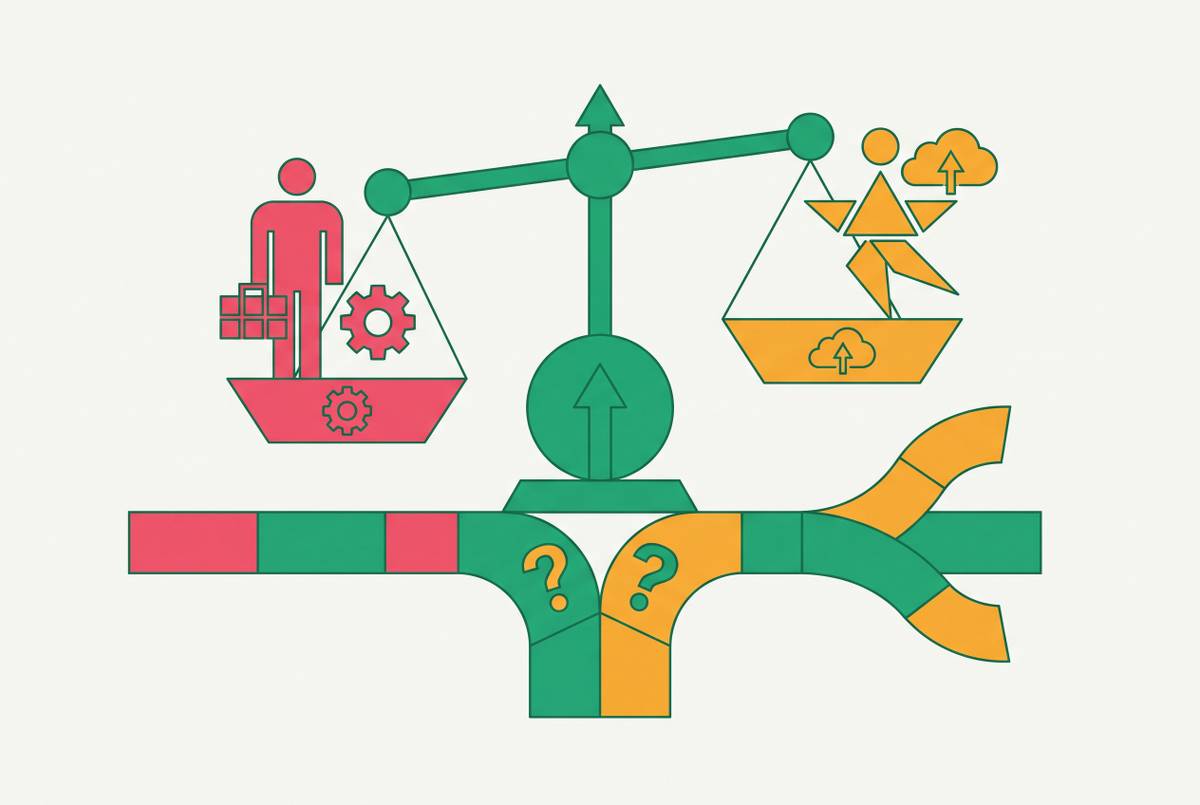
Multi-State Payroll Tax Registration for Remote Teams
Each new state requires separate registrations, accounts, and deadlines simultaneously.
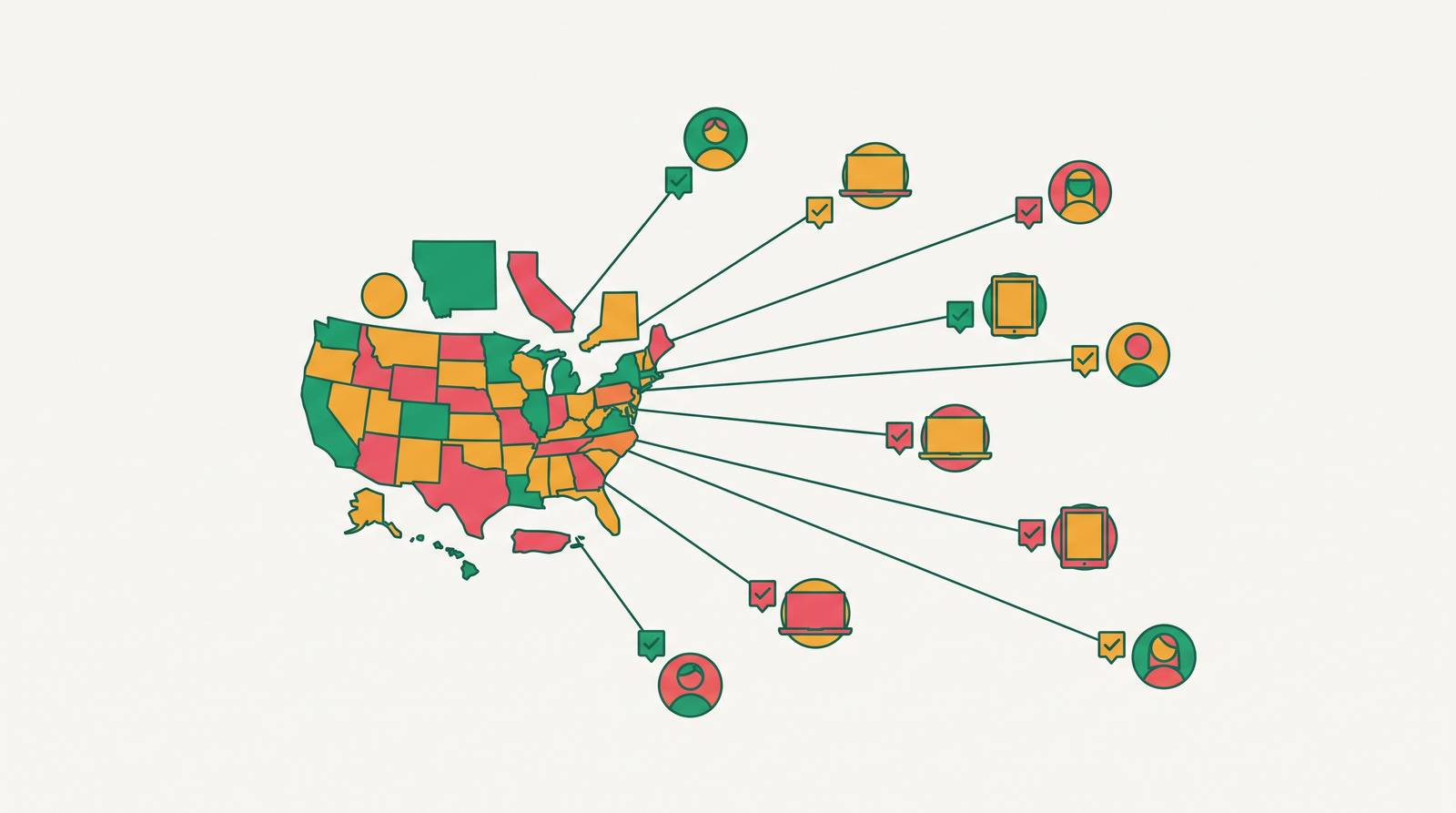
Registration is not a single action. It's a bundle of simultaneous obligations, each belonging to a separate agency, each with its own deadlines and renewal cycles. Opening a withholding account with the state tax authority is the most visible step, but it runs alongside State Unemployment Insurance registration with the state workforce agency, enrollment in mandatory paid family and medical leave programs, new hire reporting under federal law within 20 days of the hire date, labor law posting requirements calibrated for remote employees, and local minimum wage and pay transparency compliance where applicable.
Paid family and medical leave is the fastest-growing component of this burden, and it catches companies off guard more reliably than anything else on that list. Colorado, Connecticut, Maryland, Massachusetts, New York, Oregon, Rhode Island, and Washington each require PFML contributions withheld from wages. Delaware added a similar program in 2025. These programs are introduced and modified on a rolling basis, and enrollment is required at the moment of hire.
One employee in one new state equals one registration bundle. Five employees across five states equals five separate bundles, each with its own accounts, deadlines, and renewal schedules.
The common failure mode is not negligence. It's a configuration problem, and it's nearly universal. Companies set up payroll for their home state at founding, and that configuration becomes the default. As the team expands geographically, the original settings persist. The result is employees paid below local minimum wage, missing PFML enrollment, governed by the wrong leave policy. Not because anyone made a deliberate choice, but because no systematic process existed to update the configuration when new states entered the picture.
The Step-by-Step Registration Process for a New State
The process begins before any account is opened. The first step is confirming that nexus actually exists, which requires verifying the employee's work location, not their residence. These don't always share the same address, and the distinction carries legal weight.
Where required, the next step is registering the business entity with the state through a foreign qualification or Secretary of State filing. In many states, this entity-level registration must precede any tax account registration. Companies that skip it find themselves unable to open payroll accounts or, more seriously, operating as an unregistered foreign entity, a status that invites exactly the kind of audit nobody wants.
From there, the company opens a state employer withholding account with the relevant revenue or taxation agency. Most states now offer online registration. The information required is consistent across jurisdictions — federal EIN, legal business name, business address, expected first payroll date, estimated employee count. Processing times vary considerably. Some states issue account numbers the same day; others take several weeks. The obligation begins on day one of employment regardless of where the state is in its queue.
State Unemployment Insurance registration follows, typically with a separate agency from the one handling income tax withholding. Two distinct registrations, easily conflated, and frequently missed because the first one feels like the finish line.
Then come enrollment in any mandatory state leave programs, new hire reporting within 20 days of the hire date, labor law posting for remote employees in whatever electronic format each state specifies, and updating the payroll configuration to withhold at correct state and local rates from the employee's first paycheck. Not the second. The first.
Retroactive corrections are common and costly for exactly this reason. Every payroll run in an unregistered state is an unresolved liability, accruing without any signal until someone looks.
Three Rules That Complicate Which State's Taxes Actually Apply
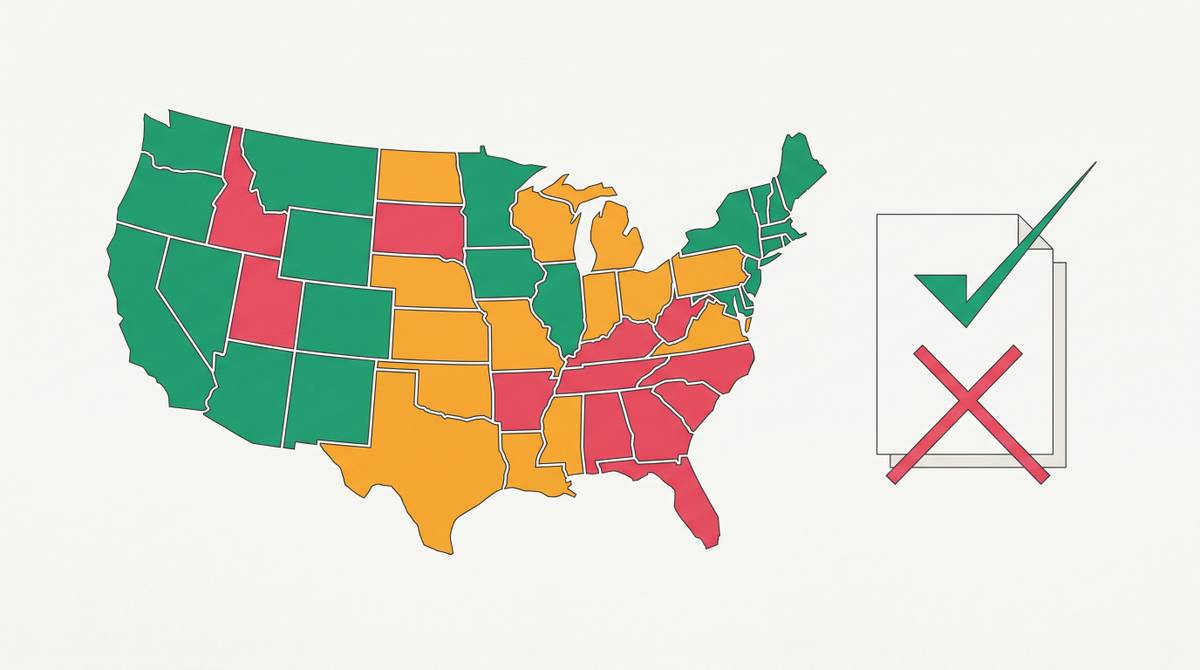
Reciprocity agreements are narrower than most employers assume. Roughly 17 states plus the District of Columbia have reciprocity agreements with at least one other state, per Thomson Reuters. These agreements typically apply to commuter situations, where employees cross a state border daily for work. They don't apply to employees who have relocated. Reciprocity is also not self-executing; the employee must file a specific exemption form with the employer. Many companies assume broader coverage than actually exists, which produces misallocated withholding and retroactive corrections when the error surfaces.
The "convenience of employer" doctrine presents a second complication, concentrated in a small number of states but most consequentially in New York. Under this rule, a New York-based employer with a remote employee working in another state still owes New York withholding if the employee works remotely by personal choice rather than business necessity. The practical implication is real — an employee physically located in a different state can still generate New York withholding obligations alongside withholding obligations in the employee's own state. That double-withholding scenario requires careful tracking and, in many cases, tax credits to resolve.
Physical presence remains a legally operative standard. In Kuklenski v. Medtronic USA, decided by the Eighth Circuit in April 2025, the court clarified that a Minnesota-based employer was not automatically subject to Minnesota law for a remote employee who had ceased traveling to the state after February 2020, requiring instead some degree of actual physical presence. The ruling reinforces that work-location determinations require specificity — where the employee performs work, when, and for how long.
Before assuming reciprocity applies, or that only one state's rules govern a given situation, verify the specific state pairing and the employee's actual work pattern. Most retroactive corrections trace back to an assumption someone never checked.
What Non-Registration Actually Costs When It Surfaces
IRS penalty rates for unpaid payroll taxes range from 2% to 15% of the unpaid amount. FLSA recordkeeping violations can reach $1,100 per employee, a figure that compounds quickly across a distributed workforce. Direct penalties, though, are only part of the exposure.
State audits triggered by registration gaps can extend back several years, creating retroactive liability for every payroll run during the gap period. A company that registered a year late doesn't simply owe one year of corrected withholding. It owes corrections, interest, and penalties across the entire unregistered period, on every affected employee.
The employee-side consequences are equally serious and considerably harder to quantify. Registration failures that produce incorrect withholding, missing PFML contributions, or incorrect leave accruals show up on paystubs and in leave balances. They surface in offboarding conversations, in unemployment claims, and in the kind of attrition that is difficult to trace to its source but costly nonetheless, particularly among remote employees who often carry less institutional attachment from the start.
What makes multi-state non-compliance genuinely dangerous is how long it stays invisible. The gap between when an obligation starts and when a penalty notice arrives can span years. Exposure accumulates while the payroll cycle runs normally, and nothing in a manual process flags the problem until an audit or a notice makes it visible.
Why Manual Tracking of Multi-State Registration Breaks Down at Scale
Adding a new state doesn't add one task to the payroll workload. It adds a parallel compliance track with its own accounts, deadlines, renewal cycles, rate changes, and reporting requirements, running indefinitely alongside every other state in the company's footprint.
Many small businesses still use spreadsheets or manual processes for payroll functions. These tools record what was true when someone last updated them. They have no mechanism for monitoring regulatory changes across jurisdictions and no capacity to anticipate what is coming. That's a structural limitation of the tool itself, and treating it as a process failure is how companies end up surprised by liability they had no way to see accumulating.
The configuration-once failure mode is pervasive. Companies configure payroll at founding for their home state, and no systematic process exists for adding states as the team grows geographically. Each new remote hire depends on someone remembering to trigger registration, usually in the middle of onboarding something else, against a deadline that is already running.
What manual tracking can't do is monitor thousands of tax jurisdictions for rate changes, new PFML programs, updated posting requirements, or revised reciprocity agreements on an ongoing basis. The regulatory environment doesn't pause while an HR team manages other priorities.
The compounding problem here is not one issue growing larger. It's multiple independent problems, each accruing retroactive exposure, each with its own discovery timeline. A company that hires across five states over two years without a systematic process has five separate compliance gaps, potentially of different ages, each requiring its own remediation. They don't resolve each other. They accumulate.
How Automated Platforms Handle Multi-State Registration and Ongoing Compliance
When registration is automated, a new hire's work location triggers immediate nexus detection. The platform initiates state account registrations without requiring manual action from HR or finance. Withholding configuration updates before the first payroll run in that state. New hire reporting files within the 20-day window automatically. For a company hiring across 15 states, the difference is not incremental. No one is relying on memory, and memory is where multi-state compliance goes wrong.
Initial registration is necessary but not sufficient. Ongoing monitoring matters as much as setup. PFML programs are added and modified continuously, minimum wage rates change on legislated schedules, and posting requirements are revised by state agencies without advance notice to employers. A platform that registers accurately at onboarding but doesn't monitor the regulatory environment afterward leaves the company exposed to the same accumulating liability that produces retroactive corrections in the first place.
Evaluating a multi-state payroll platform requires specificity. Does it cover all 50 states for withholding and SUI registration? Does it monitor for PFML enrollment requirements and rate changes automatically? Is new hire reporting tied to the hire date or a manual reminder? Are reciprocity and convenience-of-employer rules applied at the employee level without manual configuration? The most consequential question is whether the platform opens state accounts itself or delegates that back to the employer. A platform that provides guidance but expects the employer to handle account opening hasn't automated the highest-friction part of the process.
Warp is an AI-native payroll platform built around this architecture. Its AI agents open state tax accounts, resolve compliance notices, and monitor tax jurisdictions continuously, handling work that in a manual environment falls to finance or HR teams to track across every new hire event. Both EY and Deloitte have found that companies using automated payroll systems recover the investment within a year, with measurable reductions in compliance issue rates. The economics favor automation more decisively as headcount and jurisdictions grow, because the cost of automation is largely fixed while the cost of manual multi-state compliance scales with every new hire and every new state.
A company growing from 20 to 100 employees across 15 states needs a process that holds at hire number 100 the same way it held at hire number one. Platforms that require manual intervention at each new state don't scale with the business. They create a ceiling on how cleanly the business can grow, and that ceiling appears exactly when growth is moving too fast to notice it.