AI-Driven Payroll Error Detection Before Processing
Catching payroll mistakes before they process costs nothing; catching them after costs everything.
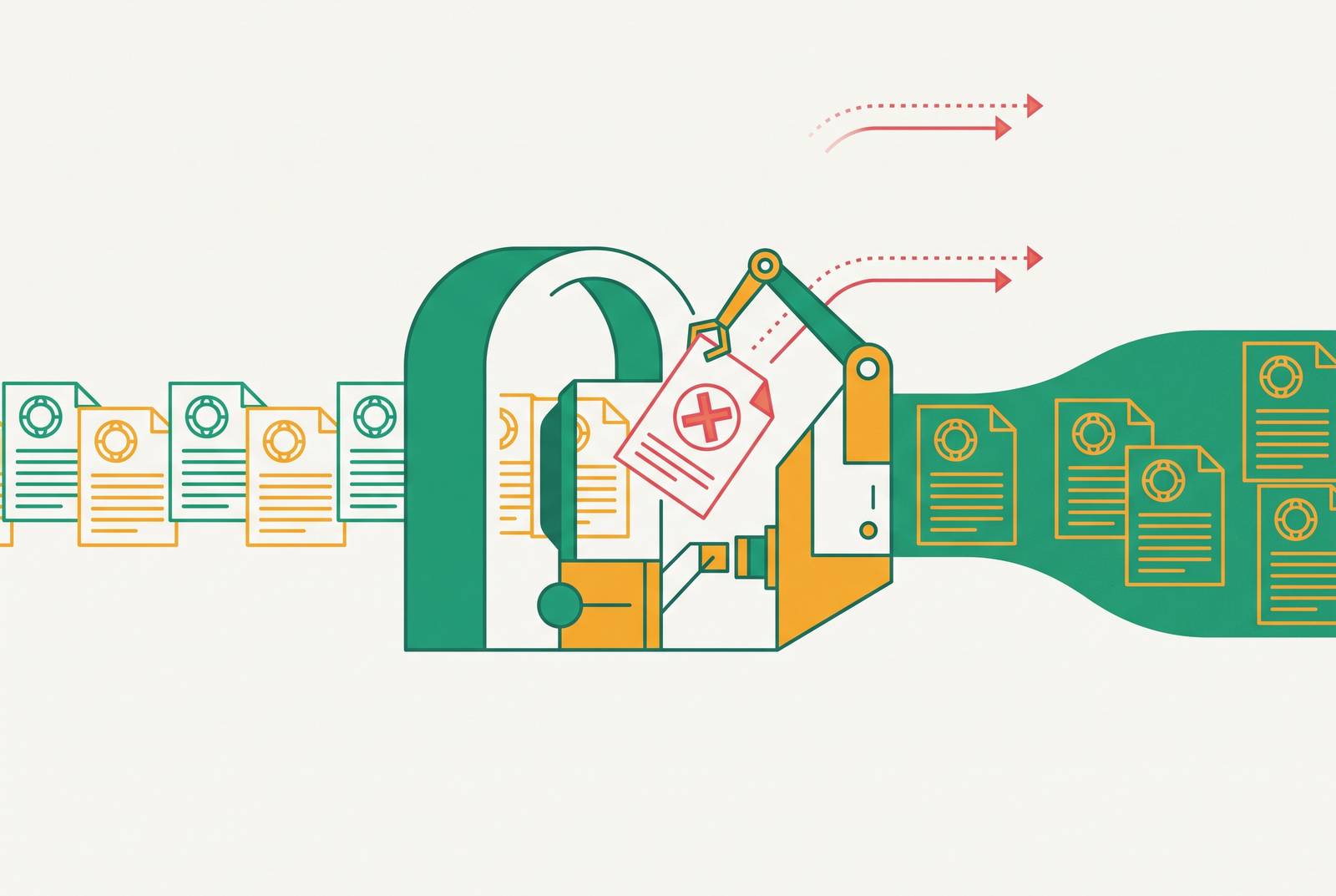
Payroll errors are routine even at well-run companies. What separates a costless mistake from an expensive one is timing, not competence, and AI-driven pre-processing detection exists to fix the timing problem: it catches anomalies, miscalculations, and compliance gaps before a payroll run finalizes, while the fix is still free. Many vendors selling into this space describe it as a nice-to-have layered on top of existing payroll software, and that framing undersells what's at stake. For any company operating across multiple states, pre-processing detection is the difference between a payroll function and a liability sitting quietly on the balance sheet.
The math is not subtle. A miskeyed hour or a stale tax code caught before the run is a five-minute fix, while the same error discovered after checks have gone out means retroactive adjustments, hours spent diagnosing what went wrong, and in the worst cases a reprocessing cycle that bleeds into the next pay period. Errors involving retroactive pay or tax recalculations are among the most time-consuming to resolve, because untangling them means reconstructing what should have happened across several interlocking systems at once, after the fact, with less information than existed the day the error was made. The IRS does not extend patience to employers who miss a tax deposit deadline: penalty structures are tiered and escalate fast, so an error sitting for two weeks costs meaningfully more to fix than one caught the same day. Add the human cost, since paycheck inaccuracies erode trust quickly and employees who eat repeated errors leave, and the real exposure runs well past whatever the payroll department spends on labor.
None of this is the payroll team's fault, and it's worth saying plainly: blaming the reviewer for missing something a spreadsheet was never built to surface is an instinct most organizations default to, and it misreads where the limitation actually sits. Manual payroll systems process data; they don't interrogate it, and a person scanning a spreadsheet before a run works within the limits of that design. Errors surface after the run, at the exact moment fixing them starts costing something, and no amount of diligence on the reviewer's part changes that structural fact.
What "pre-processing detection" actually means and where it sits in the payroll workflow
Every payroll cycle has a seam: the window between when data comes in (timesheets, expense submissions, classification changes, benefits elections) and when that data locks into a final run. Pre-processing detection lives in that seam, questioning inputs before they become outputs, well ahead of any reconciliation process that would only audit the damage afterward.
In a manual environment, that seam gets a partial glance at best. A payroll manager scans for anything obviously wrong, but in any organization of moderate size, the volume of entries exceeds what one person can review meaningfully in the hours available before a run has to go out. Things get missed not from negligence, but because human attention doesn't scale with headcount.
Three categories of problems hide in that gap: data errors, such as duplicate entries, missing hours, a figure miskeyed, or an employee record that never got updated after a status change; calculation anomalies, such as overtime run against the wrong base rate, a deduction outside its normal range, or a paycheck that jumps with no approved raise behind it; and compliance gaps, such as the wrong tax code applied to a remote worker who moved states, a state-specific wage rule that never got applied, or a contractor-to-employee conversion that never triggered the corresponding payroll adjustment.
Catch any of these before the run processes and the fix costs nothing: no reissued checks, no amended filings, no letter from a tax authority. The same mistake, caught twelve hours sooner, costs nothing instead of costing plenty. That's the whole argument for moving detection earlier, and it doesn't need dressing up.
How AI detects anomalies that manual review consistently misses
The mechanism is pattern recognition applied at a scale no human auditor can match. These systems ingest historical payroll cycles and build a baseline for what "normal" looks like, for each employee, each role, each department, each location. Once that baseline exists, anything that deviates from it, a pay spike with no approved raise behind it, overtime hours clearing a threshold without manager sign-off, a deduction that vanishes without a corresponding benefits change, gets flagged before the run goes through.
What separates this from a spreadsheet formula catching outliers is the cross-referencing, work that takes a human hours and a system seconds. Submitted hours get checked against scheduled shifts to surface off-the-clock work or time entry mistakes, work location records get matched against the tax codes actually applied to catch the case where an employee's address changed but their withholding profile never did, deduction line items get checked against current benefits enrollment to catch elections that fell out of sync after open enrollment closed, and duplicate entries, especially common during system migrations or when a manual correction gets layered on top of an already-automated one, get identified and isolated.
Detection compounds over time. The system learns from each cycle, flagging patterns that recur across multiple pay periods instead of treating every anomaly as a one-off. That distinction matters: a single error is a mistake, but a pattern that shows up in three consecutive cycles is a process problem, and the two demand different responses. Most manual reviews never make that distinction at all, because nobody is tracking the pattern across cycles in the first place.
Worker classification sits near the top of the risk list. Misclassifying a contractor as an employee, or the reverse, carries tax and benefits consequences that compound the longer they go unnoticed and become genuinely difficult to unwind retroactively. Manual review isn't careless here; the volume of data in a multi-state or global payroll has simply outgrown what a periodic human audit can reliably cover, no matter how careful the reviewer is.
The compliance problem is hardest at scale, and that is exactly where AI's advantage is largest
A single-location employer operating in one state has a manageable compliance footprint. A company scaling across states, or across borders, faces a footprint that grows non-linearly: every new state an employee works from brings its own withholding rules, filing deadlines, deposit schedules, and wage-and-hour requirements, and the combinations multiply faster than any compliance team can track by hand. The received wisdom holds that compliance risk scales roughly with headcount, but the pattern in the data looks different: it scales with the number of distinct jurisdictions touching that headcount, which is a different and much steeper curve.
Remote and hybrid work made this considerably worse. Employees now work from locations their employer never anticipated when tax and benefits profiles were first set up, and nothing flags that mismatch automatically unless something is built specifically to look for it. Global payroll adds another layer: different currencies, different social security thresholds, different local labor laws, different reporting cadences, all varying independently in ways that make manual audit impractical past a certain volume.
AI-powered pre-processing checks apply the correct jurisdiction-specific rules to each employee based on where that person is actually working, and adjust in real time when the location changes, well ahead of the quarterly reconciliation that would otherwise surface the gap months later. Compliance professionals have pointed to local regulatory compliance as their single hardest challenge consistently, across multiple years of industry surveys, rather than the answer shifting from one cycle to the next. That consistency points to a structural problem built into how work and regulation now interact, not a temporary headache that resolves once teams adjust.
The companies most exposed to this are, unhelpfully, the ones growing fastest. Headcount expands faster than a manual compliance process can adapt, so the risk grows precisely when a company can least afford to absorb it.
How agentic AI goes further than flagging — handling the exception workflow end to end
First-generation AI in payroll did one thing well: it surfaced flags for a human to review. That was real progress over no detection at all, but someone still had to open each flag, investigate it, decide what to do, and execute the fix. The bottleneck just moved from finding the error to resolving it, which is a smaller win than it sounds, and treating flag-surfacing as the finish line is where a lot of "AI-powered payroll" marketing quietly stops.
Agentic AI removes that bottleneck by acting on the flag itself. Instead of waiting for someone to click into an exception queue, the system routes the exception, pulls the relevant records, applies the correction logic, and either resolves the issue on its own or escalates it with a recommendation and the supporting evidence already assembled. A tax code mismatch caused by a remote worker's address change gets detected, the correct jurisdiction identified, and withholding recalculated before the run ever processes, with no payroll manager stepping in. A duplicate entry gets flagged, traced back to a manual override left over from the prior cycle, and removed, with an audit trail logged automatically as it happens. An overtime calculation that deviates from the applicable state rule gets caught, recomputed correctly, and substituted into the run in place of the error.
What changes, practically, is the job itself. Finance and HR teams move away from executing correction workflows line by line and toward reviewing exception summaries, approving or overriding what the system already recommends. Reviewing a system's conclusions is a fundamentally different task from chasing individual errors through raw data, and it's worth being blunt about which one is the better use of a skilled person's time.
Industry analysts expect this model to become the default rather than the exception within the next few years, with a substantial majority of large organizations adopting AI-assisted payroll and agentic orchestration spreading across core HR and finance functions more broadly. The return shows up quickly where it's been measured: organizations that automate payroll tax filing and compliance checks report sharply shorter processing cycles and steep drops in compliance penalties within the first year or two.
What high-growth companies should look for in a pre-processing AI layer
Integration depth is the first thing worth checking, and it's where most vendor claims fall apart under scrutiny. A detection layer bolted onto a legacy system, without native access to HR records, benefits data, and tax tables, catches surface-level errors and misses exactly the cross-system anomalies that matter most, because it never had visibility into the second system to begin with. That should disqualify a vendor outright. It is not a minor gap to work around later.
A few capability areas separate a genuinely useful layer from a cosmetic one. Multi-state and global coverage matters: does the system maintain current rules for every jurisdiction where the company has people, and update those rules automatically when regulations change, rather than on a vendor's release schedule? Classification monitoring matters just as much: does it track worker status across the full roster and alert when a change, contractor to employee, part-time to full-time, should trigger a payroll or tax adjustment? Historical pattern learning separates a system that gets sharper each cycle from one applying the same static rule set indefinitely. The exception workflow needs scrutiny too: does it dump every flag into a human queue regardless of severity, or resolve routine cases on its own and escalate only the genuinely ambiguous ones? A vendor that can't answer that last question specifically is still selling first-generation flagging with a new label on it.
Audit trail quality deserves its own line of questioning. Every automated action needs enough detail logged that a finance team can explain a correction to an auditor without reconstructing the underlying logic from memory months later.
There's a consolidation argument underneath all of this that's easy to skip past. Pre-processing detection works best when payroll, HR records, benefits, and IT provisioning share a single data model, because fragmented systems create exactly the gaps errors hide in. A tax code error caused by an address change that never synced to payroll traces back to a data architecture failure; it only happens to surface in payroll.
The real test comes down to one question: does the system treat compliance as something it owns, or as something it merely helps a human keep track of? Most vendors sell the second thing while implying the first, and the difference matters enormously for a company scaling headcount fast. A tool that assists a compliance team breaks down the moment that team gets too small, or too stretched, to keep pace with the growth around it. A system built to own the outcome doesn't have that ceiling, and that's the version worth buying.