AI Agent Workflows vs Human-in-the-Loop HR Processes
End-to-end AI agents automate routine HR work, freeing teams for strategy.
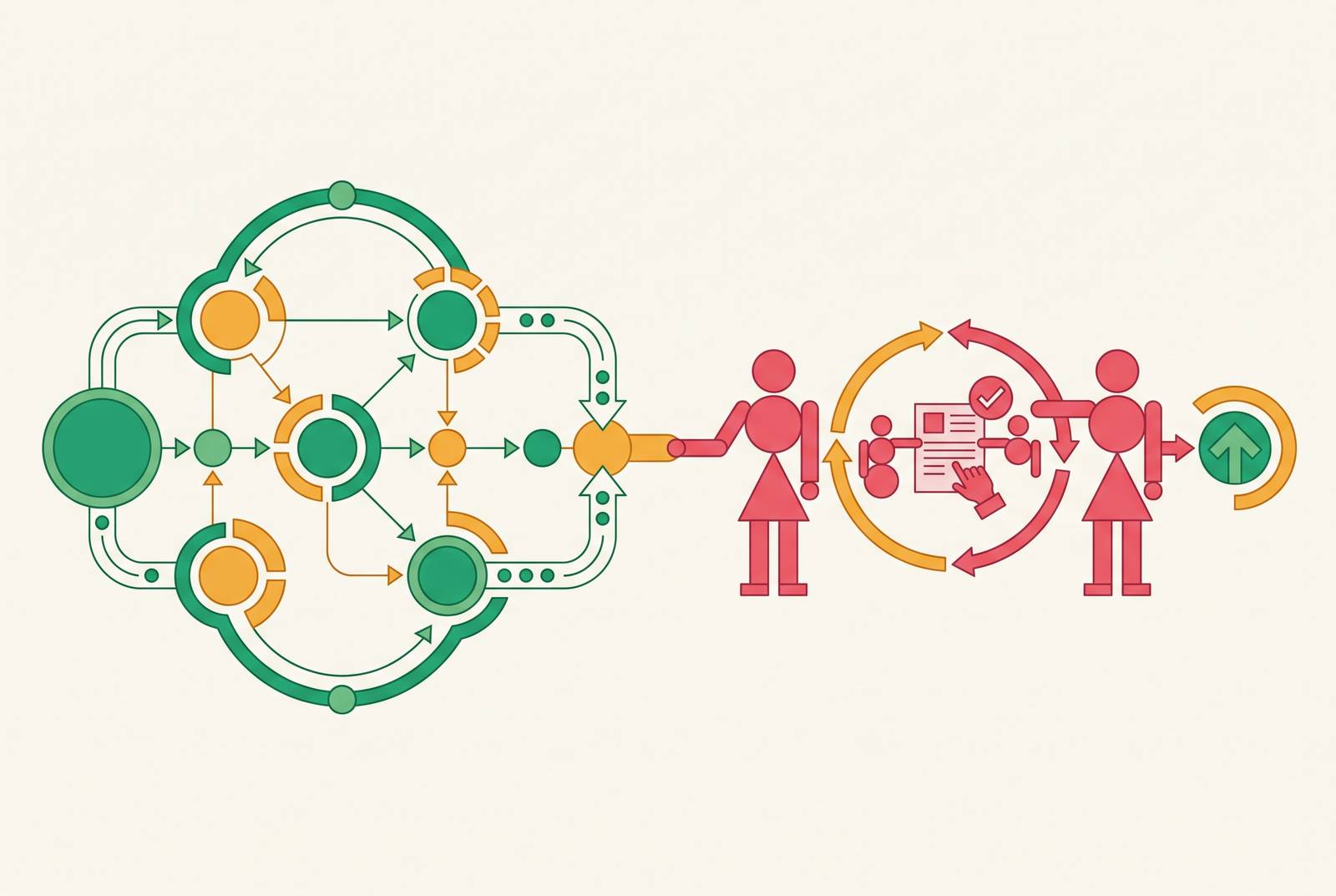
SHRM's 2023-2024 State of the Workplace Report found that 20% of manually processed payrolls contain errors, each costing $291 to fix. At 50 employees, that's a nuisance a bookkeeper cleans up on a Friday afternoon. At 500, it's a recurring five-figure liability with a compliance tail attached, and the cost doesn't stay flat as headcount grows. It recurs with every hire, every pay cycle, every open enrollment window, on a schedule set by the business rather than by anything HR controls.
People make mistakes, and always will. The deeper issue is structural: route every step through a human queue, and error rates climb with volume, because the number of manual touchpoints climbs right alongside it. Two models are on the table. Human-in-the-loop means a person reviews, approves, or executes each step in a workflow, while end-to-end agent ownership means software runs the full workflow and escalates only the exceptions that actually need a judgment call. Most growing companies are still running the first model well past the point where it can hold, and that failure traces to how work gets routed, not to a shortage of staff. This is the wrong place to be understaffed, and hiring more coordinators is the wrong fix.
Deloitte research found that HR teams spend 57% of their time on administrative tasks. Over half the working week is gone to processing rather than to the things HR actually exists to do: cutting turnover, improving engagement, planning the workforce three quarters out instead of reacting to it. Four failure modes show up as teams scale, and none of them are random.
Sequencing bottlenecks come first. Manual processes run in sequence by nature, so onboarding step four can't start until someone approves step three, and time-to-productivity for every new hire ends up gated by how fast a person can clear a queue. Error propagation follows close behind: a data entry mistake made in the payroll system at step one doesn't announce itself. It surfaces three or four steps later in tax filing, by which point it has already touched other records, and with a 20% manual payroll error rate, that kind of downstream contamination is close to guaranteed.
Knowledge concentration is the quieter failure, and often the most damaging. When critical HR records live in individual inboxes, personal spreadsheets, and shared drives with no clear owner, the organization discovers the gap only when someone leaves and the records leave with them. What looked like HR infrastructure turns out to have been a series of individual memories standing in for one.
Compliance blind spots round out the list, and they carry the sharpest financial teeth. Manual I-9 processing produces errors in an estimated 12% of cases, and federal penalties for a defective form run from $220 to $2,191 per form, scaling with every hire the company makes. Each of these four failure modes is the predictable output of a system that forces every step through a human queue. At growth inflection points, when hiring speeds up or multi-state complexity kicks in, the failure rate spikes rather than creeps.
What AI agents actually do differently — end-to-end ownership vs. assisted workflow
Most HR software sold with "AI features" still routes execution through a human being, and that distinction matters more than vendors like to admit. The software surfaces the next step; a person takes it. That's human-in-the-loop with a nicer interface on top of the same bottleneck, and "AI-powered" often describes the marketing copy more than what the system does.
True agentic AI differs in how much action it takes, not in how it looks on a screen. It runs multi-step plans, talks directly to third-party systems, and escalates only genuine exceptions rather than every routine task. The gap looks like this in practice: under human-in-the-loop, a system flags that a new hire lives in a state the company has never operated in, and an HR manager has to log into that state's tax portal, register an account by hand, and come back later to mark the task done. Under agent ownership, the system spots the new hire, opens the tax account, registers with the state agency, and updates internal records, all without anyone opening a browser tab.
Adoption has already moved past the pilot stage. A May 2025 PwC survey of 300 U.S. executives found that 79% of organizations run AI agents in production, and 66% report measurable productivity gains from doing so. Within HR specifically, adoption grew to 43% of organizations in 2025, up from 26% the year before. The early movers have already validated the model rather than just poked at it; the ones still piloting are behind, not cautious.
Vendor behavior tells the same story from a different angle. An MIT study found that only about 5% of organizations saw a return on AI investment, which is exactly why integrated, purpose-built agent systems have become the credible path for finance and HR platforms moving teams from manual transaction processing toward exception management. Watching for exceptions is a fundamentally different job from executing routine steps by hand. Treating "AI-assisted" and "agent-owned" as points on the same spectrum, rather than two different jobs, is what keeps growing teams stuck in the manual model long after they can afford to leave it.
Multi-state and global payroll as the clearest stress test for both models
Payroll complexity in the U.S. isn't shrinking. There are 51 distinct jurisdictions to track, each with its own income tax withholding rules, unemployment insurance obligations, and workers' comp requirements, and 41 states collect income tax on wages and salaries at all. Remote work stacked a new layer on top of that: an employee working from a home office in one state, for a company headquartered in another, can create tax nexus and withholding obligations the employer never had reason to expect.
The edge cases are where manual processes actually snap. New York taxes remote workers based on the employer's location under its "convenience of the employer" rule, not where the employee physically sits, which creates double-taxation exposure that most growing companies don't discover until a notice arrives in the mail. Then add the 22 states that raised minimum wages in early 2024, each one triggering its own set of downstream payroll tax compliance changes. Year-end concentrates all of it: W-2s, 1099s, and state-specific filings across every jurisdiction a company touches, a season with a way of funneling every small error made over the prior twelve months into one filing window.
Manual compliance infrastructure doesn't fail because the people running it are careless. It fails because the rule surface, thousands of jurisdictions, each changing on its own schedule, is too large and too fast-moving for a human team to track without a system built to watch it continuously. Platforms built natively for multi-state and global payroll treat this complexity as infrastructure to automate: opening state tax accounts on their own, processing contractor payments across well over a hundred countries as routine work. The human-in-the-loop version carries a different shape entirely. Every new state a company enters spins up its own queue of manual registration tasks and ongoing monitoring, and that queue multiplies with each remote hire until keeping pace requires adding headcount just to stand still. That's the tell: if growth requires proportional headcount in HR operations just to maintain compliance, the system is the bottleneck, not the team running it.
Onboarding as the workflow where the agent model's advantage is most measurable
Onboarding is where the gap between intention and execution shows up most starkly. An Enboarder survey found that 88% of employees say their organization does a poor job of onboarding, and Gallup's 2025 research puts the number who strongly agree their company does it well at just 12%. Those two figures describe the same failure from opposite ends.
The administrative weight explains why. SHRM's 2025 Onboarding Benchmark report found that the average small business takes 10.4 business days to fully onboard a new employee, spread across 54 discrete tasks: paperwork, system access, training schedules, equipment orders, introductions. SHRM's 2025 Human Capital Benchmarking Report puts the average administrative cost of manual onboarding at $4,129 per hire. Delays in basic setup shape a new employee's read on the company's competence before they've sat through a single real meeting.
Agent-owned onboarding rebuilds this from the ground up. Once an offer is accepted, payroll setup, benefits enrollment, device provisioning, system access, and state tax registration all kick off in parallel rather than in sequence. The new hire fills out a single intake flow, and everything downstream runs without an HR coordinator manually pushing each piece along. What's left for humans is the part suited to them: the manager introduction, the culture conversation, the role-specific training no workflow engine can deliver.
The retention math backs this up. SHRM research finds that employees who experience effective onboarding are 69% more likely to stay with their company for three years. Stripping friction out of 54 administrative tasks is precisely what frees up the human interactions that decide whether a new hire commits to the company for the long run. No workflow software substitutes for that conversation; it only clears the runway for it.
Benefits administration as the gap between what HR teams intend and what employees experience
A 2025 Deloitte study found that 67% of HR leaders report AI-powered tools have meaningfully improved department efficiency, yet AI adoption in benefits administration specifically has lagged behind other functions. That gap is worth sitting with: adoption lags most exactly where the stakes for employees are highest, and that ordering is backwards.
Manual benefits administration produces a familiar set of problems. HR teams process enrollment by hand during a compressed open enrollment window, the single period each year when error volume peaks and staff capacity is stretched thinnest. Employees get generic plan descriptions instead of guidance built around their actual situation, whether that's a new dependent, a chronic condition, or a life change the plan documents were never written to address. And the benefits decisions HR makes upstream often rest on thin historical data, without real visibility into how employees actually use what's offered.
Agent-owned enrollment changes what the workflow does, not just how fast it runs: automated plan recommendations built from an employee's actual profile, guided self-service enrollment that doesn't need an HR staffer sitting in on every selection, exception escalation saved for cases that are genuinely unclear. The legitimate worry here deserves to be named directly, because in benefits, as in finance, errors aren't abstract; a missed enrollment or a wrong deduction hits someone's actual healthcare coverage. But a system that escalates the genuinely hard cases to a person, while handling routine enrollment the same reliable way every time, catches more of the real problems than a human team reviewing every transaction by hand ever could. It stays steady where fatigue, enrollment-deadline rushes, and volume wear a manual process down. When enrollment runs accurately and without friction, benefits stop generating HR complaint tickets and start working as the retention tool they were always meant to be.
How to identify which HR workflows are ready for full agent ownership today
The sorting question isn't complicated, even if applying it takes discipline: does this step need human judgment, or does it need human execution of a rule that's already been decided? Judgment stays with people; rule-based execution belongs to agents, full stop. Treating the two as interchangeable is exactly how HR teams end up over-staffing the wrong half of the job, and most do.
Several workflows sit squarely in the second category, ready for agent ownership today: state tax account registration whenever a new hire lands in a new state, payroll processing and tax filing across jurisdictions the company already operates in, I-9 and compliance document collection and verification, benefits enrollment routing and deadline tracking, device and system access provisioning at both hire and offboarding, and contractor payment processing across multiple currencies.
Other workflows still need a person in the room, and that isn't a temporary limit of the technology; it's the nature of the work. Performance conversations and disciplinary action need the kind of contextual read no rule set captures, and benefits counseling for an employee's unusual personal circumstances needs someone who can actually listen. Equity grant communication needs someone who can explain a vesting schedule to a person hearing it for the first time and answer the follow-up question that wasn't in the FAQ. Culture and role-fit assessment during onboarding is, by definition, a human judgment about other humans, and no agent should be given that call.
A useful warning sign comes from an adjacent industry: Wolters Kluwer's 2025 research found that 73% of banks still rely on manual compliance processes, in a sector where regulatory stakes are about as high as they get. That persistence shows how expensive inertia can be, and how slow even well-resourced, heavily regulated organizations are to drop a broken default. A practical test for any HR team: if a step needs someone to log into a system, copy data from one screen to another, or send a reminder email, that step is a matter of availability, not judgment, and availability is exactly what agents are built to provide. The sorting question matters most at the inflection points: when hiring speeds up, when the company enters new states, when headcount crosses a threshold the existing manual process was never built to handle.
What finance and HR teams actually own when agents handle the execution
Humans move upstream in this picture, from running tasks to designing the system that runs those tasks, setting the policy the system enforces, and handling the exceptions that genuinely need a person's judgment.
For finance leaders, once payroll runs on its own, the job becomes exception review, audit readiness, cash flow visibility, and the strategic workforce planning that administrative overload used to crowd out. For HR leaders, once onboarding and benefits enrollment run without manual coordination, the job becomes culture, retention strategy, manager development, and workforce planning that requires actually thinking ahead rather than clearing today's queue.
IDC forecasts that by 2030, 45% of organizations will run AI agents across core business functions as standard operating infrastructure. Teams that rebuild around this now gain an edge that compounds over years, rather than one they try to bolt on after the fact once a competitor has already made the switch.
The compounding risk of manual HR doesn't peak at 50 employees, or even 500. It peaks at the exact moment a company's ambition outgrows the operational infrastructure meant to support it, and by then, the fix costs far more than the decision to build it right the first time ever would have.