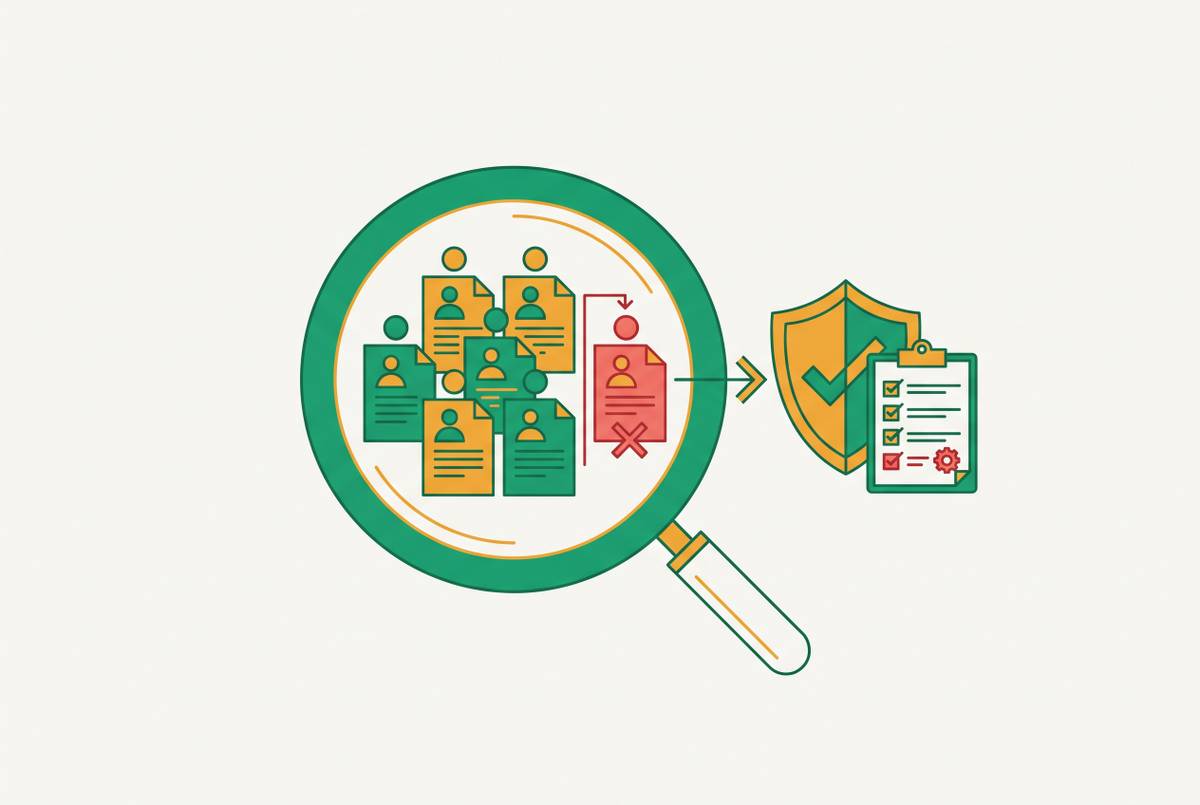
W-2 vs 1099 Classification and Audit Triggers
Misclassifying workers as contractors can cost companies far more than back taxes and penalties.
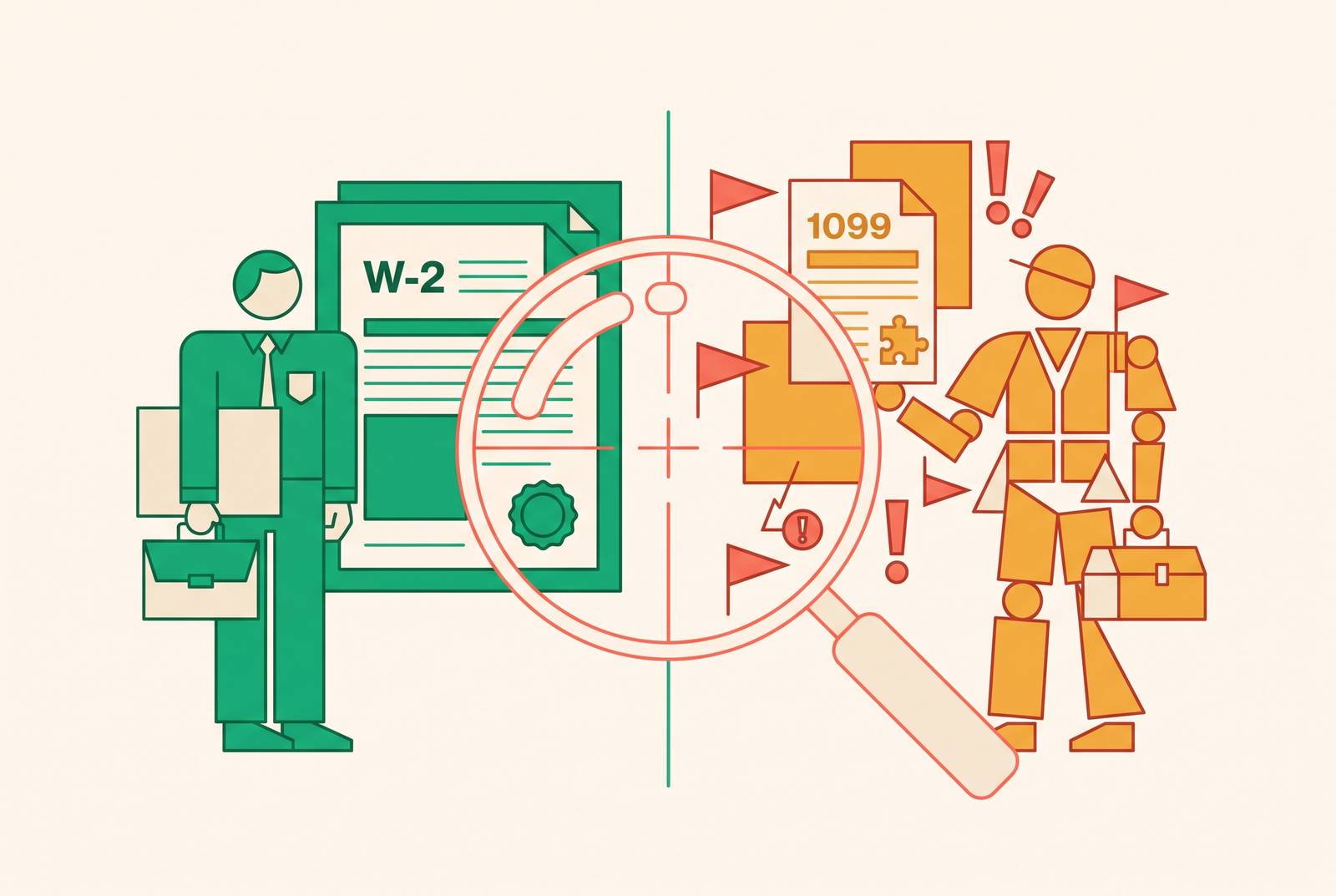
Getting worker classification right comes down to two separate skills, and most companies only bother to develop one. The first is understanding the legal tests, the IRS common-law factors and the DOL's economic reality standard, that decide whether someone is a W-2 employee or a 1099 contractor. The second, and the one operators consistently skip, is knowing which patterns in a company's own hiring data get flagged for audit in the first place. Knowing the tests without watching for the triggers is half a compliance program, and half a compliance program is the version that gets discovered at the worst possible time, usually during a funding round or an acquisition's due diligence.
Start with the mechanics. A W-2 employee has taxes withheld by the employer, who also pays a matching share of payroll taxes. A 1099-NEC contractor handles all of that alone: no withholding, no employer match, full self-employment tax burden. That distinction sounds simple. Figuring out which one applies to a given worker is not, and the gap between the two categories is exactly where most enforcement action lives.
The IRS uses a three-category common-law test. Behavioral control asks who directs how the work gets done: does the company set the hours, require specific tools, dictate the process? Financial control asks who has skin in the game: does the worker invest in their own equipment, can they lose money on the engagement, are they free to take other clients? The relational category looks at the shape of the arrangement itself, written contracts, whether the engagement has an end date, whether the work is central to what the business does, whether benefits are offered. No single factor decides the case, and that's the part operators get wrong most often. A signed contractor agreement does not settle the question by itself, no matter how many founders assume it does. The IRS and the DOL both weigh the whole relationship, and a company that leans on one clause in one document is building its defense on the weakest possible foundation.
The DOL's approach adds a sixth dimension worth knowing, even though its legal status keeps shifting under it. The 2024 Economic Reality test looked at opportunity for profit or loss based on managerial skill, investment by both parties, permanence of the relationship, degree of control, whether the work is integral to the business, and whether the worker's specialized skill reflects an independent enterprise rather than dependence on one employer. The DOL suspended enforcement of that rule in mid-2025, reverted to earlier guidance, then filed a new proposed rule on February 27, 2026. The rule version changes. The underlying questions an operator has to answer don't.
State law raises the bar further in some places, and California is the one that trips up companies that haven't checked. The ABC test requires a worker to be free from company control, to perform work outside the company's usual line of business, and to be independently established in that trade, all three, no partial credit. A software company cannot classify a full-time engineer as 1099 in California no matter how clean the paperwork looks, because writing code is the company's usual business. New York and Illinois apply their own stricter standards too. In January 2025, the IRS issued Revenue Procedure 2025-10 and Revenue Ruling 2025-3, the first real clarification of Section 530 relief in roughly four decades, spelling out what counts as a "reasonable basis" for a classification decision and when reduced Section 3509 rates apply. Any company still leaning on classification guidance from before that update is working from an outdated map, and the map matters more than most operators want to admit.
How the tests play out differently for common roles in fast-growing companies
Sales reps are the classic trap, and they're the role operators get wrong most often. A rep who gets trained on company process, logs activity in the company's CRM, follows a script, and works hours set by a sales manager looks like an employee under both the behavioral and relational tests, no matter what the contract calls them. Calling that person a 1099 contractor because the offer letter says so is not a classification decision, it's a bet against an auditor ever reading the CRM logs.
Administrative and operations support falls into the same trap. Company laptop, fixed schedule, ongoing engagement with no end date, work that keeps the business running day to day: nearly every factor in that arrangement points toward W-2, and pretending otherwise doesn't change the facts an auditor would find sitting in the file.
Specialized, project-based contractors are the case that actually holds up, and they're worth naming because they show what a genuine 1099 relationship looks like in practice. A developer who works for several clients, owns their own equipment, and delivers a defined project with a clear finish line qualifies as 1099 because the facts support it, not because the paperwork says so.
The trap that catches high-growth companies specifically is drift, and it's the one most operators never think to check for. A role starts as a genuine 90-day project, and nobody revisits the classification when it quietly turns into a three-year relationship. The relational factor in every one of these frameworks flips over time, even when the contract itself never changes. Single-client dependency is the clearest warning sign: a contractor whose only income for an extended stretch comes from one company raises serious concerns under the economic reality test's permanence and dependency factors, regardless of what the original agreement says. Classification isn't a decision made once at hiring. It has to be checked again whenever the actual shape of the relationship changes, and most companies never build the process to check.
The specific patterns that trigger a classification audit
The IRS runs algorithmic screening that cross-references 1099-NEC filings against individual tax returns, flagging high-risk businesses before a human auditor ever opens the file. A contractor with a single income source working full-time hours for years is exactly the pattern that system is built to catch, and it catches it without anyone at the company doing anything to invite scrutiny.
Then there's the SS-8 chain reaction, and it's the trigger most operators never see coming because it starts with someone else's decision, not the company's. When a former contractor gets denied unemployment, is let go without severance, or exits on bad terms, they can file Form SS-8 asking the IRS to formally determine their worker status. A single SS-8 can open a review of a company's entire contractor workforce, not just the one worker who filed it. How a company ends a contractor relationship, in other words, can trigger the exact scrutiny that unwinds the whole arrangement.
Unemployment claims work the same way through a different door. When a 1099 worker files for state unemployment, the state investigates the classification, and state findings get shared with the IRS, creating a federal-state enforcement loop that runs independently of anything the company initiates. States including California, Illinois, and New Jersey have tightened enforcement further, and a worker complaint filed in any of them can escalate on its own, separate from federal action. A company with a pattern of contractor arrangements that consistently fail the economic reality factors draws attention on that basis alone.
Put it together and the highest-risk profile becomes obvious: a long-tenure, single-client contractor doing work central to the business, whose engagement ends badly. Every element of that profile is a known trigger, and they don't just add up. They compound, and a company that has two or three of them running at once is not managing risk, it's waiting for a letter.
What a misclassification finding actually costs
Under Section 3509, unintentional misclassification carries income tax liability at 1.5% of wages, employee FICA at 20% of the worker's share, plus the full employer FICA share. One misclassified worker paid $50,000 in a given year generates roughly $5,340 in taxes and penalties before interest even starts accruing. That's the cheap version.
Willful misclassification is a different order of magnitude entirely, carrying significantly higher tax liability on wages and FICA shares, plus criminal exposure that includes fines up to $1,000 per misclassified worker and up to a year in prison. The IRS can look back six years, with interest compounding daily, so a classification mistake made at a Series A round can still be an open liability by Series C. State penalties stack on top of the federal number, and California alone can add $5,000 to $25,000 per misclassified worker.
A small firm with 15 misclassified workers faced roughly $385,000 in total liability after audit, back taxes, penalties, and interest combined over three years. Annual penalty caps run as high as $1,329,000 for businesses under $5 million in revenue and up to $3,987,000 for larger ones. Late-filing penalties pile on separately, from $60 to $310 per form depending on how late, rising to $120 per form once a submission passes 30 days overdue, and at any real scale those late-filing penalties alone accumulate before a misclassification finding even enters the picture.
There is one exit ramp, and it closes fast. The Voluntary Classification Settlement Program lets an employer self-report and pay just 10% of the employment tax liability for the most recent year, with no interest and no penalties, as long as Form 8952 is filed at least 120 days before reclassifying the workers. That window closes the second an audit opens. Self-identification has to happen first. Waiting to see if anyone notices is not a strategy, it's a gamble with the IRS's own enforcement algorithm as the house.
How hiring and contracting practices can be structured to hold up to scrutiny
Classification needs to happen at the point of engagement, checked against the IRS test and the DOL test at the same time, not one or the other in isolation. A worker can clear the IRS behavioral factors and still fail the DOL's economic reality test on permanence or integral-function grounds, so passing one test proves less than most operators think it does. Treating either test as sufficient on its own is the single most common design flaw in company classification policy.
Document the decision when it's made, not after the fact. Record which factors were assessed, what evidence backed the call, and who signed off. That contemporaneous record is the "reasonable basis" defense that Revenue Procedure 2025-10 spells out directly, and it holds up far better in front of an auditor than a reconstruction assembled two years later under pressure, which is what most companies attempt and what most auditors see straight through.
Build re-evaluation triggers directly into contractor agreements. Any extension past the initial term, any expansion of scope, any move toward exclusivity, any point where the company starts supplying equipment, should automatically kick off a reclassification review rather than waiting for someone to notice. For arrangements genuinely meant to stay 1099, avoid the practices that quietly turn a contractor into a single-client dependent: exclusivity clauses, full-time hour expectations, anything that crowds out room for other clients.
Exits deserve the same care as intake, since the SS-8 and unemployment-claim triggers both start at separation. Clean, documented project-completion terms cut down on the adverse endings that generate those filings. High-risk roles, sales, admin, anything integral to core operations, shouldn't default to 1099 without an explicit review each time they're filled. Multi-state companies can't rely on one national standard either: California's ABC test, Illinois's enforcement posture, and New Jersey's tougher rules can all override a federal determination, so classification logic has to run state by state, not company-wide. The DOL's pending February 2026 rulemaking matters here not as background noise but as a live risk: a new final rule could change which arrangements that pass today stop passing tomorrow.
Where manual classification processes break down at scale
Construction, hospitality, and gig-economy sectors post the highest misclassification rates, but fast-growing companies face the same structural pressure for a different reason: hiring velocity outpaces process. Roles shift shape faster than job descriptions get updated, and founders make contracting calls without HR in the room, which is exactly how a 90-day contractor becomes a three-year employee that nobody reclassified.
Manual I-9 processing produces errors in an estimated 12% of cases, carrying federal penalties from $220 to $2,191 per defective form. Classification follows the same shape: reviewed once at intake, never re-evaluated, with the gap surfacing only when an audit forces the question. Deloitte research has found HR professionals spend up to 57% of their working hours on administrative tasks, which leaves little room to run classification checks at the pace a growing contractor pool actually demands.
The per-task costs are concrete, not abstract. EY's 2025 Cost Update study puts a single manual HR data entry at $4.86, with complex enrollment tasks running $89.00 per employee, and those costs accumulate fast across a contractor population that tends to grow faster than headcount at high-growth companies. A 2022 Ernst & Young survey found that 1 in 5 payroll cycles contains an error, averaging $291 per mistake, and classification-driven errors, the wrong form issued, the wrong withholding applied, carry penalty exposure well beyond that per-cycle figure.
The real failure is treating classification as a decision made once, rather than a status that has to be watched as facts on the ground change. No manual workflow reliably catches the 90-day contractor whose engagement quietly became a three-year relationship. In recent years, a majority of companies have faced penalties for payroll noncompliance, a number that mostly reflects routine operational gaps rather than deliberate misclassification, exactly the kind of gap that continuous, automated monitoring catches long before it turns into audit exposure.
What automated workforce infrastructure does that manual review cannot
The IRS already runs AI screening to flag misclassification patterns before a human auditor looks at a file. Enforcement has moved to continuous, automated detection, which means a manual compliance process is playing defense against a system that never stops running, and a quarterly HR review is not a fair fight against software that checks every filing against every benchmark, every day.
AI-based compliance systems can substantially reduce data-entry errors compared to manual processes, and applied to classification and payroll filing, that closes the error gap driving the penalty exposure described above. PwC's Global Compliance Survey 2025 found that companies adopting real-time compliance automation saw cost savings of 43%.
A manual process cannot track, continuously, how long a contractor engagement has run and whether its scope has changed. It cannot apply classification logic consistently across all 50 states instead of state by state on an ad hoc basis. It cannot trigger automatic re-evaluation the moment engagement terms shift, and it cannot generate audit-ready documentation the moment each classification call gets made rather than reconstructed two years later under pressure. Payroll complexity has climbed enough that the country's layered federal, state, and local requirements make it one of the more complex payroll environments to navigate, with 51 state-level jurisdictions each running distinct rules. No manual process reliably tracks thousands of overlapping tax jurisdictions as a company adds states one at a time, and pretending otherwise is how the 90-day contractor turns into an open six-year liability.
The VCSP's 120-day window only works for a company that already knows which workers need reclassifying, and that kind of early self-identification is exactly what automated monitoring makes possible before an audit forces the issue. Platforms built for companies scaling from roughly 10 to 1,000-plus employees increasingly bring payroll, compliance monitoring, benefits, and contractor payments into a single system, closing the handoff gaps between classification and payroll where errors accumulate and where the 1099/W-2 mismatches the IRS is built to flag tend to originate.
None of this argues against hiring contractors. It argues against treating classification as a paperwork exercise finished on day one and never revisited. The operators whose contractor arrangements survive scrutiny are the ones who understand the underlying tests, know which patterns draw audit attention, and run their classification checks through systems built to monitor continuously, not review once and file it away.