Payroll Compliance Penalties and How They Compound
Multiple penalties stack on every missed payroll deposit, compounding across time and jurisdictions.

Payroll compliance penalties rarely show up as a single fine for a single mistake. They stack: multiple penalty tracks running on the same missed deposit at once, each on its own schedule, joined by interest that never pauses long enough to let an operator catch up. A missed deposit doesn't trigger one consequence. It triggers multiple overlapping ones, starting from the original due date, not the day the IRS gets around to sending a notice. Most operators treat the gap between "missed" and "noticed" as free time, but it's the most expensive stretch in the whole cycle.
IRS Publication 15 for 2024 lays out the deposit penalty schedule in flat, unambiguous tiers. Miss a deposit by one to five days, the penalty is 2%. Six to fifteen days late, it jumps to 5%. Sixteen days or more, it's 10%. If the amount is still unpaid ten or more days after the IRS sends a notice, the rate jumps again, to 15%. That last jump isn't part of the same ladder as the first three. It's a separate trigger, set off by IRS contact rather than the passage of time, and it punishes inaction after the employer already knows there's a problem.
Take a quarterly deposit that goes out three weeks late. No new mistake happens in those three weeks: nobody miscalculates anything twice, and no filing gets botched again. The exposure simply moves from 2% to 10% because of how many days pass, multiplying the penalty several times over without a single additional error. That's before interest, which accrues on the underlying tax alongside the penalty percentage, not instead of it. The dollar exposure compounds on two axes at once, the penalty tier and the interest clock, both counting the same days against the employer.
Everything above assumes one missed deposit, corrected once, never repeated. Most payroll operations don't get that clean a story.
Why errors repeat, and how repetition turns a one-time penalty into a pattern liability
Payroll errors show up in roughly one in five manually processed pay cycles. That's not an edge case, it's a baseline failure rate built into how manual payroll works. Recurrence isn't a risk to plan for. It's close to the default outcome, and any compliance plan that treats a payroll error as a one-off event is solving for the wrong scenario.
The IRS assessed more than 4.4 million employment tax penalties in fiscal year 2024, totaling nearly $26.9 billion. A number that size doesn't come from isolated mistakes scattered across the country. It comes from the same categories of error happening again and again inside the same organizations: late deposits and calculation errors made up 73% of assessed penalties that year, and both are exactly the kind of mistake a manual process is built to repeat, because nothing about the process changes between the first error and the second.
An HR team running manual payroll spends around 15 hours per pay period on processing alone, which leaves little room for the cross-checking that would catch a wrong deposit date or a miscalculated withholding before it becomes a filed, penalized error. Only 29% of companies audit their payroll processes regularly. Without that step, the same error can run three, four, five cycles before anyone notices, and by then it isn't one penalty. It's several, each calculated as if it were the first.
Repetition carries a second cost that never shows up as a dollar figure on its own. The IRS reads pattern data, and an employer with multiple late-deposit penalties in a single fiscal year draws more scrutiny than one with a single, promptly corrected mistake. Roughly a third of small businesses get fined for incorrect payroll practices each year, at an average of $845 per infraction, per infraction, not per year. A business hitting the same error three times pays that average three times over, and each occurrence adds to the file the IRS is already building on the company.
The misclassification track: a slower-burning but much larger compounding liability
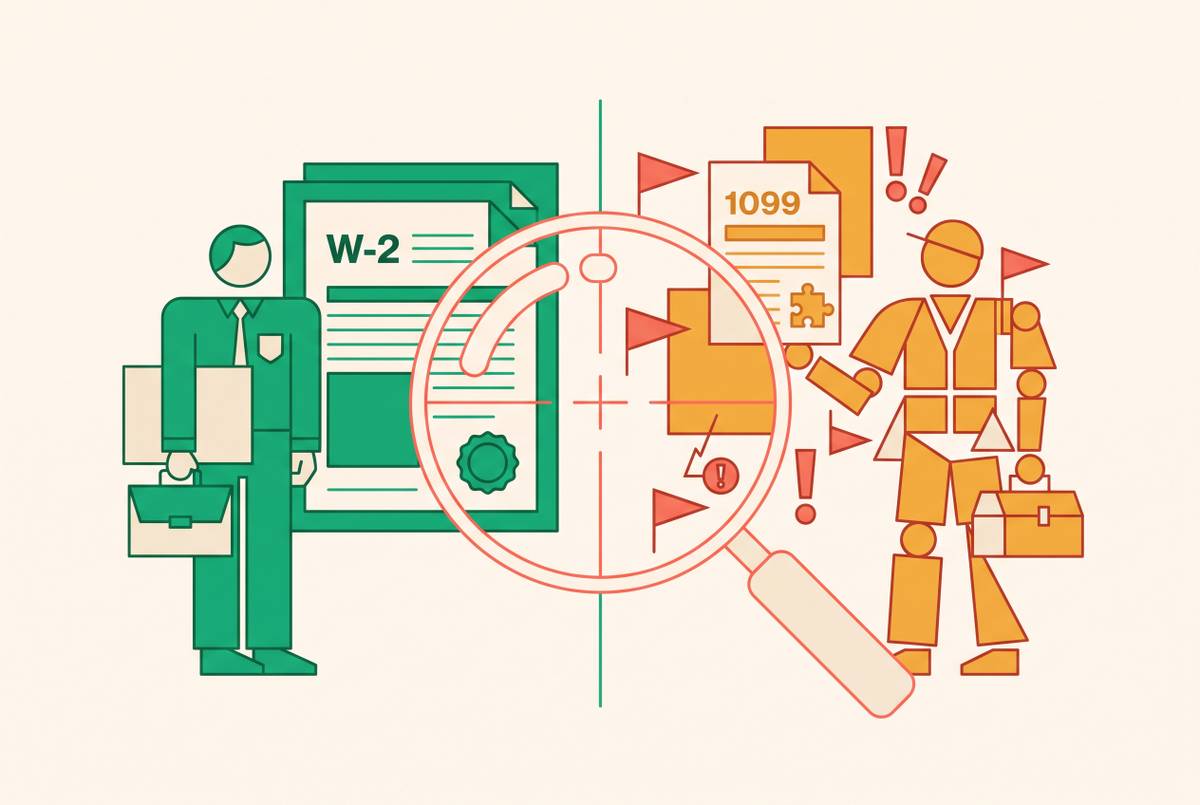
Misclassification runs on a different clock. A deposit penalty compounds through repetition across cycles. A misclassification error compounds through time, silently, without triggering any penalty at all until the day someone finally catches it. At that point the liability isn't for one pay period, it's for every pay period since the misclassified relationship began. The silence isn't safety. It's accrual, and that's the part most operators get backwards.
Once discovery happens, the liability stacks in layers. Back taxes come due on every affected paycheck, going back to day one. Penalties apply to each period's unpaid deposits, calculated individually, as though each were its own separate failure-to-deposit event rather than one long-running mistake. Interest accrues on the full back-tax amount from each original due date, not from the date of discovery. If the misclassified worker was denied overtime under the Fair Labor Standards Act, that's a separate liability stacked on top of the tax exposure, and benefits the worker should have received during the misclassification period can add further exposure depending on plan terms and state law.
The Department of Labor's Wage and Hour Division recovered more than $259 million in back wages for nearly 177,000 workers in fiscal year 2025, an average of about $1,465 per worker. That's what discovery looks like in aggregate. Up close it looks like the 2022 case out of Alabama, where steelworkers won $13.2 million for years of unpaid overtime, built on the same mechanism: a recurring payroll error left uncorrected long enough to accumulate into a courtroom-sized number.
None of this compounds through tiers the way deposit penalties do. It compounds through duration. The longer a misclassification runs before anyone catches it, the larger the base becomes, and every penalty, every interest calculation, every back-wage figure gets computed against that larger base.
How multi-state operations multiply every compounding factor across parallel jurisdictions
Add a second state to the payroll, and every mechanism above stops running once and starts running in parallel. Each state has its own penalty structure, its own deposit schedule, its own withholding rates. A missed state deposit doesn't fold into the federal penalty. It's a wholly separate event, escalating on that state's own ladder, independent of whatever the IRS is doing with the federal side of the same paycheck.
Multi-state taxation errors have been identified as one of the largest single categories of payroll compliance failures. That makes multi-state exposure one of the largest single categories of compliance failure, not the marginal add-on risk most single-state operators treat it as.
The mechanism worth naming here is nexus. A single remote employee, working from a home office in a state the company has never done business in, can establish physical nexus on their own. That triggers the state's registration, withholding, and deposit requirements immediately, often before the employer realizes the threshold's been crossed. Some states also apply economic nexus rules tied to revenue or transaction volume, so a company can become liable in a state it never deliberately entered at all, through sales activity rather than a hire.
From there, the variation multiplies. Income tax rates and the definition of taxable income differ state to state. Unemployment and disability insurance rates and reporting schedules differ too, and local city, county, and municipal taxes add a sub-state layer of filing obligations most single-state operators never have to think about. Multi-state compliance errors carry compounding costs built from the same errors running across several jurisdictions at once rather than one state's penalty schedule alone.
The enforcement environment that removes the margin for error operators assume they have
The federal tax gap for tax year 2022 came to $696 billion gross, with $127 billion of that tied to employment taxes specifically, against an 85.0% voluntary compliance rate. The remaining 15% is exactly what enforcement exists to recover, and operators who assume a human reviews the account before a penalty lands have the mechanics backwards.
Assessment doesn't require an audit. Penalties get applied administratively the moment a filing is late or a deposit is missed, without an examiner ever looking at the account by hand. Many employers find out about a penalty only when the notice shows up, and by then the 15% post-notice tier may already be in play, because the clock started at the original due date, not at the moment of discovery.
The enforcement landscape has also gotten messier in ways that add exposure without adding clarity. The IRS flagged AI-enabled impersonation scams on its 2026 "Dirty Dozen" list, and employers who fail to distinguish fraudulent notices from legitimate ones risk compounding their exposure. W-2 and Social Security number theft schemes that impersonate executives remain active, and a compromised payroll data set can create overlapping legal and compliance exposure from the same incident.
None of this runs through a single agency, either. The Labor Department's Wage and Hour Division operates its own enforcement track, entirely separate from anything the IRS does, and its fiscal year 2025 recovery of more than $259 million in back wages shows that track working independently. A single payroll error, misclassification especially, can draw attention from both agencies at once. On top of that, a Government Accountability Office report flagged increased complexity and improper payment risks tied to the Employee Retention Credit, adding yet another layer of potential exposure on top of everything else.
What the fully loaded cost of a compounded payroll penalty actually looks like
Before any penalty gets assessed, correcting a single payroll error costs an average of $291, according to EY research covering staff time, rework, and the communication needed to explain the mistake to an affected employee. That's the floor, not the ceiling. The penalty stacks on top of it.
The number moves with the size of the operation. Small and mid-size businesses average closer to $180 per error in correction cost, while enterprise environments with more complicated payroll rules average around $390. Scale doesn't shrink the problem, it pushes correction costs up in the same direction it pushes penalty exposure.
Zoom out to the national level: businesses paid $2.8 billion in payroll penalties in 2024 for incorrect or missed employee payments. That figure excludes interest, correction labor, and legal fees. It also excludes what happens to the workforce once trust in payroll breaks. One in three employees has quit a job over payroll problems at some point, and many more begin considering leaving after repeated errors. Replacing a departed employee costs real money, and it adds to the total liability of the original mistake even though no line item on any IRS notice will ever reflect it. The penalty is the most visible cost here. It's also the smallest piece of the structure.
How automated payroll systems interrupt the compounding cycle at its earliest points
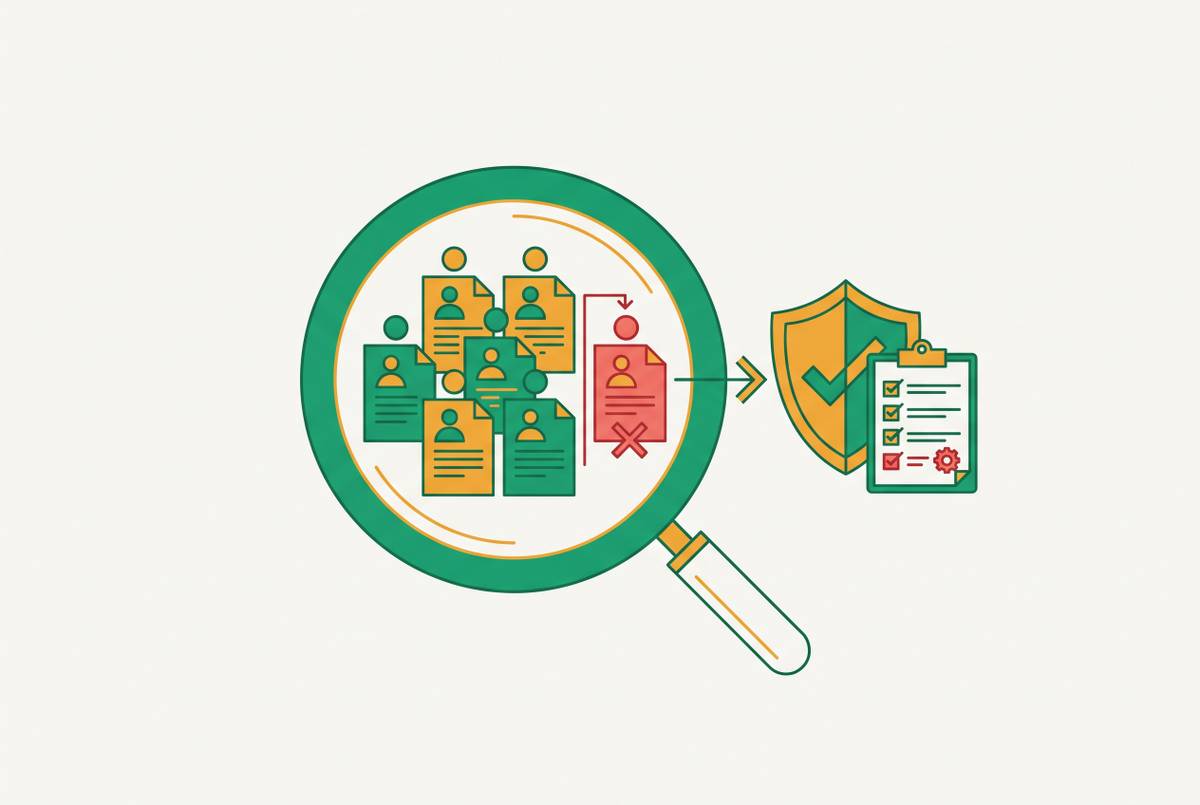
The compounding sequence described above has identifiable starting points: the deposit due date, the calculation step, the jurisdiction identification step, the filing submission. Automation that removes manual handling from each of those points interrupts the chain before the first penalty tier ever applies. That's the case for automating early, not for automating after the first notice arrives, and the two are not the same strategy dressed up differently. One prevents the liability. The other just responds to it faster.
Organizations using AI for payroll tax filing close quarterly 941 and 944 filings in an average of 4.1 hours, against 22.4 hours under manual processing, an 82% cut in cycle time that shrinks the window in which a late filing can happen at all. Separate 2025 research from ADP's research arm found that AI-driven payroll tax filing automation cuts payroll tax errors by 80% to 94% compared with manual filing, with multi-state employers seeing the largest drop, since that's where manual processes fail most often. Research into AI payroll tax automation deployments has found meaningful reductions in compliance penalty rates within the first 18 months of adoption.
What's actually happening at each break point is mechanical, not magic. Tax liability data gets pulled straight from payroll calculations instead of being exported and re-entered by hand, removing the transposition step where a lot of small errors originate. Withholding amounts get checked against current rate tables in real time, catching a calculation error before the deposit goes out rather than after. Jurisdiction changes get flagged as they happen, addressing the nexus problem before the first missed deposit in a new state rather than after the state notices a company operating there unregistered. Filings submit through agency APIs directly, without manual rekeying, cutting out the timing and transposition mistakes that generate most deposit penalties in the first place.
Vendors are building toward this from different angles. Established HR and payroll vendors have been expanding AI capabilities across their product lines, adding tools aimed at labor allocation and payroll compliance support. Separately, AI-native platforms built specifically for scaling companies are going further, combining payroll, compliance, benefits, and IT management under one system where AI agents handle entire workflows end to end: opening state tax accounts, resolving compliance notices, running multi-state payroll across all 50 states, removing the human-in-the-loop steps where most deposit and filing errors actually start.
Adoption is still catching up to the technology. Broader AI adoption among accounting firms rose from 9% in 2024 to 41% in 2025, a sharp jump by any measure, but it also means most employers are still running manual or rules-only payroll today, carrying the full weight of the compounding risk described above.
What operators should do now to stop a compounding liability before it grows
The highest-leverage move is also the earliest one, and it isn't buying software. Stopping the deposit penalty clock means catching the error before the original due date, not correcting it faster after an IRS notice arrives. Audit cadence matters more than how fast a company can fix a mistake once it's found, and any plan that jumps straight to remediation speed is solving the wrong half of the problem.
Only 29% of companies audit their payroll processes on a regular basis. That's the gap to close first, before anything involving new vendors or new systems. A pre-cycle review, run consistently, catches the deposit-schedule and calculation errors that make up 73% of assessed penalties, long before those errors repeat across multiple cycles or drift into a multi-state nexus problem nobody's tracking. Waiting for a notice to trigger the correction means paying at the highest tier, on the largest base, with the longest interest run already attached. Catching it before the due date means none of that compounding ever gets the chance to start.
Sources
- Payroll Compliance: See the 11 Key Tips for Avoiding Costly Penalties
- AI Payroll Tax Filing Automation Statistics 2026: Adoption, Accuracy, and Cost Data
- Payroll compliance risks leaders can’t ignore
- Payroll Compliance: Top 6 Issues and Solutions for 2025 | Lift HCM
- Payroll Compliance in 2025: Payroll Regulations and Compliance Checklist | Paycom
- Payroll Tax Penalties: What Triggers Them, What They Cost, and How to Avoid Them
- Payroll Error Benchmarks 2025. 18 Metrics on Rates, Costs and Fixes