Payroll Compliance Risks During Rapid Headcount Growth
Scaling payroll across states multiplies compliance obligations exponentially, not linearly.
Rapid headcount growth doesn't just mean more payroll runs. It means new states, new tax jurisdictions, new worker classifications, and new deposit deadlines, all arriving at once, and none of them scale the way most operators assume they do. Most founders and finance leads carry a simple mental model: more employees means bigger payroll runs, same basic rules. That model is wrong, and it breaks the moment a company crosses state lines, headcount thresholds, or classification boundaries. It breaks hardest exactly when hiring velocity is highest, which is exactly when nobody has time to notice.
A single remote hire in a new state can trigger a state withholding account, an unemployment insurance registration, a local tax obligation, and a paid leave contribution, all at once. Cross a headcount threshold and a company activates entirely new categories of obligation: employer health taxes in some states, workers' comp tier changes, accelerated remittance schedules. None of this stacks in a straight line. It multiplies across dimensions at the same time, and the infrastructure that covered a 50-person company is often structurally unfit for the same company at 150. The rest of this piece maps where that risk actually lives, and what it costs when it's missed. The wrong assumption to make here is that a bigger payroll team fixes this. It doesn't, because the problem isn't headcount on the compliance side, it's architecture, and no amount of hiring more people to watch spreadsheets solves an architecture problem.
The baseline penalty exposure companies are already absorbing before they scale
Before any hiring sprint begins, the baseline cost of payroll error is already high. Businesses paid $2.8 billion in payroll penalties in 2024 for incorrect or missed employee payments. The aggregate number matters less than the per-incident mechanics, because that's what an operator actually plans around.
EY research puts the average cost to correct a single payroll error at $291, covering reprocessing, reconciliation, and the admin hours spent chasing it down. That figure has nothing to do with penalties, litigation, or the employee who quits over it. It's just the cost of fixing the mistake. And these mistakes aren't rare: 1 in 5 payrolls contain an error, which makes this a systemic feature of how payroll runs today, not an occasional slip.
The IRS layers its own penalty structure on top of that correction cost. Deposit errors start at 2% for deposits one to five days late and climb to 15% once the IRS has issued a notice, per Publication 15. W-2 and 1099 information-return penalties run up to $330 per form for 2025.
Then there's the time nobody bills for. Companies spend an average of 91 hours a year handling compliance issues and another 29 hours resolving related litigation. That's 120 hours that could have gone toward something the business actually wants to build, and it's the steady-state cost, the amount a company absorbs before it adds a single new hire. Scaling doesn't just add volume on top of that baseline. It multiplies both the surface area for error and the penalty exposure sitting behind it.
How multi-state hiring turns each new employee into a compliance event
Hire someone in a state the company hasn't operated in before, and that one hire creates obligations that take weeks to work through, obligations most employers don't even realize exist until they're already behind on them. That's the nexus trigger, and it fires per new state, every time.
Each new state means a state income tax withholding account to register, an unemployment insurance account to set up, potentially a city or county tax layer, and in a growing number of states, a paid leave program that requires its own contributions and filings. None of these move fast. Registration alone can take weeks, and payroll doesn't wait for paperwork to clear.
The regulatory floor keeps moving under all of this. California, Washington, Maine, and Michigan, among others, expanded paid leave programs with payroll implications in 2025. Michigan's Earned Sick Time Act took effect February 21, 2025, replacing the prior Paid Medical Leave Act. Minnesota's contribution requirement starts January 1, 2026, but filings are already required ahead of that date. Pay transparency law is expanding too, with California, Colorado, Washington, New York, Massachusetts, and Illinois already requiring salary disclosure, and Oregon's SB 906 taking effect January 1, 2026. Layer on top of that the Social Security wage base moving from $168,600 in 2024 to $176,100 in 2025, a shift that touches employer and employee contributions in every state at once.
A company hiring into five new states in a single quarter isn't running one payroll process with five extra line items. It's running five separate jurisdictional compliance programs in parallel, each with its own filing calendar, its own registration lag, and its own penalty schedule, and none of those calendars line up. Anyone who tells you this is a matter of "just adding a state to the system" has never had to register for unemployment insurance in a state with a six-week backlog.
Worker misclassification risk grows with every contractor and hybrid-role hire
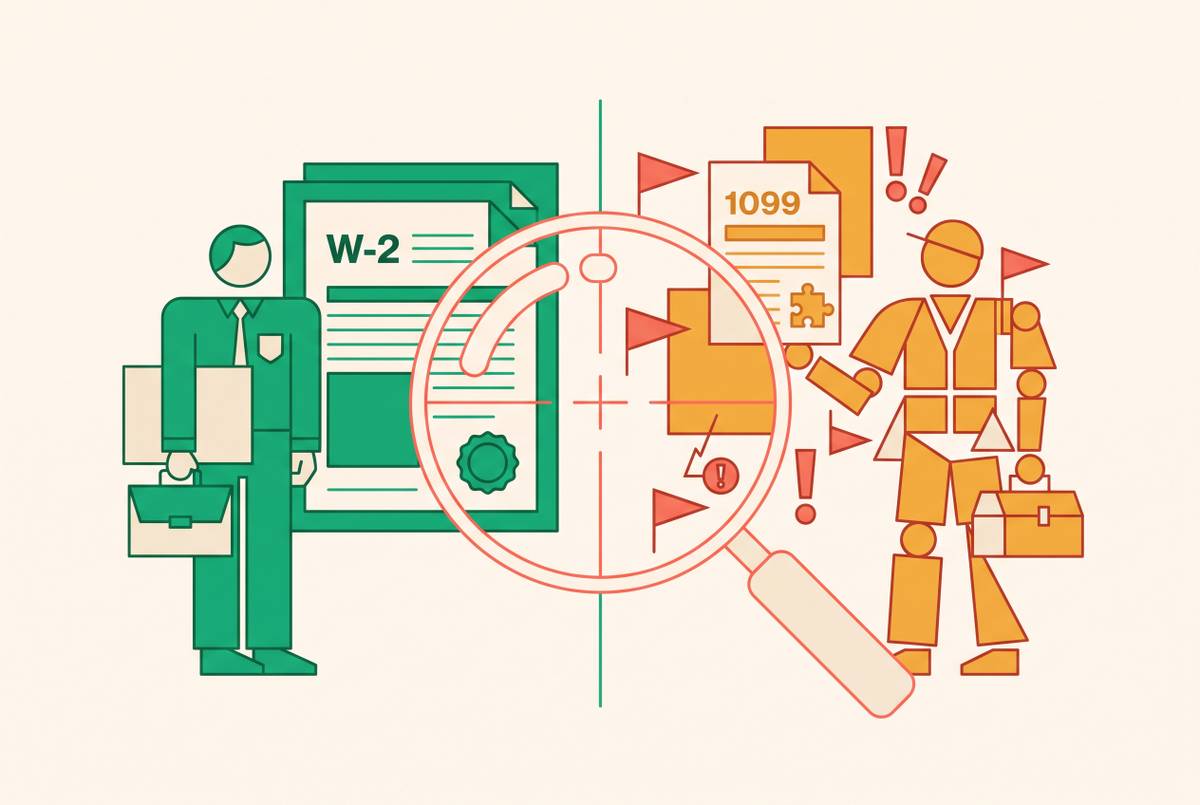
Somewhere between 10% and 30% of employers may be misclassifying at least some portion of their workforce, which makes this one of the most common wage-and-hour failures in the country. Rapid hiring doesn't fix that problem, it makes it worse. State it plainly: the classification call made under hiring pressure is usually the one that gets challenged later, and the challenge tends to land long after the person making the original call has moved to a different project.
High-growth companies mix full-time employees, part-timers, contractors, and project-based hires in the same hiring cycle, often under time pressure. Classification calls made quickly during a hiring sprint rarely get revisited once a role shifts or expands, and every new state adds its own classification test on top of whatever federal standard already applies. A contractor hired for a narrow project in January can look, by June, like an employee in every way that matters legally, without anyone updating the paperwork.
Enforcement isn't loosening up. A federal agency's 2024 final rule on the economic reality test is in effect, and audits are expected to climb through 2025 and 2026. Federal enforcement has produced significant recoveries of back wages for misclassified workers in recent years. A single audit covering several misclassified workers can produce six- or seven-figure liability: Colorado ordered one construction company to pay $1 million in fines over misclassification uncovered in 2024.
The exposure doesn't stop at the company, either. The Trust Fund Recovery Penalty can hold individuals personally liable for 100% of unpaid trust fund taxes, meaning a compliance failure doesn't stay contained to the balance sheet. It can follow a specific person, by name, for years. The faster a company hires, the harder it becomes to apply the same classification rigor to hire number 40 as to hire number four, particularly when HR capacity hasn't grown at the same rate as headcount.
Deposit schedule changes and threshold triggers that catch scaling companies by surprise
Companies that grow quickly can find themselves subject to a stricter deposit schedule than the one they started with. Plenty of operators don't notice until they've already missed a deadline, and missing it by even a few days sets off the tiered penalty structure: 2% for one to five days late, climbing through 5% and 10% up to 15% once the IRS sends a notice.
Deposit schedules aren't the only thing that shifts with size. Workers' comp obligations can shift as payroll volume and headcount grow. State-level obligations, employer health tax requirements among them, can activate as a company grows and crosses various state-level thresholds. Additional federal reporting obligations can activate as a company crosses certain headcount thresholds, classifications that are tied to prior-year headcount metrics.
That last detail is the structural trap: these thresholds trigger off trailing metrics, last year's numbers, but the obligations they activate are immediate. A company growing fast is always about a quarter behind its own compliance posture, measuring today's obligations against yesterday's headcount. The only real defense is continuous monitoring of headcount and payroll totals against a threshold map, checked constantly, not reviewed once a year at tax time.
Why manual processes structurally cannot keep pace with this risk surface
At 200 employees spread across a dozen states, the number of jurisdictional rules, filing calendars, threshold monitors, and classification checks that need tracking at the same time exceeds what any single team can hold in working memory. This isn't a knock on the people doing the work. It's arithmetic, and no amount of diligence changes the math.
The data itself works against manual tracking. Forrester research found that 77% of organizations store employee information across multiple HCM databases, drawing on an average of 6.17 separate systems, and 71% cannot effectively share employee data between those platforms. Every manual re-entry is another chance for a number to get typed wrong, a start date to get missed, a state code to get transposed.
HR teams spend as much as 60% of their time managing handoffs between systems, chasing updates, and reconciling records, time that isn't going toward watching for compliance risk in the first place. Only 29% of companies audit their payroll processes on a regular basis, which means most organizations find out something's wrong only after the fact, once penalties have already accrued.
The number that should end the argument for the manual status quo comes from ADP: globally, businesses hit only about a 78% payroll accuracy rate. Nobody would accept a 78% accuracy rate on invoice processing or bank reconciliation. Payroll runs at that level across huge swaths of the market anyway, and somehow, it's treated as normal.
Employees notice, and they leave over it. Per the UKG Workforce Institute's 2024 research, 49% of employees start looking for a new job after just two incorrect pay cycles, and 1 in 3 employees has quit a job outright over payroll problems. For a scaling company, every departure triggered by a payroll mistake costs recruiting spend, onboarding time, and ramp-up, expenses that dwarf the original $291 correction cost many times over.
What automated, jurisdiction-aware payroll infrastructure actually handles differently
The core shift is architectural, not cosmetic. Compliance stops being a periodic manual review and becomes a continuous background function, running all the time rather than checked once a quarter. Threshold monitoring against more than 10,000 tax jurisdictions runs continuously instead of on an annual audit calendar. Deposit schedule reclassification triggers automatically the moment payroll liability crosses the line that changes it. State registration starts the moment a new hire's work location creates nexus, ideally before that person's first paycheck runs, not after. Classification questions get flagged at the point of hire, not discovered months later during an audit.
Most vendors get the pitch wrong here, and it's worth saying directly: the meaningful advance isn't AI that surfaces a suggestion for someone to review later. A dashboard that flags a risk is still a task for a human to finish, on top of everything else that human is already behind on, and a flagged risk sitting in an inbox is functionally identical to no risk detection at all if nobody acts on it in time. What actually changes the risk picture is AI that owns the workflow start to finish: opening a state tax account the moment nexus triggers, resolving a compliance notice before it lands on a finance team's desk, syncing benefits enrollment with payroll deductions automatically, coordinating IT access provisioning with onboarding and offboarding as part of the same system rather than a separate checklist somewhere else.
Industry research projects that by 2030, 45% of organizations will orchestrate AI agents across core business functions. That's a five-year horizon, but the compliance risk compounding inside fast-growing companies right now doesn't wait for 2030. It's already accruing, quarter over quarter.
Consolidation matters as much as automation, and it's the part easiest to underrate. Payroll accuracy and compliance coverage improve when onboarding, payroll, benefits, and IT access run through one coordinated system rather than several disconnected tools stitched together with manual handoffs between them. For companies scaling globally, the risk surface gets wider still: domestic multi-state payroll, contractor payments across dozens of countries, and employer-of-record coverage all need to sit inside the same compliance layer rather than living in separate platforms that don't talk to each other.
The standard worth holding any platform to is simple: does it own the workflow, or does it just generate a task for a person to finish later? Everything else is a variation on that one question, and any vendor who can't answer it directly is selling the dashboard, not the fix.
The practical compliance posture a scaling company should establish before the next hiring sprint
Before the next hiring sprint starts, a handful of specific checks matter more than any general best-practices list. Map current multi-state exposure first: which states already have registered employees, and which states have quietly triggered nexus that's never been formalized. That gap is usually where the first surprise notice comes from.
Audit worker classification before the next batch of contractors or hybrid roles gets onboarded, not after they've been working for six months. Verify the deposit schedule classification against current payroll liability, because the IRS is working off the company's current size, not the smaller company it was a year ago. Identify which headcount or payroll thresholds the next hiring sprint is going to cross, and map out exactly which obligations those thresholds activate before the sprint begins.
Confirm whether the payroll system updates automatically when state paid leave programs change, when wage bases shift, or when new transparency laws take effect. If it doesn't, know exactly who owns that update manually and how fast they can move on it.
The honest question underneath all of this: is the current payroll and compliance setup built for the company's size today, or for the size it was twelve months ago? Catching a nexus problem before the first payroll run in a new state is a registration task, a few forms and a short wait. Catching the same problem after an audit turns it into a multi-quarter remediation project, and the difference between those two outcomes is usually a matter of weeks, not competence. Compliance infrastructure isn't a back-office detail for a company scaling from 50 employees to 500. It's a strategic risk category that compounds with every single hire, and it tends to come due at precisely the moment the business has the least room to deal with it.
Sources
- Payroll Compliance: See the 11 Key Tips for Avoiding Costly Penalties
- What Is the True Cost of Payroll Errors?
- Payroll Compliance Issues 2026: Real Penalty Costs
- Payroll Error Benchmarks 2025. 18 Metrics on Rates, Costs and Fixes
- The Real Cost of Payroll Mistakes for Small Businesses
- Payroll Compliance Challenges Every Growing Business Faces in 2026
- automationanywhere.com