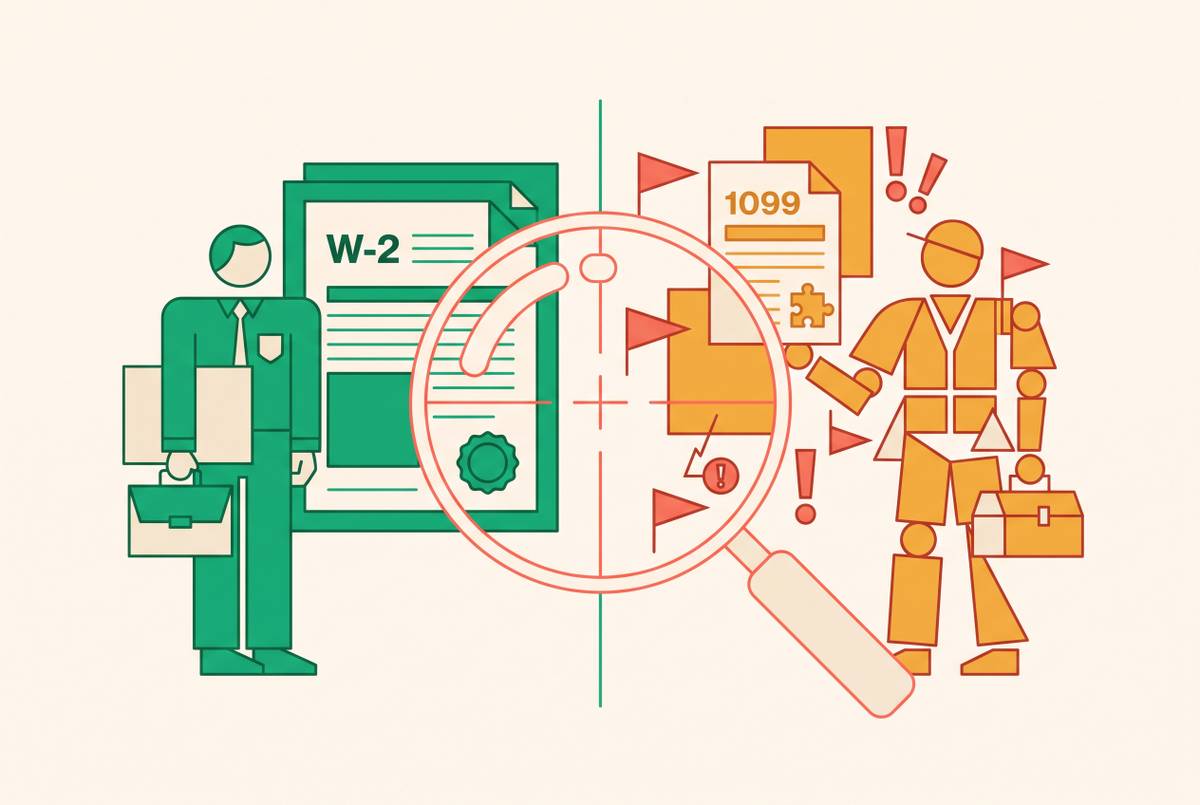
Resolving IRS Payroll Compliance Notices Efficiently
Identify the notice type first, then respond within the deadline.
Every notice carries a reference code, CP136, CP2100, CP215, and that code determines everything that happens next. Read it before doing anything else. Most payroll notices trace back to one of three root problems: a calculation error or missing detail on a filed return, an unpaid balance or missed deposit, or a mismatch between the wages a company reported and what the IRS actually received from third parties.
Before drafting a response, confirm four things: which tax period the notice covers, which specific form or return it references, whether it's purely informational or demands action, and the deadline. Deadlines swing wildly by notice type, and missing one can turn something disputable into something final. Pull the original filing, the 941, the W-2, the 1099, before writing a single word back to the IRS. Responding to the wrong document is a common mistake, and it's an expensive one to unwind.
One more thing worth checking before reacting to anything: the IRS has warned repeatedly about schemes that impersonate executives to steal W-2 and Social Security data, and its 2026 "Dirty Dozen" list flagged synthetically generated phone calls impersonating the agency itself. Real IRS notices arrive by mail, at the address of record. A call or text demanding immediate payment isn't how this agency operates, and treating it as legitimate is how companies get scammed on top of getting audited.
The five notice types operators are most likely to encounter and what each demands
CP2100 and CP2100A, known informally as B-Notices, show up when a filed 1099 has a name and TIN combination that doesn't match IRS records. Payers who filed 50 or more mismatched returns get the CP2100; fewer than 50, and it's a CP2100A. These arrive twice a year, once in September or October and again in April. The response window is tight: send a B-Notice to the affected payee and request updated taxpayer information. If the payee doesn't respond, backup withholding requirements apply. Skip this process, and the penalties run from $60 to $310 per incorrect form, or $630 per form if the IRS decides the disregard was intentional, with no ceiling on the total.
CP215 is a penalty assessment notice tied to payroll compliance failures. The dispute window is narrow from the notice date. It's easy to lose several of those days just getting the notice routed to the right desk.
CP259 is a notice indicating a filing issue for a given period. If it genuinely wasn't filed, file it immediately. If it was filed, the fix is proof: a certified mail receipt, an e-file confirmation, something with a timestamp.
CP2000 flags a mismatch between third-party reported amounts and what appeared on the return, including information returns such as 1099-DA for digital assets. Crypto payroll is becoming a real source of these. If fair market value at the moment of payment wasn't documented, the IRS can assume a zero cost basis, which manufactures the appearance of underreporting out of nothing.
CP504 is the final notice before collection. By the time it arrives, the underlying balance generally isn't disputable anymore without a formal appeal, because it means an earlier notice already went unanswered or unresolved. The right move here is payment in full or a formal installment agreement, not a standard response letter. Companies that draft one anyway are wasting the little time they have left.
Here's where most compliance teams get it wrong: they treat these five as variations on the same problem, answerable with the same template letter. They aren't. Responding to a CP2100 the way you'd respond to a CP259 wastes the narrow window each one gives, and it can activate penalties that a correct, notice-specific response would have avoided entirely. The form of the response has to match the notice type, not the company's internal process for "handling IRS mail."
How penalty escalation works and why the timeline matters more than the dollar amount
Deposit penalties scale with time elapsed, not with whether the IRS thinks the employer meant to be late. A deposit more than 15 days overdue can draw a penalty worth 10% of the amount owed, and failure-to-deposit penalties can climb to 15% on top of accruing interest. None of this requires a human at the IRS to make a judgment call. It's automatic, which means intent is irrelevant and excuses don't slow it down.
Information return penalties are worse in one specific way: they have no cap. At $60 to $310 per form for ordinary errors, and $630 per form for intentional disregard, a batch of mismatched 1099s at any real scale turns into a six- or seven-figure exposure fast.
CP504 marks the point where the case has already been escalating quietly for a while. Each missed or half-answered notice before it pushed the file one step closer to a lien or levy, and once that happens, both the cost and the time to resolve it multiply.
The dollar figure on the notice is not the number that should worry an operator most. The internal scramble a notice triggers, the searching, the re-keying, the routing between departments that don't normally talk to each other, usually costs more than the assessment itself, and it costs it whether or not the company ever writes a check to the IRS. A 10-day CP215 deadline can expire before the notice even clears an internal routing queue, if nobody at the company is named as the owner of compliance mail. The real failure mode is the absence of a person whose job it is to open the envelope on day one instead of day six, apart from any error in the payroll data.
The sequenced response: from receipt to closed file
Assign ownership immediately. Not a department, a named person. Notices sent to "finance" or "HR" as a general inbox routinely sit unread until the deadline is gone. The owner's first job is to log the notice date, the deadline, and the IRS reference number, before anything else happens.
Verify the data before accepting the IRS's version of events. Pull the original 941, W-2, or 1099 and compare it line by line against what the notice claims. Automated matching sometimes surfaces the IRS's own data error, not the employer's, so don't pay or agree to anything until that comparison is done. For a CP2100 or CP2100A, cross-check the payee TINs against W-9s already on file. For a CP2000, reconcile the third-party amounts against internal payroll records directly.
Decide whether to agree, partially agree, or dispute. If the IRS is right, pay it or set up a payment plan, and log the correction in the payroll system so it doesn't recur. If the IRS is partly right, a written explanation with documentation for the disputed portion often reduces the final penalty. If the IRS is wrong, say so in writing, inside the deadline, with every supporting document attached, and keep copies of all of it.
Respond in writing, to the address on the notice, before the deadline. Include the notice number, the tax period, the EIN, a clear statement of the company's position, and full documentation. Send it certified, or by some method that generates a delivery record, because that timestamp is the legal proof of a timely response. For a CP2100, remember the response clock starts from receipt, not when internal review wraps up.
Get resolution in writing, and keep everything. Don't call the matter closed until the IRS confirms it in writing. Retain the original notice, every piece of correspondence, and the closure letter for the full period required by applicable payroll record retention guidance.
Tracing the notice back to its root cause in payroll operations
Most notices, once unpacked, come from a short list of recurring failures, and naming them directly beats treating each new notice as a fresh mystery. Stale or incorrect TIN and name combinations on contractor files are the single most common trigger behind a CP2100. Deposit obligations get missed or miscalculated when headcount or pay structure shifts mid-quarter and nobody updates the deposit schedule to match. Wage base changes, like the jump to $176,100 in 2025, don't always propagate into the withholding tables that generate Form 941, and that gap becomes a mismatch the IRS eventually flags. In a lot of companies, payroll, HR, and benefits simply run on separate systems, so a change entered in one place never reaches the others.
Those are cycle-level mistakes, and by the time they surface as an IRS notice, the error has usually been compounding for a quarter or two already. Growth doesn't make this better. It makes it worse, because the number of chances for a mismatched TIN or a stale withholding table multiplies with every hire, while the internal capacity to catch it rarely grows at the same rate.
After any notice, three questions are worth asking every time, in this order. Was it a data entry mistake, a system configuration problem, or a process gap, like no TIN verification at onboarding? Does the error touch only this period, or is it sitting in prior filings too? And did it come from a manual handoff between systems, payroll to HR, or contractor management to 1099 filing? Crypto payroll adds a newer wrinkle here: paying contractors or employees in digital assets without tracking fair market value at the wallet level, as required under applicable tax guidance. Proc. 2024-28, is a direct path to a CP2000.
What proactive compliance controls prevent most notices from forming in the first place
TIN verification belongs at onboarding, not after the first 1099 gets rejected. Collect the W-9 before the first payment goes out, and run the TIN and name combination through IRS TIN matching before filing. Handled this way, CP2100 notices are almost entirely avoidable, and companies that skip this step are choosing to find out the hard way, twice a year, every year.
Deposit schedules need to track actual payroll liability, not a set-it-and-forget-it calendar. Whether a company deposits semi-weekly or monthly for the coming year depends on total tax liability during the IRS lookback period crossing the applicable threshold, and companies that don't track that threshold are the ones generating the late-deposit penalties in the 10% to 15% range. Automating that scheduling removes the human decision point where the timing gap actually forms.
Annual updates, the wage base, cost-of-living adjustments, and withholding tables, arrive on a known schedule every year from the IRS and from PayrollOrg. Building a compliance calendar around those dates, so system configuration updates automatically rather than reactively, closes off most of the Form 941 mismatches these changes cause.
IRS Notice 2025-69 is worth acting on now rather than later. Voluntarily reporting tip and overtime figures in Box 14 of the 2025 W-2 gets payroll systems ready for the mandatory separate reporting, via new Box 12 codes TP and TT, that becomes required in 2026. Companies that wait will be building that capability under deadline pressure instead of on their own schedule.
The controls matter more than the notice ever will. A stack of mismatched 1099s sitting unaddressed can generate substantial penalty exposure that a W-9 collected at onboarding would have prevented for the cost of a form. Waiting for the notice to force the discipline is the expensive way to learn what the compliance calendar was supposed to teach for free.