Regrettable vs Non-Regrettable Turnover Measurement for Scaling Teams
Distinguishing high-performer exits from routine departures reveals true retention problems.
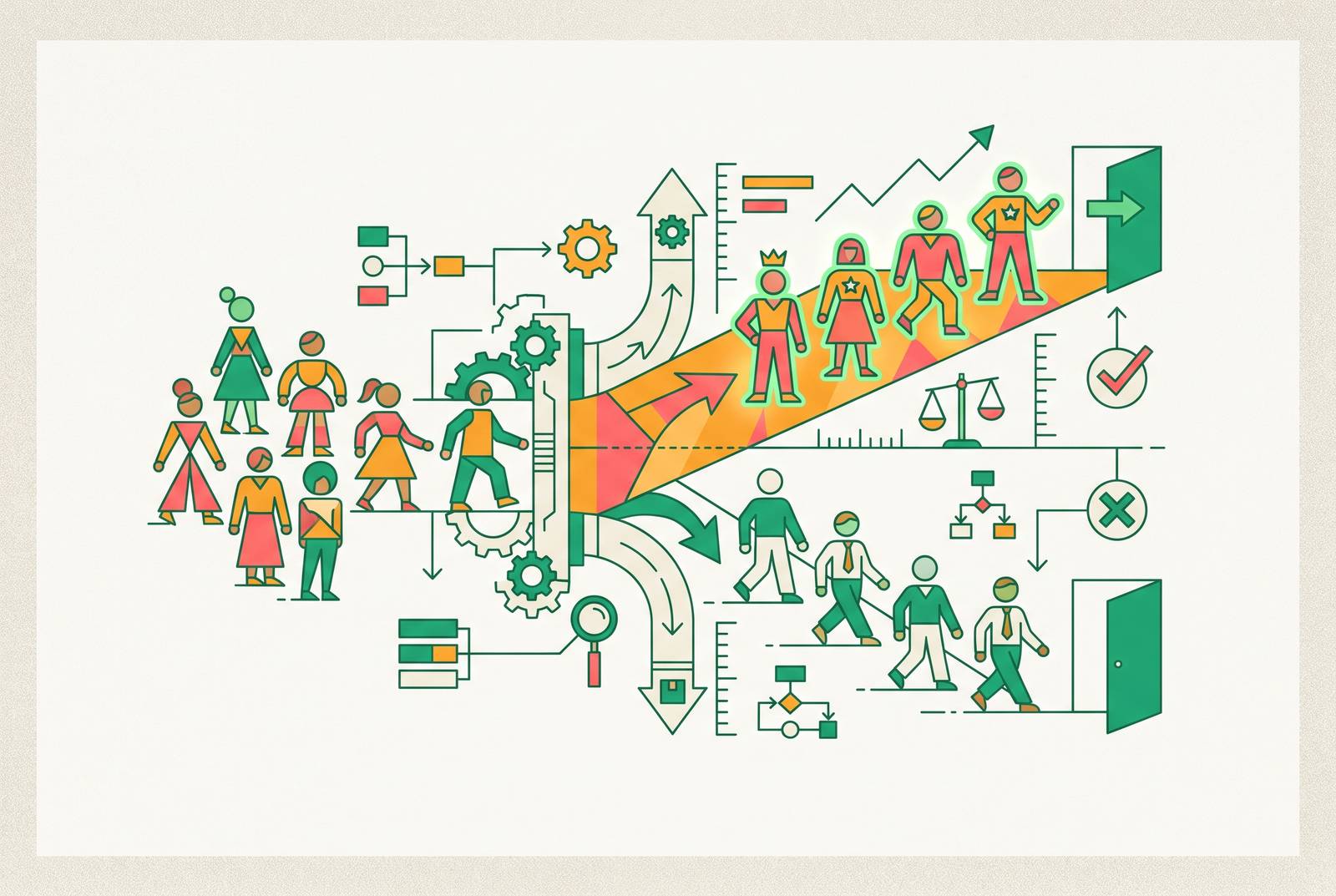
The standard turnover formula is simple: divide separations during a period by average headcount, multiply by 100, and the result is the rate most companies report to their board. That formula is universal, widely adopted across HR functions, and almost useless as a measure of organizational health, because it counts every departure as an identical event. A company loses its best engineer and loses someone who has missed every performance target for a year, and the formula records both exits the same way. Two companies can post the same headline rate and sit in entirely different strategic positions: one is shedding low performers while building bench strength for the next stage of growth, the other is hemorrhaging the people it most needs to retain. SHRM's coverage of research from the Institute for Corporate Productivity makes the point directly: tracking turnover alone isn't enough, and high-performing companies go further to determine the extent to which they might be losing their most valuable employees.
What regrettable and non-regrettable turnover mean
The question that matters is not how many people left but who left and whether the organization wanted to keep them. That distinction, between regrettable and non-regrettable turnover, gives scaling teams a vocabulary for separating noise from signal. Regrettable turnover describes a top performer or an employee in a critical role leaving voluntarily for a reason the organization could have addressed: lack of career growth, friction with leadership, compensation that hasn't kept pace with expanding responsibility, or a culture and policy shift such as a hybrid-to-in-office mandate. 15Five frames the operative phrase precisely: the top performer left, and the company could potentially have avoided it with the right initiative or retention effort. Non-regrettable turnover covers departures the organization doesn't need to prevent, and sometimes benefits from: low performers exiting voluntarily or involuntarily, cultural misalignment, planned retirements, seasonal or temporary employees reaching the end of their term, and new hires who sign an offer letter but never start. These exits can open room for restructuring, bring in fresh talent, or reduce workforce cost, and none of that makes them a failure of retention.
The line between the two categories runs through controllability, not sentiment. A planned retirement after forty years of service represents a genuine loss of institutional knowledge and talent, yet it falls on the non-regrettable side of the ledger because nothing the organization could reasonably do would have changed the outcome. A resignation triggered by a blocked promotion path sits on the opposite side, even if the employee's departure feels, in the moment, less painful than losing a retiring veteran. The question scaling teams need answered is whether the departure was avoidable and whether the person's absence actually hurts the business, and that question has to be asked the same way every time, not reinterpreted case by case after the fact.
Calculating regrettable turnover rate and setting a useful baseline
Regrettable turnover rate uses the same arithmetic as the standard formula, narrowed to a specific numerator: regrettable separations during the period, divided by average headcount during the period, multiplied by 100. A company with a modest average headcount and a small number of regrettable departures in a quarter can end up with a quarterly regrettable turnover rate that looks low in isolation, a number that only means something once it's tracked consistently and annualized correctly. Annualizing requires applying the formula across a full 12-month window, using total annual regrettable separations divided by average annual headcount. Multiplying a monthly or quarterly rate by 12 overstates the real figure and produces a number that looks alarming without being accurate.
Deciding in advance who counts as regrettable is harder than the math. That decision needs explicit criteria set before anyone leaves, not a judgment call made in the exit interview. Two thresholds do most of the work: a performance threshold, where employees rated at or above a defined level such as "exceeds expectations" in their most recent review qualify, and a role-criticality threshold, where employees in positions that take longer than a defined period to backfill also qualify. High-growth companies need HRIS platforms that distinguish between regrettable and non-regrettable exits from the moment they happen, which requires the infrastructure to encode exit criteria upfront. Both thresholds belong in the HRIS as a structured termination-reason field, filled in at the time of separation. Noise has to be filtered out of the numerator just as deliberately: involuntary terminations, rescinded offers, and seasonal or temporary exits don't belong in a regrettable turnover calculation, because they measure something other than avoidable loss of talent the company wanted to keep.
Turnover patterns by quality
Once regrettable exits are tracked separately from everything else, patterns appear that a single headline rate can't show. Those extra fields exist for a specific reason: without them, no-shows and seasonal exits would distort the core regrettable number and make the data harder to trust. Before this taxonomy was in place, leadership, finance, and HR at Brightwheel struggled to build accurate headcount plans because the reasons employees left weren't being captured in a form anyone could analyze.
The change after implementation was immediate and practical. HR business partners could spot regrettable attrition trends by department and by tenure group, and an elevated rate in a specific cohort became a flag that something in that part of the business needed attention, rather than a number buried inside a company-wide average. Finance reported that annual headcount planning, previously dreaded as a guessing exercise, became straightforward once a known regrettable attrition rate could be translated directly into a hiring volume and a budget forecast. Recruiters read the data differently too: a rise in non-regrettable exits pointed to a hiring-criteria problem to fix at the top of the funnel, not a retention failure to solve after the fact. Research from i4cp, covered by SHRM, confirms this isn't an isolated case. High-performing companies measure more than low-performing ones, and the specific metrics that separate the two groups are quality-of-attrition measures: high-performer separation rate, regrettable termination rate, and critical-role turnover. Most teams know they should be measuring this way and still aren't, which leaves a meaningful analytical edge available to the ones that actually close the gap. Early turnover, departures within the first weeks on the job, behaves as a leading indicator rather than a lagging one, a point the onboarding discussion later in this piece builds on directly.
Why regrettable exits compound into cascading organizational damage
The cost of losing a top performer is a cascade that starts with knowledge loss, moves through a measurable decline in team productivity, and ends, if left unaddressed, in morale erosion that makes the next regrettable exit more likely. 15Five documents both ends of this pattern: a leader's departure can leave a team rudderless and disrupt broader business strategy, while an individual contributor's departure can halt a critical project. The near-term damage is usually the knowledge gap and the productivity dip that follows it; the longer-term and more dangerous damage is what happens to the people who stay.
That longer-term damage is what makes regrettable turnover categorically different from an ordinary operating cost. When the employees who should have become culture champions keep walking out the door, the culture available to everyone still on the team erodes a little further with each departure. Teams that have to relearn how to collaborate every time a new hire replaces a departed one become less effective over time, a drag on output that compounds well past the original vacancy. And each regrettable exit raises the odds that another strong performer starts looking elsewhere, a dynamic that accelerates once it gets moving.
Replacement cost is the most visible piece of this equation and also the smallest. It scales with seniority: a frontline role costs less to backfill than a skilled technical role, and a technical role costs less than a manager or a leader. The costs that don't appear on a recruiting invoice, including the workload absorbed by remaining staff during the vacancy, the time it takes a replacement to ramp to full productivity, and the second-order departures the vacancy itself can trigger, together run meaningfully higher than the recruitment spend most finance teams track as the "cost" of the departure.
How onboarding quality drives early regrettable attrition
A large share of regrettable exits are decided before the employee's first performance review even happens. Poor onboarding sets the conditions, and the early departure that follows is one of the cleanest signals of avoidable loss available to a scaling team. Early exits deserve their own category inside the regrettable turnover framework because departures early in the job almost always point to a hiring or onboarding failure. The root cause is different, so the fix has to be different too, and tracking early regrettable exits as their own line lets a team catch an onboarding failure before it hardens into a pattern that shapes the company's reputation among candidates.
HRBench lists weak onboarding as a primary driver of high turnover, and the mechanism is straightforward: new hires who don't get the tools or support they need in the first weeks are disproportionately likely to leave within the first year. An inconsistent, sink-or-swim start raises that likelihood further. Confusion about role expectations and a sense of being undervalued are the two proximate causes, and both sit within the organization's control, making early regrettable attrition a high-leverage place to intervene.
Fragmentation drives most onboarding breakdowns at scaling companies. HR owns the offer letter, IT owns device provisioning, finance owns payroll setup, and benefits enrollment sits somewhere else again, with no single system coordinating all of it. A new hire who shows up without system access, without a configured laptop, or without a first paycheck processed on time receives a clear message that the organization wasn't ready for them, and that message lands during the exact window when the decision to stay or leave is most unsettled. Defining who qualifies as regrettable, by performance threshold, role criticality, and tenure band, has to be encoded in the system itself as structured termination-reason fields rather than left to manager judgment at the moment someone exits. Platforms built to handle complex payroll and compliance workflows, Warp among them, can extend that same rigor to workforce analytics, so the classification happens systematically instead of becoming one more task an HR team has to interpret by hand after the fact.
Infrastructure for acting on regrettable turnover data
Knowing a company's regrettable turnover rate only matters if the systems behind it can explain why the number is moving, and most scaling teams run on infrastructure built to obscure that explanation. HR, payroll, IT, and benefits data typically live in separate tools that don't talk to each other. A termination reason captured by HR, a performance rating stored in a different system, and a department assignment recorded in a third rarely end up in the same place at the same time. Turning a regrettable-exit flag into a decision leadership can act on requires someone to manually extract and reconcile records across all three, and that work, done by hand, rarely happens fast enough to matter.
Brightwheel's experience before it built a unified termination-reason taxonomy illustrates the pattern clearly. Leadership, finance, and HR could not align on headcount plans because the underlying data was never captured in a form anyone could actually use. This same operational problem occurs at every stage of the employee lifecycle, including at exit. Hiring, onboarding, a change of role, and offboarding each require manual coordination across disconnected systems, and that manual coordination is where delays creep in, where errors get made, and where an employee first senses whether the organization has its operational act together. At a handful of employees, that coordination is a scheduling inconvenience. At dozens, it becomes a compliance and retention risk. At hundreds, it turns into a structural ceiling on how fast the company can actually scale, regardless of how good the hiring pipeline or the compensation strategy looks on paper.