Real-Time Payroll Processing vs Batch Payroll Processing
Real-time payroll catches errors early; batch discovers them during a frantic sprint before payday.
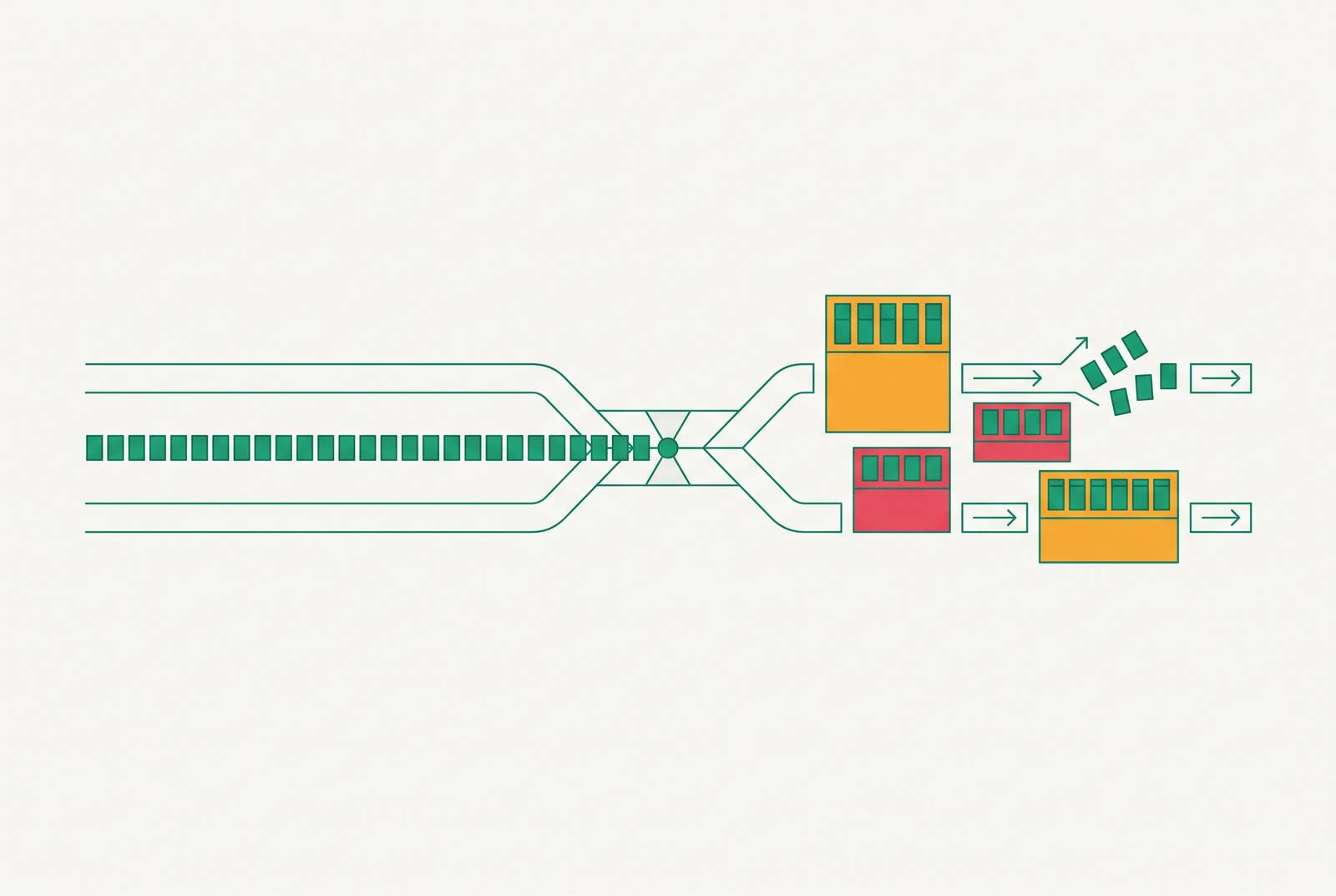
Batch payroll runs its calculations in one concentrated window near the end of a pay cycle, after time, pay, and deduction data has already piled up. Real-time payroll calculates gross-to-net wages continuously, as hours worked, overtime, and pay-rate changes happen. Both are legitimate ways to run payroll, and neither is a relic. But real-time is the better default for most growing companies now, and batch is the exception you choose deliberately, one you actively pick rather than one you inherit because it's already installed.
The central operational difference between the two models: timing of error detection
Batch payroll's weak spot is a timing problem, not a technology problem. Missed punches, overtime discrepancies, and pay exceptions sit undetected until the payroll run starts, which leaves a short, stressful window to catch and fix mistakes before payday lands. Most employee timesheets contain some kind of error. That means those errors sit invisible in the system until the batch window opens, at which point a payroll team is scrambling instead of reviewing.
Real-time payroll pushes the detection point earlier, so labor costs and pay exceptions get watched throughout the pay period instead of getting discovered during one brief processing sprint at the end of it. That changes the actual job. Payroll teams stop firefighting after the fact and start monitoring while there's still time to act. It's calmer work, and it's also just better work: catching an overtime miscode on day three of a pay period costs a phone call, while catching it during the batch run on day fourteen costs a corrected paycheck, an apology, and sometimes a penalty.
The compliance pressure that is making batch payroll's timing assumptions harder to sustain
Governments have stopped waiting weeks for earnings and tax data. Most tax authorities worldwide are moving toward real-time or near-real-time payroll reporting, and the shift is already underway across Europe, APAC, and Latin America, often through digital portals or API integrations that validate submitted data on the spot.
Batch systems were built for a world where a company closed payroll, then reported afterward, on its own schedule. That world is disappearing in much of the globe. When a tax authority receives data continuously and a company's internal system is still bundling everything into one run at the end of the cycle, the two clocks stop matching. Once they stop matching, a discrepancy doesn't get quietly caught and fixed internally anymore. A regulator's dashboard flags it instead, and the company finds out from the outside.
Scenarios where batch payroll still holds up
Batch isn't wrong for every company. It fits a predictable workforce well: salaried employees, fixed compensation, little overtime, headcount that doesn't swing much month to month. In that setting, real-time monitoring doesn't have much to catch that a well-run batch process wouldn't catch anyway.
Batch also carries a lower switching cost, mostly because it's had decades to mature. The tooling is familiar, the integrations already exist, and finance teams know how it behaves day to day. Consolidating everything into a single run reduces system load too, since there's one processing event instead of continuous calculation running in the background all period.
There's a governance case for batch, and it's a real one, not just inertia. A single bounded processing event gives a company a clear, defined moment of record: this is when payroll closed, and this is what it said. Some finance teams genuinely prefer that clean audit line over a system where the numbers are technically shifting all the time. That preference is defensible. It just doesn't hold up once a company operates across enough jurisdictions that the "clean line" stops being clean.
Multi-state and global expansion as a compliance decision in payroll model selection
Multi-state operations in a single country mean dealing with a patchwork of state and local jurisdictions, each with its own rules and reporting demands. California and New York are the difficult end: layered wage rules, strict payment-timing requirements, combined state and city taxation. Massachusetts and Oregon add paid-leave programs, and Massachusetts layers on surtaxes on high earners as well. Washington and New Jersey bring long-term care deductions and rate changes that don't sit still for long.
Most multi-state compliance failures trace back to something almost embarrassingly small: a missing or outdated work-location record. One employee quietly moves to a different state without mentioning it, and a single untracked remote-work move like that typically creates four additional compliance touchpoints that the company now has to address.
In a batch model, a change entered mid-cycle may not hit the calculation until the next processing run. That leaves a gap, sometimes a fairly long one, between the moment the legal obligation exists and the moment payroll actually accounts for it. Compliance exposure lives in that gap, and it grows with every state a company adds.
What AI agents change about payroll processing, beyond faster calculation
The real shift with AI in payroll is the move from assistance to orchestration. Agentic process automation doesn't wait for someone to ask a question. It watches for signals and acts on them across systems, without a person triggering each step.
Applied to payroll, that means an AI agent can watch continuously for anomalies, flag an overtime discrepancy the moment it appears, apply a regulatory update on its own, and reconcile data across time, attendance, and finance systems, all without a human sitting in the loop for every decision. Organizations running this kind of automation report fewer paycheck corrections, faster pay cycles, and a sharp drop in helpdesk tickets asking "where's my paycheck." A payroll team either spends its week explaining errors after the fact, or it spends its week doing something else.
Sage's HCM Agent, the company's first AI agent built for HR and payroll work, shows what this looks like in practice: it handles payroll preparation, validation, and reconciliation, flags compliance risk as it comes up, and cuts down how much manual intervention a payroll team needs just to get a normal cycle out the door.
The operational cost of staying on manual or batch-heavy payroll as a company scales
A single manual data entry task performed by an HR professional runs about $4.86, up from $4.78 in 2023. Without AI-assisted search, just looking up an employee's information costs an estimated $11.75. Manual payroll processing runs roughly $15 per hour to process, against about $2 per hour when the process is automated, and that gap doesn't stay flat. It compounds with every new hire, so the cost of staying manual gets worse exactly when the company can least afford it.
HR professionals report spending as much as 60% of their time on handoffs, chasing down updates, and reconciling employee records across disconnected systems, time that doesn't scale no matter how good the team is. A lot of the real cost appears elsewhere, not on a payroll line item. Finance stays late reconciling differences that shouldn't exist. HR answers the same net-pay question from five employees in one week. Sales hesitates to commit to a new market because nobody's confident payroll can support it. Engineering gets pulled off product work to build one-off gross-to-net workarounds that should never have needed building.
Evaluating which payroll model fits a company's current growth stage and trajectory
Match the model to the operational profile the business will actually have in 12 to 18 months, focusing on that future state rather than the one it has today. Payroll decisions sized for current headcount tend to age badly the moment growth accelerates.
A few signals suggest batch is creating risk instead of stability: rapid headcount growth with variable or hourly pay, employees spread across multiple states or international contractors, compliance notices arriving after payroll has already closed instead of before, and finance time increasingly eaten by reconciliation instead of actual analysis. Operating in, or expanding into, a jurisdiction with real-time reporting mandates belongs on that list too, and it's often the one that forces the decision.
Batch still serves a business well on the other side of that line: a workforce that stays mostly salaried with low pay variance, jurisdictions that stay few and stable, and processing errors rare enough to get caught inside the existing window without drama.
Real-time payroll only delivers on its promise when time and attendance, payroll calculation, and compliance monitoring all run on the same platform. A fragmented stack, where those three pieces live in separate systems that don't talk to each other cleanly, limits what either model can do, no matter which one a company picks.