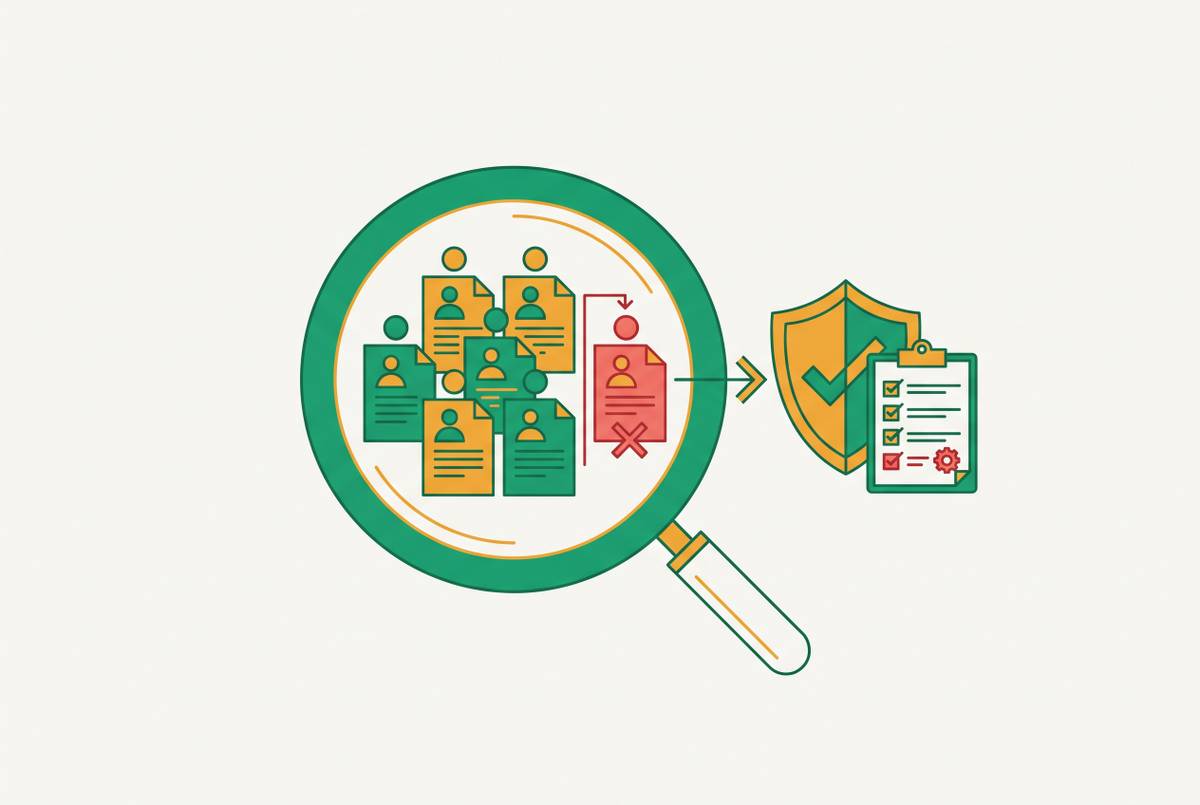
Payroll Reconciliation Process for High-Growth Companies
Unreconciled payroll costs 2-5% annually and compounds fast.
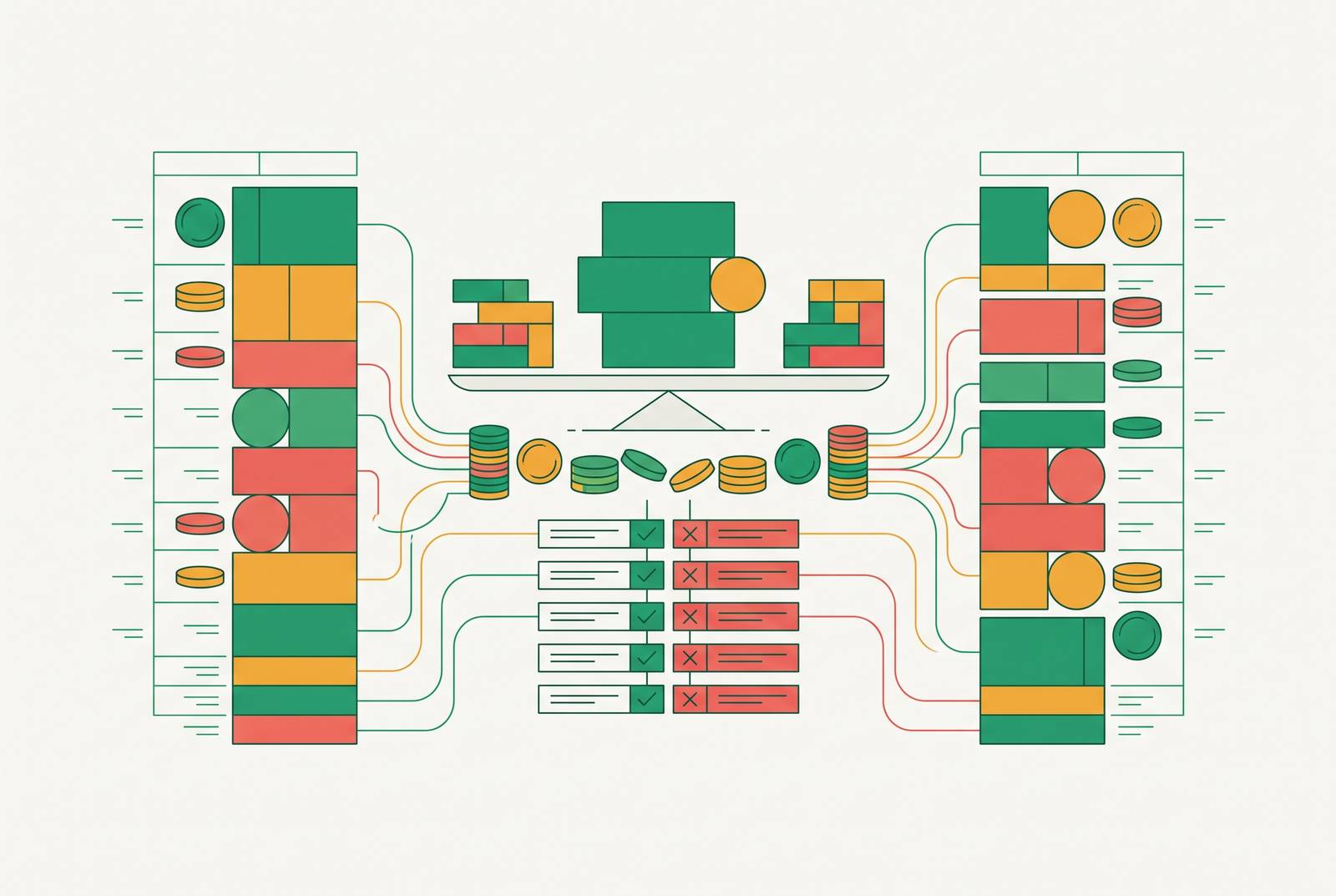
Payroll reconciliation breaks at scale not because the people running it get sloppy, but because the process itself was built for a world of stable headcount and one admin who knew every exception by heart. That world doesn't exist once a company starts hiring across states and time zones every week. This piece lays out where reconciliation actually fails at high-growth companies, what a process that scales looks like, and what to consolidate before compliance debt piles up faster than anyone can track it.
What unreconciled payroll costs at scale
EY put the average cost of correcting a single payroll error at $291 in 2022, and found organizations run roughly 15 corrections per pay period on average. Run that math across a year and the number stops looking like a rounding error. For a 1,000-employee organization, the cumulative cost of correcting errors can reach $922,131 annually, and that's before penalties, legal fees, or the cost of losing someone over a paycheck mistake even enter the picture.
Payroll errors eat up 2% to 5% of total annual payroll spend for the average organization. That's not an occasional bad quarter. That's a permanent drain sitting inside the budget every year, quietly, whether anyone notices it or not.
Then there's the IRS. Publication 15 lays out the penalty schedule for late deposits: 2% for deposits one to five days late, 5% for six to fifteen days late, 10% for sixteen or more days late, and 15% once an amount stays unpaid ten or more days after an IRS notice arrives. Across the country, businesses pay a combined $4.5 billion a year in these penalties. That figure alone says reconciliation failure isn't some rare misstep. It's closer to a tax that bad process pays on itself, year after year, industry-wide.
The employee cost is harder to put a dollar figure on but just as real. Roughly 49% of employees start job searching after just two payroll errors. Replacing that person costs somewhere between a substantial fraction and roughly double their annual salary. So the math on "good enough" reconciliation doesn't hold past a certain size. These costs accumulate across pay periods rather than appearing as one bad month. They build quietly, pay period after pay period, until a growing company's payroll function is effectively funding its own dysfunction.
The specific points where reconciliation breaks at high-growth companies
Data fragmentation causes most of this. Separate research found that Many organizations store employee data across multiple HCM databases, and a large share report they can't share data effectively between those platforms. Every time someone re-types a number from one system into another, that's a fresh chance for reconciliation to fail later.
Time and attendance is a major upstream source of trouble: time-tracking and data-entry mistakes are a recurring problem, happening repeatedly across the employee population. No amount of careful review downstream fixes an error that got baked in at the clock.
Multi-state hiring compounds the problem fast. Every new state hire triggers a new nexus: registration, withholding rules, local tax layers, unemployment insurance rates, filing deadlines, the whole set. Multi-state payroll errors climbed sharply in recent years, largely because of remote work, and Fixing non-compliance after the fact consistently costs far more than handling it proactively would have. A company hiring across new geographies is adding compliance surface area with every single offer letter it sends.
Contractor growth adds another layer on top. Global contractor hires have grown substantially as companies lean into more flexible hiring models, and each one of those contractors is a separate classification question, a separate payment rail, a separate reporting obligation that manual reconciliation has to absorb somehow.
Benefits add their own quiet mess: deduction errors, mid-cycle enrollment changes, life-event updates that don't flow automatically into the payroll calculation. None of these appear with any noise. They just pile up invisibly until someone runs reconciliation and finds the gap.
A coordination tax produces all of it. HR professionals spend a large portion of their time managing handoffs and reconciling data between systems that don't talk to each other. None of these failure points get solved by asking someone to check more carefully. They get solved by changing the architecture that produces the checking.
What a scalable reconciliation process looks like
Reconciliation can't be something that happens at the end of a pay period when the inputs feeding it change every single day. It has to move upstream, and it has to run continuously instead of on a schedule.
The difference between continuous and periodic reconciliation comes down to timing. Periodic reconciliation catches an error after payroll has already run, after money has already moved, and after the correction has to happen off-cycle at extra cost. Continuous reconciliation checks every input the moment it enters the system: a new hire, a termination, an hours update, a benefit election, a change in work state. Catch it there, and it never becomes a costly correction later.
None of that works without a single source of truth for employee data, one record that HR, payroll, benefits, and IT all read from directly. That single change removes the re-entry problem that EY flagged as the most common source of payroll error in the first place.
Automated variance detection matters just as much: flagging unusual overtime, missing withholding data, a pay rate change with no approver attached, a new-state employee whose state account was never registered, all before payroll actually runs, not after. Multi-jurisdiction logic needs to be built into the system itself rather than bolted on with a spreadsheet somebody updates when they remember to. A new remote hire in a new state shouldn't trigger a manual research task; the system should already know what that state requires.
Reconciliation against the prior period deserves a permanent spot in the process too. Checking individual transactions catches individual mistakes, but it misses the slower drift: gradual headcount cost creep, rate changes that add up, benefit cost shifts nobody flagged. Comparing period over period catches that kind of drift before it becomes a pattern.
If reconciliation eats up more than 30% of the payroll cycle, the software isn't the problem. The data feeding it is. Fix that layer first, or any new system will just inherit the same mess.
Offboarding deserves the same structure as onboarding, not less. Final pay calculations, benefits terminations, equity cliff adjustments, and state-specific final pay deadlines all create reconciliation exposure on their own, and treating offboarding as an afterthought is how a lot of avoidable errors sneak through.
How multi-state and global complexity changes the reconciliation calculus
Nexus doesn't wait for a company to notice it. A remote employee establishes payroll nexus in whatever state they actually work from, regardless of where the company's headquarters sits. A fast-growing company can end up with compliance obligations in a state it never formally set foot in, simply because someone accepted an offer and moved there.
Every new jurisdiction adds its own layer to reconcile against. State income tax withholding rates and definitions differ from state to state. Unemployment insurance rates and wage bases vary. Some cities and counties layer their own local taxes on top. Reciprocal agreements between certain states, Ohio and Indiana, for instance, or Ohio and Kentucky, Michigan, Pennsylvania, and West Virginia, determine which state actually gets the withholding, and getting that wrong is its own reconciliation problem. On top of all that, pay transparency laws are now active in 15 states in the country. states and more than 20 local jurisdictions as of 2025, adding a compliance layer that reconciliation now has to track alongside tax and benefits.
Global contractor payments run on a parallel track with their own headaches: currency, local tax treatment, classification rules, and reporting requirements that differ by country. Managing multiple vendors is consistently cited as one of the top payroll challenges when organizations run different providers across different countries. When every country runs through a different provider with its own data formats and its own update schedule, producing one consistent report across all of them becomes nearly impossible without something tying it together.
The regulatory picture in Asia-Pacific illustrates just how heavy this gets. ADP's Potential of Payroll 2026 research found that 80% of payroll leaders in the region say keeping up with local regulation is difficult, and a large share report hitting compliance penalties at least once or twice a year. A company paying employees across several states in the country. states and contractors across several countries needs reconciliation logic that handles all of it in one pass. Running a separate process per jurisdiction just recreates the same coordination tax, at a much bigger scale.
Where automation and AI agents change what reconciliation can do
AI chatbots and query agents are projected to handle 60% to 70% of payroll-related questions by 2025. That's real progress, but it doesn't touch who actually owns the reconciliation decision. A flag still needs a human to act on it, which means the workload shrinks without the underlying bottleneck disappearing.
The distinction here is between AI that surfaces an exception and AI that resolves it. The first speeds up reconciliation. The second removes the manual step from the process entirely, which is a very different outcome.
A few production deployments show what that second category looks like. One vendor's payroll agent, announced in September 2025, automates payroll tasks and claims to enable compliance checks up to four times faster, with a related audit agent saving early customers up to 900 hours a year by automating the collection of audit evidence. Another vendor announced in April 2026 that it's expanding AI across HR and payroll workflows, including an agent built to support workforce management, labor allocation, and payroll compliance together. A separate partnership has built more than 100 prebuilt AI agents covering payroll, benefits, compliance, and HR, reachable directly from Slack, Microsoft Teams, or Google Chat.
IDC forecasts that by 2030, 45% of organizations will run AI agents across their core business functions, not just payroll. Reconciliation automation is one piece of a much bigger architectural shift happening across the business, not a feature unique to payroll software.
That said, an MIT study found that despite billions of dollars spent on AI tools, only 5% of organizations actually saw a return on that spending. The gap sits between AI that assists a human and AI that owns the workflow. Bolting an AI feature onto a fragmented reconciliation process doesn't fix the fragmentation. It just adds a faster way to notice the same mess.
What real agent ownership looks like in reconciliation: opening a new state tax account automatically the moment a nexus gets triggered, resolving a compliance notice without routing it to a person first, catching and fixing a withholding discrepancy before payroll ever runs. The goal is that these issues never land on a finance or HR person's desk in the first place. SHRM found AI adoption in HR functions climbed to 43% of organizations in 2025, up from 26% the year before. The infrastructure is getting built quickly. The open question is whether it's getting built in a way that actually connects reconciliation inputs to outputs, or whether it's just one more system that now needs reconciling against everything else.
Building the reconciliation stack: what to consolidate and what to watch for
When payroll, HR data, benefits, time and attendance, and IT provisioning all live in separate systems, reconciliation stays permanently manual by design. Every integration point between those systems is a seam where data can quietly drift apart.
A genuinely unified platform changes what's possible in a few concrete ways. Payroll reads from one employee record directly, with no re-entry and no import errors along the way. Benefits enrollment changes flow into payroll deductions automatically and get reconciled before the next cycle runs. Onboarding and offboarding trigger payroll setup and termination steps on their own, without a separate HR ticket sitting in someone's queue. Multi-state compliance logic applies the moment a new hire's work location gets entered, rather than getting discovered months later at year-end.
A few warning signs suggest the current stack won't hold. Reconciliation eating more than 30% of the payroll cycle is one. State registrations getting opened reactively, after payroll has already run in a jurisdiction the company just started operating in, is another. So is reconciling benefits and payroll deductions as two separate exercises instead of from one shared source, or routing contractor payments outside the main payroll system with no unified report covering both populations. Needing to pull data from several disconnected systems just to prepare W-2s at year-end is as clear a sign as any that the architecture is behind the headcount.
Evaluating a platform against this problem means asking specific questions. Does it process payroll across all 50 states with built-in tax account management, rather than requiring manual registration state by state? Does it handle global contractor payments with real local compliance logic, not just currency conversion slapped on top? Does it catch variance before payroll runs, or only report on it afterward? Can it reconstruct any pay period's full calculation from raw inputs, the kind of audit trail that actually matters when a compliance notice arrives? And do its AI agents resolve exceptions on their own, or just flag them for someone else to handle?
A unified, AI-native platform, one built to process payroll across all 50 states, cover global contractor payments, and track thousands of tax jurisdictions automatically, handles a reconciliation surface area that grows alongside headcount instead of fighting against it. That's the architecture high-growth companies need in place before compliance debt has a chance to compound. The decision to consolidate isn't just an operational cleanup exercise. It's strategic: every manual reconciliation step that survives a platform migration becomes a ceiling on how fast the company can add people without adding payroll staff just to keep up.
The reconciliation practices that hold at 50 employees, 200 employees, and beyond
Reconciliation doesn't follow one script at every company size, but the architectural choices made early determine whether the process survives the next stage of growth or collapses under it.
Somewhere between 10 and 50 employees, reconciliation is still manageable by hand, which is exactly why this stage matters so much. Whatever habits and systems take root here tend to stick. The priority is establishing one single source of truth for employee data before headcount multiplies the re-entry problem past the point of catching by eye. The first multi-state hire is the moment to build state registration and withholding logic directly into the platform, not the moment to open a new tab and start a spreadsheet.
Between roughly 50 and 200 employees, benefit complexity, varied pay structures, and a growing multi-state footprint turn manual reconciliation from a manageable task into a recurring emergency. Period-over-period variance review becomes essential here, catching drift in headcount costs, benefit deductions, and tax withholdings before it compounds into something bigger. Contractor headcount is usually growing right alongside full-time headcount at this stage too, and reconciliation needs to cover both populations in the same view rather than treating them as separate problems.
Past 200 employees, and especially heading toward 1,000 or more, manual reconciliation produces exactly the kind of correction-cost picture EY's research points to, numbers approaching the $922,131 mark for organizations of that size. At this scale, the process has to run automated, end to end. Continuous validation takes the place of periodic review entirely: every input gets checked the moment it enters the system, every pre-run check happens automatically, and reconciliation runs as a built-in part of how payroll operates rather than as a step performed on payroll after the fact.