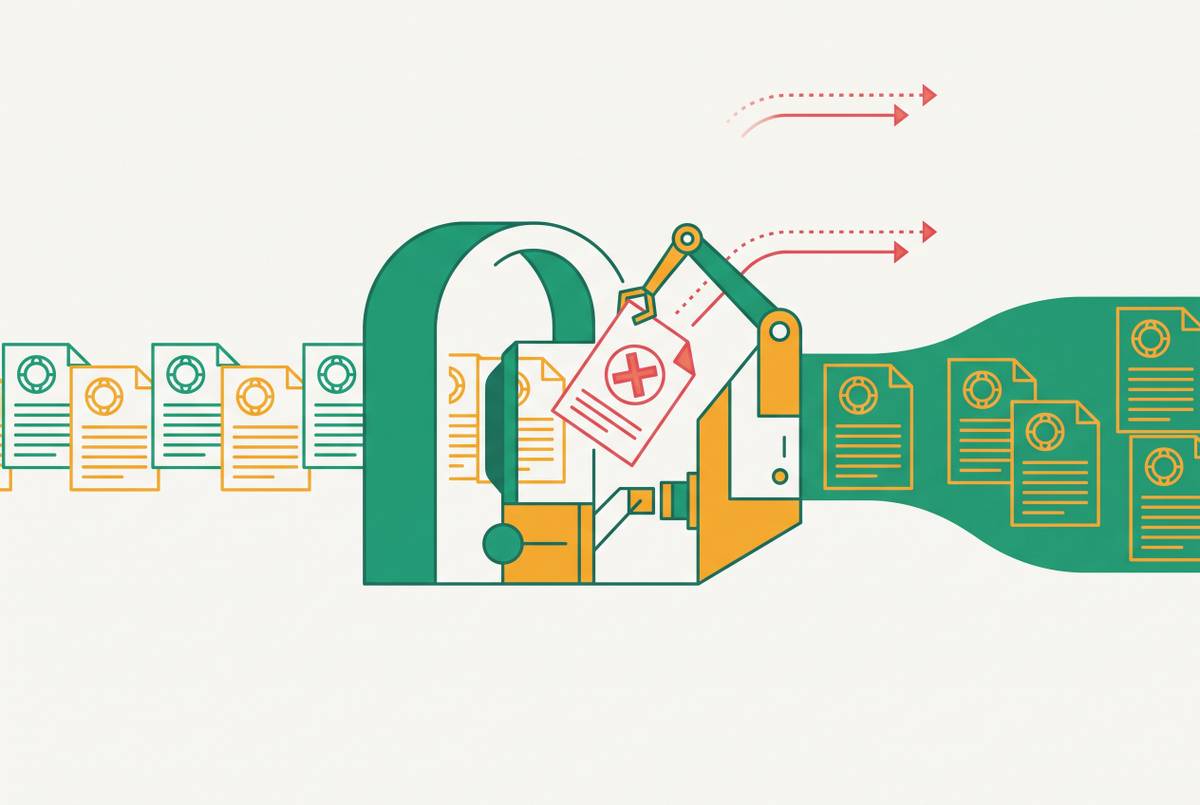
HR Tech Stack Consolidation for Scaling Companies
Fragmentation costs companies thousands in manual work, errors, and compliance penalties.
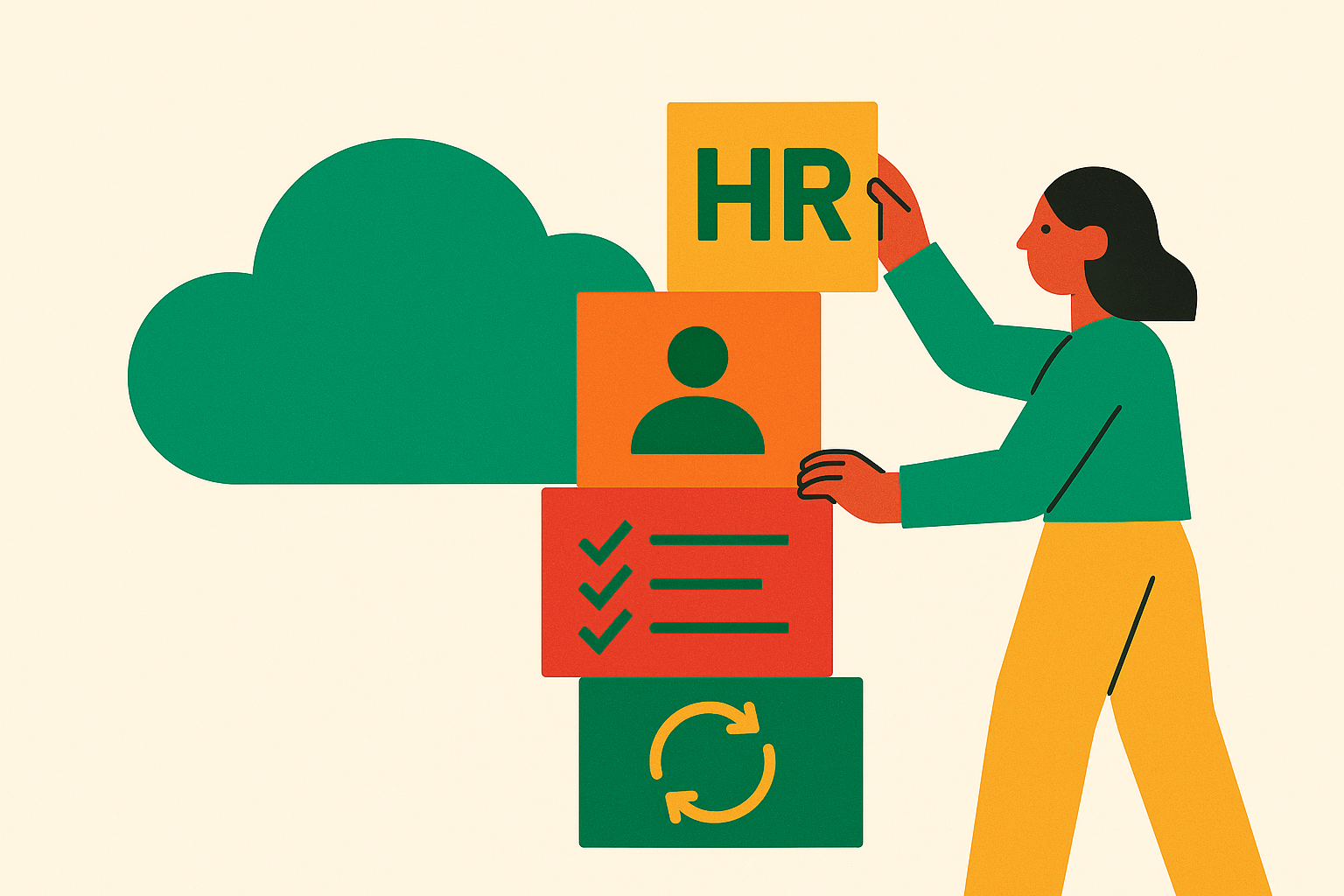
A scaling company's HR stack usually looks like five separate purchases that made sense on their own and now don't talk to each other: payroll here, benefits there, IT provisioning somewhere else, a spreadsheet tracking state registrations, maybe a bolt-on system for contractor payments. Nobody sets out to build it this way. It accumulates, one reasonable decision at a time, until the headcount grows past whatever size made the gaps invisible. This piece is about what that fragmentation actually costs, in dollars and hours you can point to, and what replacing it really requires.
What manual HR processing actually costs at the transaction level
EY ran the numbers on individual HR tasks in 2025. Manual data entry, no self-service tool involved, costs $4.86 a pop. An employee looking up their own information costs $9.42. Hand that same lookup to HR or a manager and it climbs to $11.75. Keying in a W-4 by hand runs $12.85.
None of that sounds like real money. Five dollars here, twelve there, and a founder skimming the list could be forgiven for shrugging. But the number was never the point; the frequency is. A 50-person company running semi-monthly payroll hits each of these tasks dozens of times a month, then dozens more once you count benefits changes, tax form updates, and the questions that land on HR's desk because nobody built a portal that actually reflects current data.
Time bleeds out the same way, quietly, in the background. Payroll admins typically lose three to eight hours per cycle to manual entry alone, before corrections, approvals, or compliance checks even start. Run that semi-monthly and you're looking at 72 to 192 hours a year spent typing the same information into different boxes. Manual payroll processing costs roughly $15 an hour to run; automated, it's closer to $2. That gap doesn't hold steady as headcount grows. It widens with every hire, every added approval chain, every extra system someone has to cross-check before payroll actually goes out the door.
A company with 20 to 100 employees can easily burn $5,000 to $15,000 a year on what looks, from the outside, like "just payroll." And that's before anything breaks.
How payroll errors and compliance failures turn fragmentation into direct liability
Something does break, on a schedule you could set a watch to. An Ernst & Young survey found that one in five payroll cycles contains an error, averaging $291 apiece. Run biweekly payroll and that's at least $1,500 a year gone, before a single penalty enters the picture.
Penalties aren't rare. A survey of 1,000 HR and finance professionals from October 2025 found one in three employers had been penalized for noncompliance in the prior year, with the average payroll tax violation running $850 per incident. Cleaning up the mess eats real hours, too: 29 a year on average for litigation, another 91 for compliance work, 120 hours total pulled off whatever actually grows the business. EY put 14% of companies in litigation or compliance trouble tied to payroll errors in the prior twelve months.
Staying compliant costs money, and staying non-compliant costs considerably more. The pattern is consistent: reactive compliance, once fines, lost time, and the operational scramble are counted, reliably costs far more than staying ahead of the rules. The environment isn't getting friendlier, either: Fenergo tracked a 417% jump in regulatory fines in the first half of 2025 versus the same stretch in 2024, totaling $1.23 billion across 139 penalties.
There's a quieter cost that never shows up on an invoice. Employees hit by a payroll error are twice as likely to start job hunting, and replacing one typically runs about 25% of their annual salary. Prevent a single turnover for a $15-an-hour employee and you save roughly $7,800. Fragmentation doesn't just cause errors; it makes them harder to catch before they land in someone's paycheck. By the time an employee notices, the trust is already spent, and no apology buys it back cheap.
Why multi-state and global headcount makes a fragmented stack untenable
Payroll in the US spans 51 separate state and local jurisdictions, each running its own rules and its own calendar. Strada's 2025 Global Payroll Complexity Index confirms the US ranks among the most complex payroll environments in the world. Hire one remote employee in the wrong state and you can trigger payroll tax, unemployment insurance, and business registration obligations you didn't have the day before. New York, New Jersey, and Pennsylvania make it worse with "convenience of the employer" rules, taxing income based on where the employer sits rather than where the person actually works.
The rules don't hold still, either. Multiple states raised their minimum wage in recent years. Pay transparency laws keep spreading across jurisdictions, each with its own scope and effective date. Every one of those changes has to land in payroll logic, and in a fragmented stack that means updating the payroll engine, the HR system, and the benefits platform separately. In practice, it rarely lands in all three at once.
Go global and it gets worse. Multiplier's Global Hiring Gap Report found only 8% of companies report full compliance with international tax and labor law. That leaves the other 92% exposed. Late-deposit penalties in the US run 2% to 15% of the unpaid amount depending on how late you are, and a fragmented stack that slows data moving between systems increases that exposure directly, not as some hypothetical.
The failure pattern repeats: a jurisdictional rule updates in the payroll engine, nobody remembers to push it into the HR system or the benefits platform, and the mismatch sits there quietly until an audit or an employee complaint drags it into the light. A system that updates tax withholding rules across every jurisdiction from one source closes that gap outright. Manual reconciliation, run at whatever pace an already-stretched HR team can manage, simply can't keep up with how fast the rules move.
What a consolidated HR tech stack actually looks like in practice
Consolidation works best when it puts the data, the workflows, and the compliance logic into one system of record so the handoffs that cause errors stop existing, rather than simply shrinking a vendor list from five to one for a tidier invoice.
A consolidated stack covers payroll (domestic multi-state and global contractor payments), benefits administration and enrollment, compliance monitoring and tax account management, IT provisioning and device management, onboarding and offboarding. Put all of that in one system and a new hire triggers payroll setup, benefits enrollment, state tax registration, and laptop provisioning as one coordinated sequence, rather than four separate to-do lists sitting on four separate desks. A termination cuts access, stops payroll, and ends benefits at the same moment, instead of dragging out over a ragged few days where somebody forgets a step. A jurisdictional rule change updates once and applies everywhere, rather than getting fixed in one tool while it stays quietly wrong in the others.
The AI layer matters here because it changes what "consolidated" is even capable of meaning. A stack built around AI agents can open a state tax account, respond to a compliance notice, or run benefits enrollment on its own, no human stitching the steps together across tools. Compare that to the patchwork most companies actually run: point solutions glued together by integrations that need constant babysitting, that snap the moment an API changes, and that still leave someone squinting at two screens trying to confirm the numbers match.
Warp is a decent example of what this looks like once it's actually built out, combining payroll, compliance, benefits, and IT management in one place. The bet underneath it: the platform acts on the data itself, and a person doesn't need to act on it manually later.
How AI agents change what consolidation can actually do
AI agents are everywhere, at least in name. McKinsey found 62% of organizations are experimenting with or scaling AI agents, with 23% already scaling agentic systems in at least one business function. Adoption and payoff aren't the same thing, though, and mistaking one for the other is where most of these projects quietly die. MIT research found that despite the billions poured into AI tools, only 5% of organizations have seen an actual return, largely because most deployments get bolted onto existing, disconnected workflows instead of built into how work actually moves.
That distinction is the whole argument. An AI agent embedded in a unified data environment can plan a sequence of steps, take the action, route the work, catch the exception, and close the loop without anyone hovering over it. An AI assistant bolted on top of five disconnected tools can only suggest what a human should do next, and a human still has to go do it, click by click. For HR and finance teams, the job moves from processing transactions to managing exceptions, from typing data in to deciding what to do when something looks off.
Gartner named "harnessing AI to transform HR" the top CHRO priority for 2026 and expects 40% of enterprise applications to use task-specific AI agents to coordinate work across systems by the end of that year. The error-rate numbers back this up: AI-powered systems can cut data-entry errors by more than 80% and lift fraud detection accuracy by up to 80%. IDC projects that by 2030, 45% of organizations will run AI agents across their core business functions. Every one of these numbers points the same direction: toward systems that do the work, with typing speed as only a small part of the gain.
Agents built on that premise own workflows end to end, opening tax accounts, resolving compliance notices, running enrollment, instead of assisting a human who still has to finish each step by hand.
How to evaluate whether your current stack is worth consolidating onto
There's no single trigger point that applies to everyone. Some companies are locked into point-solution contracts for another year. Others outgrew whatever they cobbled together in year one and just haven't admitted it yet. What matters is spotting the signs that fragmentation is already costing more than switching would.
Watch for HR or finance staff reconciling numbers by hand every pay cycle, across systems that should already agree with each other without help. Watch for a single compliance notice that somehow needs three people and two tools to close out. Watch for onboarding a hire in a state you've never hired in before, and discovering that no system in the stack actually handles it end to end. Watch for errors that surface in an audit or an employee complaint instead of getting caught before payroll runs.
When you're evaluating a vendor, ask the blunt questions. Does the platform actually own a workflow start to finish, or does someone still have to hand information from one module to the next? When a jurisdiction changes a rule, does the update propagate on its own, or does someone have to go change it manually everywhere it lives? At a hire, a termination, or a state move, does the system take one coordinated action, or does it spin up four separate tasks in four separate places? And can it run global contractor payments and multi-state domestic payroll on the same underlying infrastructure, or are those really two products stapled together and sold as one?
The market backs this up. The Futurum Group surveyed 830 enterprises and found 74% are planning to switch, or at least seriously weighing switching, HR vendors between 2025 and 2028. Most scaling companies are already rethinking their stack. Whether they land on something genuinely unified, or just trade one pile of disconnected tools for a newer pile, is a separate question entirely. Migration carries real risk, sure, but it's a one-time cost with a clear end date. Staying fragmented keeps charging you every pay cycle, indefinitely.
Worth putting a few platforms side by side if you're in the 10-to-1,000-employee range. Rippling offers a broad, modular set of HR, IT, and finance tools, though a modular structure can still leave some coordination work sitting with internal teams. Sage is rolling out AI agents across HCM and finance starting in April 2026, with a focus on exception management and auditability.
The right pick is whichever vendor removes the coordination layer entirely, so nobody on the team is still stuck being the human API, stitching modules together by hand, forever, rather than whichever one simply reduces four tools down to one.