Benefits Compliance for Multi-State Employees
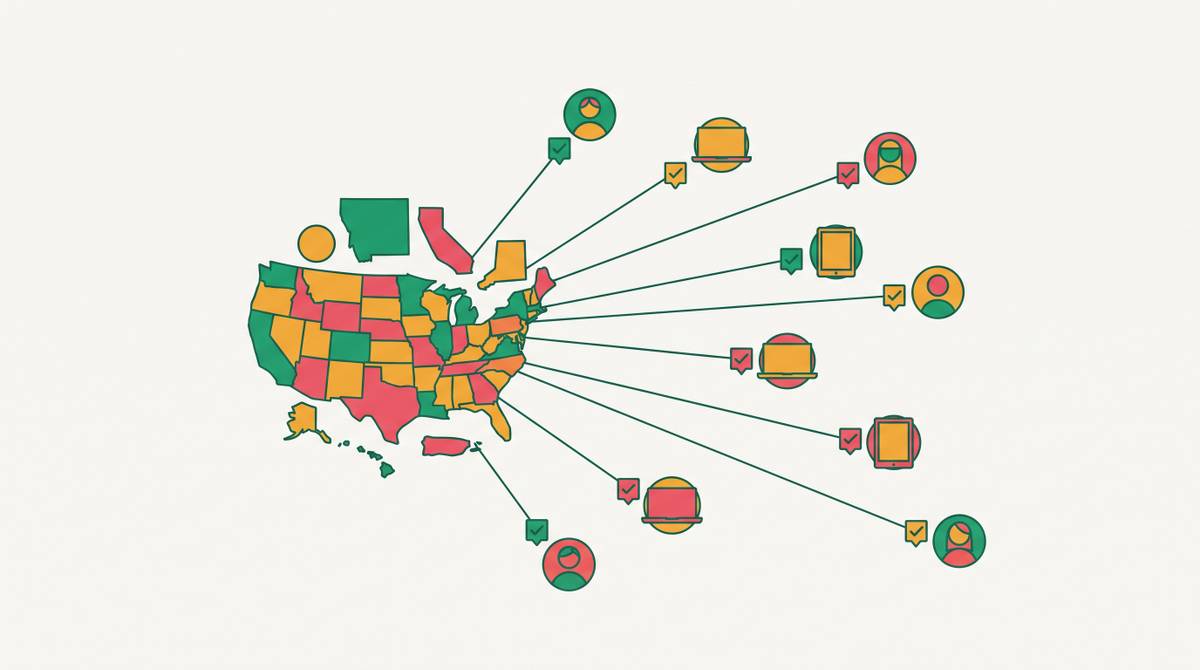
One employee in a new state triggers compliance obligations across four independent legal layers.

Multi-state benefits compliance fails for one main reason: companies treat it like a federal problem with a few state add-ons bolted on the side. That gets the structure backwards. Each state where a company has even one employee runs its own independent set of rules on continuation coverage, mandated benefits, and tax treatment, and none of those rules defer to the others. The companies that get this wrong almost always assume federal law is doing more work than it actually is.
A single remote hire in a new state sets off a chain reaction. Tax registration, unemployment insurance, updated employment-law obligations, and a data privacy review all fire the moment that employee's address changes. Compare that to other business compliance areas where thresholds and grace periods often soften the initial trigger. Employment nexus has no such cushion: one employee working from one kitchen table in a state the company has never operated in before is enough to trigger the whole stack.
Four layers stack on top of each other for any employer with people in more than one state: the federal baseline (ACA, ERISA, COBRA, FMLA), state continuation and mini-COBRA statutes, state-mandated benefit programs like paid leave and disability insurance, and state tax treatment of those benefits. Each layer runs independently of the others. A company can be fully compliant on one and exposed on another, in the same state, for the same employee. That's the premise the rest of this piece builds from.
Federal baseline requirements that apply regardless of where employees work
ERISA sets the floor for most employer-sponsored plans, health, retirement, disability, life insurance, and it preempts a lot of state law along the way. But the preemption has a hole in it big enough to drive a compliance failure through: states keep authority over insurance itself. A fully-insured health plan still answers to the insurance mandates of whatever state it's written in, ERISA or no ERISA. Self-insured plans get the preemption benefit. Fully-insured ones don't, and plenty of employers don't figure out which bucket they're in until an auditor asks them directly.
Applicable Large Employers under the ACA are any employer with 50 or more full-time-equivalent workers. Coverage has to go out to everyone working 30 hours a week or more, or the penalties start. And the number that decides whether an offer of coverage counts as "affordable" isn't fixed. For 2026, the threshold moved to 9.96% of an employee's household income, up from 9.02% in 2025, a meaningful shift that affects whether existing contribution levels still qualify as affordable. That's not a rounding change. An employer who set contribution levels to hit the 2025 number and left them alone may now be offering coverage that's technically unaffordable under the 2026 rule, without ever touching a plan design decision. Missing it pushes penalty exposure up to $2,880 per full-time employee.
COBRA applies once an employer crosses 20 employees, and plenty of companies sitting below that line assume they're off the hook for continuation coverage. That assumption is wrong, and it's the most common misread in this whole area of law. States fill the gap themselves, which is the whole subject of the next section. FMLA follows a similar pattern: the federal 50-employee threshold for unpaid leave is a floor, and a number of states have expanded their own leave laws beyond it in various respects. The federal rules are the baseline. The real compliance risk sits in everything states layer on top of it, state by state, with no two exactly alike.
Where state continuation coverage laws differ from COBRA
Employers under the 20-employee COBRA threshold are exempt from the federal version only. Most states run their own "mini-COBRA" laws that catch smaller employers, and those laws don't look anything like COBRA once you get past the name.
Employer size thresholds in some states can be substantially lower than the federal 20-employee cutoff. Coverage duration varies considerably by state depending on where the employee lives. Some states recognize qualifying events COBRA doesn't touch, and notice deadlines differ too, with COBRA's 44-day election-notice window (the window that applies when the employer doubles as plan administrator) is not a universal ceiling across all state programs. State mini-COBRA rules can impose requirements on premium structures that the federal version leaves unaddressed.
Putting employees from five different states under one centralized COBRA administration process is close to a guarantee that the company is out of compliance in two or three of those states without anyone noticing: different forms, different deadlines, different rules nobody cross-checked against the master COBRA calendar. Plan structure adds another wrinkle. ERISA generally preempts state continuation laws for self-insured plans, but fully-insured plans answer to whatever the state insurance code says. The same employer, running two different plan structures in two different states, can end up with two genuinely different continuation obligations, not just two vendors administering the same rule differently.
Tracking any of this on a spreadsheet is exactly where the errors start. Notice deadlines and qualifying events don't wait for someone to remember to check them, and a jurisdiction-specific system, built with real automation rather than a shared drive of state PDFs, is the only approach that holds up past a handful of states.
State-mandated benefits: paid leave, disability insurance, and paid family and medical leave programs
Few areas of benefits law move this fast. The number of states running mandatory paid-leave and disability programs has grown sharply over the past five years, and 2026 keeps the pace up: three new Paid Family and Medical Leave programs launched this year, bringing the total past a dozen states plus one federal district requiring PFML contributions. Minnesota started collecting PFML contributions on January 1, 2026. Delaware started collecting back in January 2025 and only began paying out benefits on January 1, 2026, a two-stage rollout that catches employers off guard when they check the rules once, at launch, and never look again.
Four categories of mandated programs exist, and each varies state to state instead of following one template. State Disability Insurance is required in a small handful of places, California, New York, New Jersey, Hawaii, Rhode Island, and Puerto Rico, each with its own contribution split and benefit level. PFML programs, active now in a growing list of states, each set their own contribution rates, their own employer-versus-employee split, and their own benefit duration. Paid sick leave is required across a large and expanding number of states and cities, with accrual rates, carryover rules, and permitted uses that differ by jurisdiction, sometimes down to the municipal level. Workers' compensation is required in 49 states (Texas is the outlier, letting most private employers opt out), but treating it as one federal program with state paperwork stapled on is the mistake that keeps recurring. Rates, coverage requirements, and administration all differ by state.
The real difficulty sits in how these programs interact. An employee who lives in one state and works in another can trigger PFML obligations in both, and New York's "convenience of the employer" doctrine makes this worse: it treats a remote worker as a New York employee for tax purposes unless the employer can prove the remote arrangement is a genuine business necessity, not just a preference. For a growing company, every new state where someone works triggers a full audit: which mandated programs apply, what the contribution structure looks like, what notice has to go out, and who administers it.
How states tax employee benefits differently changes the math for both employer and employee
Federal pre-tax treatment doesn't travel automatically to the state level. Section 125 health premiums, HSA contributions, dependent care FSAs, all of it reduces federal taxable income, but a number of states simply refuse to conform to that treatment for specific benefits.
HSAs are the clearest case, and the one most payroll teams get wrong first. California and New Jersey don't recognize HSAs as tax-advantaged accounts. Employer and employee contributions that are tax-free federally get taxed at the state level in those places, full stop. Commuter benefits follow a similar pattern of uneven state treatment, though dependent care FSA treatment still varies enough by state to matter for cost modeling.
Running one tax treatment across every state in a payroll system means the states that don't conform generate wrong withholding quietly, every pay period, until the error becomes visible at year-end reconciliation or on an employee's tax return, long after it has compounded. It throws off cost modeling too. An employer comparing the true cost of a benefits package across states can't assume the number is the same everywhere, since state payroll tax treatment, mandated contribution rates, and local surcharges all shift the real cost by geography. The gap between what a benefits broker knows and what a payroll system actually does is visible right here, because the two often run on separate tracks with nobody reconciling them in the middle.
Pay transparency laws in 17 states and the compliance surface they create inside benefits administration
Five years ago, Colorado stood alone as the only state requiring salary ranges in job postings. Today, a significant and growing number of states plus one federal district have pay transparency laws on the books, and the requirements keep expanding past base salary into total compensation, which in some states now includes a general description of health and retirement benefits. Equity disclosure is an emerging area of discussion in this space.
This lands squarely inside benefits administration, not next to it. Job postings and offer letters in disclosure states need benefits described consistently and accurately, which is harder than it sounds for a company running different plans or different employer contribution levels across locations. A patchwork benefits setup that used to be easy to gloss over gets much harder to hide once disclosure is mandatory, and pay equity audits triggered by transparency laws frequently turn up benefits disparities riding alongside the salary gaps.
The documentation burden is the real cost here, more than the disclosure itself. Employers need state-specific figures on what benefits are worth and what they cover, at the individual employee level rather than as a plan-wide summary. For companies that never mapped their benefits by state in the first place, a disclosure deadline becomes the moment that mapping finally gets done, under pressure, instead of ahead of it.
The operational root causes of multi-state benefits compliance failures
Most failures here are operational, and the most common root cause traces back to something as basic as a missing or outdated work-location record rather than a bad calculation. One employee moves, nobody updates th... They're operational, and the most common root cause traces back to something as basic as a missing or outdated work-location record rather than a bad calculation. One employee moves, nobody updates the record, and four separate compliance touchpoints, tax registration, unemployment insurance, employment-law updates, data privacy review, all go untouched at once.
Three systemic breakdowns explain most of it. Location tracking gaps top the list: HR systems that don't get updated when someone relocates or starts working remotely from a new state, so benefits and payroll keep running under the old state's rules indefinitely. Fragmented systems make it worse, since benefits administration, payroll, and core HR data often live in separate tools that don't talk to each other, turning every payroll cycle into a manual reconciliation exercise instead of a straight pass-through. The benefits-payroll disconnect rounds it out: brokers and payroll processors frequently operate on separate tracks, and state-specific tax treatment of benefits, the exact problem described above, falls straight into the gap between them.
The penalty exposure isn't theoretical. Violations can run up to $250,000 apiece. Personal liability exposure for key individuals tied to payroll withholding failures can persist even through corporate restructuring. States add their own layer on top: State-level penalties can be severe, with some states imposing substantial per-violation fines and additional remedies on top of federal exposure. None of this arrives as one dramatic event. It builds quietly and it builds cumulatively: one employee moves, one field in one system doesn't get updated, one mandated benefit goes unenrolled, and the exposure just sits there compounding until somebody finally notices.
Building a jurisdiction-aware benefits compliance process as a company scales
The rule list isn't what scales. The process is. State law changes constantly enough that a company tracking it by hand will always be a step behind a company that built a system to catch jurisdiction changes on its own.
Four elements make that process work. A state-entry checklist has to fire the moment a new employee is hired or relocates, covering continuation coverage obligations, mandated benefit programs (PFML, SDI, paid sick leave, workers' comp), state tax treatment of benefits, pay transparency disclosure requirements, and data privacy obligations, all at once, not one at a time as problems surface. Location tracking needs to be a live field somebody actually watches, not something set at hire and left alone for three years, because a remote employee quietly working from a new state is a compliance event whether anyone flags it or not.
Benefits-payroll coordination means the state tax treatment of a given benefit has to flow directly into payroll configuration instead of sitting in a benefits document payroll never opens. That takes either one unified platform or a formal handoff process between the two teams, and trying to run it on goodwill between departments doesn't hold up past a certain headcount. Regular jurisdiction audits matter too, because the ground keeps shifting: 19 states raised minimum wages on January 1 this year, three new PFML programs launched, and pay transparency is now active in 17 states. A setup that was accurate two years ago is already out of date, and nobody gets an alert telling them so.
Manually watching more than 10,000 tax jurisdictions across the country isn't a realistic plan for anyone, no matter how sharp the HR team is. Companies that stay current do it through systems built to flag jurisdiction changes and push those changes into benefits and payroll configuration automatically, not through someone's quarterly reminder to check state websites. Compliance works best as a property of the system itself. If a finance or HR person has to actively remember to check whether a state's PFML contribution rate changed this quarter, the process has already failed, even if nothing has gone wrong yet.
Platforms that unify payroll, benefits, and HR data into one system exist to close exactly this gap. Recording a new employee's work location once lets the system identify which state programs apply, configure the right deductions, and flag any coverage gap immediately, cutting out the manual steps where most of these errors start.