Automated Employee Onboarding Workflow Design
Automating onboarding from offer acceptance eliminates the hand-offs where new hires fail.
Twelve percent of employees rate their onboarding experience as great. Nearly 30 percent of new hires in the U.S. quit inside their first 90 days, and the churn lands before the company has recovered what it spent to hire them. This piece is about building the kind of automated onboarding workflow that closes that gap, and about why most attempts at automation don't.
Cost per hire runs into the thousands of dollars at most companies. When that employee walks in month two, the money's gone and someone has to spend it again on the same seat. I've sat in rooms where HR leadership treated this as a training problem, sometimes a culture problem. I kept coming back to the same objection each time: neither framing explained why the same failures showed up regardless of who ran the training or how strong the culture was. What held up under that scrutiny was simpler and less comfortable — onboarding is a design problem, and the design starts on day one, sometimes before it.
A real automated onboarding workflow is one sequence, triggered by a single event, that runs every downstream step in order without a human touching a checklist. Offer gets accepted, and from that moment payroll setup, IT provisioning, benefits enrollment, and compliance filings start moving, either all at once or in whatever order the dependencies demand. That's genuinely the whole thing, even though almost everything else marketed under this label is manual work wearing a nicer coat.
An e-signature tool automates a signature, and an HRIS with a task list bolted onto it automates a checklist view. Both are point solutions: they handle one step and still need a person to carry the output into the next system by hand, and that hand-off is where things fall apart quietly, usually surfacing three weeks later as a payroll error nobody can trace. MIT researchers looked at the billions organizations have poured into AI deployment and found that only 5 percent saw a measurable return. I expected the technology itself to be the failure point; the data pointed somewhere else. Piecemeal deployment was the culprit: automating fragments while leaving the connective tissue manual.
A workflow that works needs one system of record. HR data, payroll data, provisioning data, benefits data, all living on the same layer instead of getting copied across five tools with five incompatible formats. The logic governing the sequence, the dependencies, the triggers, the escalation rules, needs to live in one place, visible without making anyone dig for it.
Most HR tech sold today is agent-assisted rather than agent-owned, and vendors don't advertise the difference because it undercuts the pitch. Agent-assisted tools surface a suggestion and wait for a click, while agent-owned systems take a trigger and run the sequence themselves, surfacing only the exceptions that genuinely need judgment. Worthwhile onboarding automation is agent-owned, with human intervention as the exception path rather than the default one.
The five stages every automated onboarding workflow must cover
Stage one is the trigger: offer acceptance. That signed offer should be the only manual input the entire system needs. Account creation, provisioning queues, payroll record setup, compliance filings, all of it fires from that single event. For that to hold, the offer data has to arrive complete: role, start date, work location, compensation, employment classification, structured cleanly enough that every downstream system can read it without someone filling out a supplemental form three days later.
Compliance and payroll come next, and this is where manual processes usually start leaking. Tax registration in the employee's actual work state has to happen, and if the company has no existing nexus there, registration starts immediately rather than after a missed filing turns up as a surprise. I-9 verification, W-4 collection, state withholding forms: sequenced and tracked without a coordinator chasing people down over email. Direct deposit gets set up and confirmed well ahead of the first payroll run, not the week of it.
Stage three is IT provisioning, and it triggers at offer acceptance, not the morning of day one. Device orders, software licenses, email accounts, role-based access, all tied to the role and department data captured at offer stage rather than configured by hand by someone juggling six other new hires that week. A new employee staring at a locked laptop on day one is a provisioning failure, and it should get logged as one rather than shrugged off as a rough morning.
Benefits enrollment opens the moment the hire record exists. Plan options get surfaced to the employee directly, not mailed as a PDF packet from HR, with deadlines tracked automatically and reminders firing on their own. EY's 2025 research put the cost of manually providing benefit plan information at $20.32 per instance. Multiply that across a growing headcount and it turns into real money that never shows up on a line item, just hours nobody can account for later.
Stage five, readiness verification, is the one most companies skip entirely. Before the start date, the system checks that payroll is configured, access is provisioned, benefits enrollment is open, and compliance forms are in. Anything missing, an unconfirmed bank account, a W-4 that never came back, gets flagged as an alert someone can act on before the new hire's first morning, not after it. Put the five stages together and the point is simple: the employee's first real interaction with the company should be the job, with the paperwork finishing itself in the background.
Where multi-state and remote hiring breaks standard onboarding designs
Remote work turned a compliance footnote into a structural risk. Forty-one states collect income tax on wages, and in early 2024 alone, 22 states raised their minimum wage. These rules aren't fixed, and they don't hold still by jurisdiction either; they shift constantly. One remote hire in a state where the company has never had a presence can trigger new tax registration, new withholding obligations, sometimes new paid-leave requirements, all before that person sees a paycheck.
Strada's 2025 Global Payroll Complexity Index ranks California, New York, Massachusetts, and Oregon among the most complicated states for payroll administration. Companies hiring into those states without automated compliance tooling carry the highest exposure in the country, and most don't find out until a filing deadline has already slipped.
Then there's the convenience-of-the-employer rule, which catches even experienced HR teams off guard. New York and Connecticut, chief among a handful of states, tax remote employees based on where the employer sits rather than where the employee actually works. That produces double-taxation situations, and a standard workflow that just grabs a home address and routes withholding there gets it wrong every time.
A workflow built for multi-state reality detects the actual work state, not the mailing address on file, and checks whether the company already has nexus there. If it doesn't, state tax account registration starts before the payroll clock begins ticking, not after a filing bounces. The system routes the right withholding forms and flags local or city-level obligations without expecting HR to memorize which of fifty states carries which supplemental rule. Nobody memorizes fifty states of tax code, and pretending otherwise is exactly how the errors happen.
The penalties aren't abstract, either. Late payroll tax payments in the U.S. carry penalties from 2 percent to 15 percent of the unpaid amount, scaling with how late it lands. In fiscal year 2025, the Department of Labor recovered more than $259 million in back wages for nearly 176,957 employees, and a meaningful share of that traces to exactly the kind of jurisdiction-specific error a manual process tends to produce.
The data handoff problem: why most workflow automation breaks mid-sequence
Automating individual steps doesn't automate the process around them. If system A doesn't hand structured data to system B on its own, a person retypes it, and every retype is a chance for something to go sideways. EY's 2025 research put the cost of a single manual data entry at $4.86 on average, though the dollar figure undersells the actual damage. The bigger cost sits in the error rate that re-entry introduces downstream. Payroll accuracy across businesses sits around 78 percent on average, and a good chunk of that gap traces straight back to re-entry between systems that were never actually connected.
The pattern repeats across companies with almost boring consistency. Offer data goes into the applicant tracking system, then someone retypes it into the HRIS because the two don't talk. The HRIS doesn't feed payroll automatically, so someone builds the payroll record by hand. Payroll doesn't talk to benefits, so enrollment kicks off separately, usually late. IT provisioning runs through a ticket handed to a completely different team, and the timing depends on how long that queue happens to be that week, which has nothing to do with when the new hire actually starts.
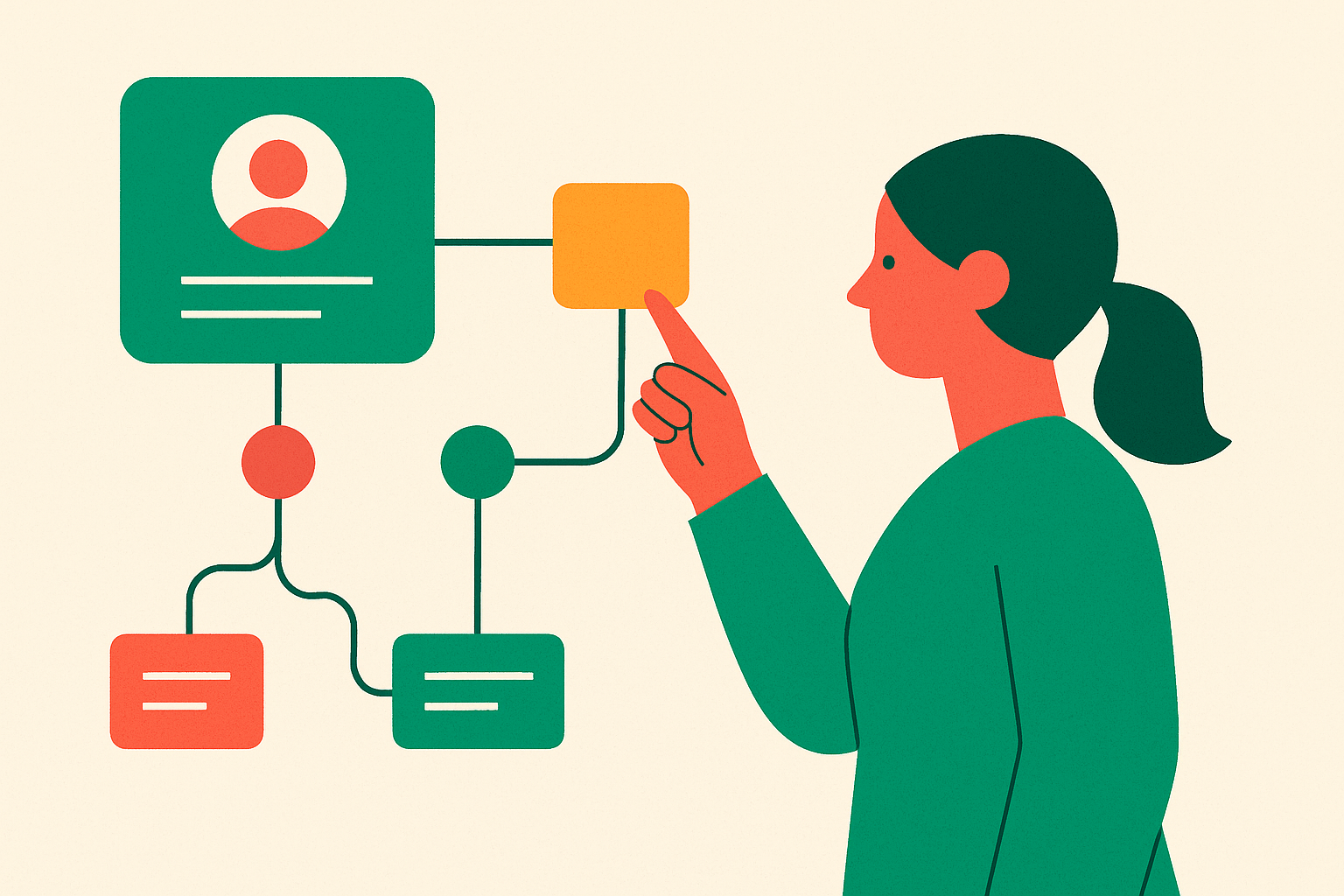
The fix rests on one principle: one record, written once, read everywhere. The new hire's canonical data (name, role, location, compensation, classification, start date) gets written a single time at the point of offer, and every downstream system reads from that record instead of keeping its own copy. Workflow logic has to be event-driven, meaning one stage finishing triggers the next stage directly, instead of a notification going to a human who has to remember to start it.
Architecturally that means native integrations between HR, payroll, benefits, and IT, or better, a single platform where those functions were never separate systems in the first place. Where tools stay separate, they need API-based connections with structured schemas that stop the translation errors that happen when one system's "employment type" field doesn't match another's definition of the same term. Audit trails matter here too: a record of what was written, when, and by which system, so when something breaks, it's traceable in minutes instead of a manual hunt across four tools.
How to design the exception-handling layer without rebuilding manual oversight
Automation skeptics have one argument that actually holds up: exceptions need a human. Where they go wrong is assuming exception-handling should be the system's default state, rather than the rare path. A well-built workflow handles the overwhelming majority of cases, comfortably above 90 percent, without anyone touching it. The exception logic exists purely to catch the rest without dragging the whole process back into manual mode.
What actually counts as an exception? A new hire classified as an employee in a state where the company has no legal entity, so tax registration can't complete on its own. Banking information that fails verification on submission. A role requiring a security clearance or background check that has to clear a human before system access opens up. A benefits election deadline that passes with no response, because that decision genuinely can't be made by software.
Good exception routing puts the problem in front of the person responsible, with the exact action needed spelled out, rather than logging it somewhere and hoping the operator remembers to check. Each exception should carry context: what stage is stuck, what's missing, what breaks downstream if nobody resolves it by a given date. Once it's fixed, the case drops back into the automated sequence on its own, and nobody should have to manually restart a stage that was already 90 percent finished before it hit a snag.
There's a real difference between escalation and intervention. Escalation means the system flags the issue and hands the operator exactly what they need to fix it in one move. Intervention means the operator has to go investigate, figure out what broke, and re-run steps by hand, which is what happens when exception design got treated as an afterthought. Good exception handling makes the operator fast when they have to act, while great exception handling makes those moments rare to begin with.
The productivity and retention payoff a well-designed workflow compounds over time
Companies with effective onboarding improve new hire retention by 82 percent and lift productivity by more than 70 percent. Those aren't rounding errors. Roughly 89 percent of employees who go through effective onboarding report feeling genuinely engaged in their first year, and organizations with strong onboarding programs see 2.5 times the revenue growth of those without. New hires get productive fast, and they stick around long enough for that productivity to actually compound.
The payoff scales with the size of the failure it prevents, and the failure doesn't stay the same size as the company grows. At ten employees, broken onboarding is a founder's problem, annoying, survivable, usually patched with a few late nights and a spreadsheet somebody's oddly proud of. At a hundred, it's an operations problem: coordinators get buried, errors show up weekly instead of occasionally, and the compliance exposure from earlier in this piece stops being theoretical.
Past five hundred, it's structural. Manual onboarding at that scale eats HR capacity that should go toward workforce strategy, not toward chasing down W-4 forms and confirming laptop shipments for the third time in a month. That's the real cost of skipping this work early: an operations team stuck running logistics forever instead of doing the work they were actually hired to do. Fix it early, and the payoff compounds well past smoother onboarding, freeing the operations team that finally gets to stop babysitting a checklist.